


Questions re: Setting AFR map with WB02, lean spool off


Thread Starter
Evolved Member
Joined: Oct 2010
Posts: 2,447
Likes: 14
From: Australia
Will do.
If I want to get the most out of this LC-1 thing, it does seem sensible to plumb its analog output directly into the ECU. It'll remove the laptop from the equation completely... and I'm using a bottom-spec Asus eee..eeePC, which uses a hamster in a wheel for cpu power.
Probably best to avoid relying on Hammy Hamster for my AFRs!!
Rich
If I want to get the most out of this LC-1 thing, it does seem sensible to plumb its analog output directly into the ECU. It'll remove the laptop from the equation completely... and I'm using a bottom-spec Asus eee..eeePC, which uses a hamster in a wheel for cpu power.
Probably best to avoid relying on Hammy Hamster for my AFRs!!
Rich


lol!
There are 3 advantages to using serial logging:
1) its the easiest - assuming you dont have any problems with the logging software/hardware
2) you dont have to worry about ground offsets affecting readings
3) you dont chew up a ECU logging slot
There are 3 advantages to using serial logging:
1) its the easiest - assuming you dont have any problems with the logging software/hardware
2) you dont have to worry about ground offsets affecting readings
3) you dont chew up a ECU logging slot

If you can figure out the time-shift correctly then serial would be more accurate. I would be less inclined to think that it is a lag in the serial data stream (unless your laptop is really taxed) and more inclined to think the sensor might be very far back (going analog won't correct this).
Thread Starter
Evolved Member
Joined: Oct 2010
Posts: 2,447
Likes: 14
From: Australia
The netbook's cpu is 35% to 45% busy while logging. Single core.
The o2 sensor is installed between t/c and cat, about in line with the downpipe's factory narrowband. Might be slightly closer to the t/c than the nbo2, if I remember correctly.
I wasn't able to take the car out this arvo, but did enable injector logging and perform a very quick throttle "blip" test...
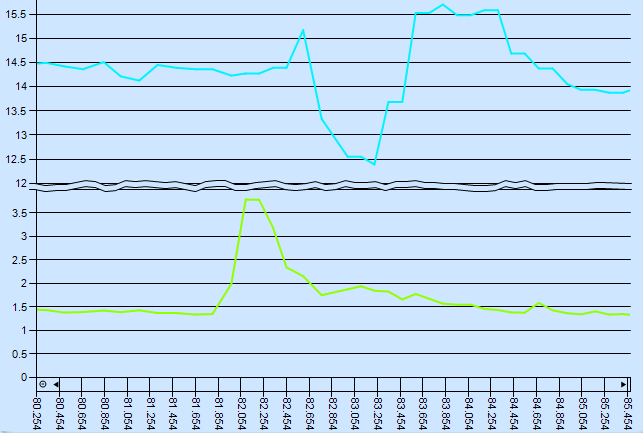
The TPS blipped at 81.97 seconds, and the injection system's reaction was logged the same row... but the LC-1 data only showed a reaction at 82.60 seconds.
So... sigh... it looks like there's work to be done on the wbo2 logging front.
A quick and easy step would be for me to order the Innovate-blessed serial-USB adapter from their website - just to see if I have a particularly inefficient one.
OR, get down and dirty with the analog stuff. My OP2.0 refuses to log from my LC-1 via serial link - despite all attempts to make it happen. An ECU ADC angle would "solve" that problem too.
OR, I just remember to copy/paste my entire WideBand column up 6 or 7 lines! Low-Tech style...
Rich
edit: And I've been using EvoScan 2.7. After many, many failed attempts to download version 2.8, I finally got it. Will see if it's better at integrating LC-1 and ECU data streams than 2.7... but I'm not holding my breath!
The o2 sensor is installed between t/c and cat, about in line with the downpipe's factory narrowband. Might be slightly closer to the t/c than the nbo2, if I remember correctly.
I wasn't able to take the car out this arvo, but did enable injector logging and perform a very quick throttle "blip" test...
The TPS blipped at 81.97 seconds, and the injection system's reaction was logged the same row... but the LC-1 data only showed a reaction at 82.60 seconds.
So... sigh... it looks like there's work to be done on the wbo2 logging front.
A quick and easy step would be for me to order the Innovate-blessed serial-USB adapter from their website - just to see if I have a particularly inefficient one.
OR, get down and dirty with the analog stuff. My OP2.0 refuses to log from my LC-1 via serial link - despite all attempts to make it happen. An ECU ADC angle would "solve" that problem too.
OR, I just remember to copy/paste my entire WideBand column up 6 or 7 lines! Low-Tech style...
Rich
edit: And I've been using EvoScan 2.7. After many, many failed attempts to download version 2.8, I finally got it. Will see if it's better at integrating LC-1 and ECU data streams than 2.7... but I'm not holding my breath!
Last edited by richardjh; Feb 6, 2011 at 07:19 AM.
Thread Starter
Evolved Member
Joined: Oct 2010
Posts: 2,447
Likes: 14
From: Australia
Nah, EvoScan 2.8 is still doing it. also tried a different USB port on the netbook - no difference.
On the plus side, it does look a lot like a consistent 0.6s - 0.7s offset. I can adjust for that.
Still, I'm ordering the serial-to-USB thingy on Inno's website. Perhaps the one I have is the underlying cause...
Thanks for adding some additional pairs of eyes to this - it was driving me just a little bit mad.
Rich
On the plus side, it does look a lot like a consistent 0.6s - 0.7s offset. I can adjust for that.
Still, I'm ordering the serial-to-USB thingy on Inno's website. Perhaps the one I have is the underlying cause...
Thanks for adding some additional pairs of eyes to this - it was driving me just a little bit mad.
Rich

I used to use the serial-usb adapter. Go with the Rear 02 patch, much cleaner. It drove me crazy having 3 cables running all over my car (serial/usb, pc power, and OP2.0). Let alone something wasn't ground right, cuz when there was a static charged wind, my paddle shifter would zap me when I started my car  The rear 02 patch is a god send, just get the updated address/formula for RA.
The rear 02 patch is a god send, just get the updated address/formula for RA.
Thread Starter
Evolved Member
Joined: Oct 2010
Posts: 2,447
Likes: 14
From: Australia
I used to use the serial-usb adapter. Go with the Rear 02 patch, much cleaner. It drove me crazy having 3 cables running all over my car (serial/usb, pc power, and OP2.0). Let alone something wasn't ground right, cuz when there was a static charged wind, my paddle shifter would zap me when I started my car The rear 02 patch is a god send, just get the updated address/formula for RA.
The rear 02 patch is a god send, just get the updated address/formula for RA.I've got data in front of me where one sample is at 12.8:1, and the next is 12.1:1 - and that's at the critical 10psi transition point out of spool-up and towards higher boost. One "tick" earlier or later changes everything, so I really have no chance getting it just right like this.
So... yes... it's time for the rear o2 sensor patch.
There's quite a bit of info about this spread throughout EvoM. However, I've got an RA, so no funky enhanced ROM work available.
What's the deal if I simply leave the rear o2 sensor itself in place, and do nothing more than physically replace its signal input to ECU with the LC-1 analog? Is the resulting CEL okay to just live with and ignore?
In Oz, there isn't any OBD-II emissions check to pass... and I can surely live with a CEL while I'm tuning from the ECU rear o2 feed.
The "real" rear o2 sensor will stay in place. That will remain heated if I leave the ROM periphery bit (Disable Rear o2 Sensor Function) alone, right?
And best of all, I won't have to pester the disassembler folks to dig into the RA 53610010 ROM. The most I'll need is the logging address (which I can probably suss out myself, with a bit of thrashing about).
To summarise...
- No ROM "Rear o2 simulator" patch applied.
- No change to ROM "Disable Rear o2 Sensor Function" periphery bit.
- Replace rear o2 signal with LC-1 analog feed.
- Expect a CEL while this is installed... but not critical...?
- Calibrate. Log. Tune. Rejoice.
Is this a feasible approach?
Rich
Thread Starter
Evolved Member
Joined: Oct 2010
Posts: 2,447
Likes: 14
From: Australia
Ah, pfft, there's no need at all for ECU rear o2 sensor analog patches - it turns out the Tactrix OpenPort 2.0 can do the job directly!
See here... the post from dschultz...
http://www.romraider.com/forum/viewt...hp?f=15&t=6512
And here... from the same bright fellow!...
http://forums.openecu.org/viewtopic.php?f=2&t=4790
As described in those references, I modified the OP2.0 "logcfg.txt" file with...
Next, I simply patched one of the Innovate LC-1 analog signal wires into my Tactrix-supplied OP2.0 cable. Cut the correct wire (green in my extension cable), and fed the signal directly in so the OP2.0 saw it on Pin 8.
Fired her up, and voila! 0-5V range being read "neat" from the LC-1. In-sync AFR logging without a laptop, and without a single wiring change to the car. And no ROM mods required (beyond mode23-enabling, of course).
I didn't have to work any of this out myself, but I still feel like a total genius. Ain't the interwebs wonderful?
I'm planning on changing my LC-1 analog config (and OP2.0 "scalingrpn") so I get:
10:1 = 0V
11:1 = 1V
12:1 = 2V
13:1 = 3V
14:1 = 4V
15:1 = 5V
That will give me an accurate "useful tuning range" configuration for AFRs in the standalone logfiles. I don't need full range in there - I've got a dashmount XD-16 gauge telling me what's going on as I drive.
Fantastic stuff - perfect!
Rich
See here... the post from dschultz...
http://www.romraider.com/forum/viewt...hp?f=15&t=6512
And here... from the same bright fellow!...
http://forums.openecu.org/viewtopic.php?f=2&t=4790
As described in those references, I modified the OP2.0 "logcfg.txt" file with...
Code:
;----------------adc----------------
type=adc       ; log from built in ADC channels

paramname=AFR
paramid=8   ; paramid is pin number on OBD connector
            ; valid pins are 8 and 16
            ; values are pre-scaled to millivolts
scalingrpn=x,0.001,*    ; here we scale to volts
Fired her up, and voila! 0-5V range being read "neat" from the LC-1. In-sync AFR logging without a laptop, and without a single wiring change to the car. And no ROM mods required (beyond mode23-enabling, of course).
I didn't have to work any of this out myself, but I still feel like a total genius.
Ain't the interwebs wonderful?I'm planning on changing my LC-1 analog config (and OP2.0 "scalingrpn") so I get:
10:1 = 0V
11:1 = 1V
12:1 = 2V
13:1 = 3V
14:1 = 4V
15:1 = 5V
That will give me an accurate "useful tuning range" configuration for AFRs in the standalone logfiles. I don't need full range in there - I've got a dashmount XD-16 gauge telling me what's going on as I drive.
Fantastic stuff - perfect!
Rich
Thread Starter
Evolved Member
Joined: Oct 2010
Posts: 2,447
Likes: 14
From: Australia
Yeah, that's more like it! The new-look data...
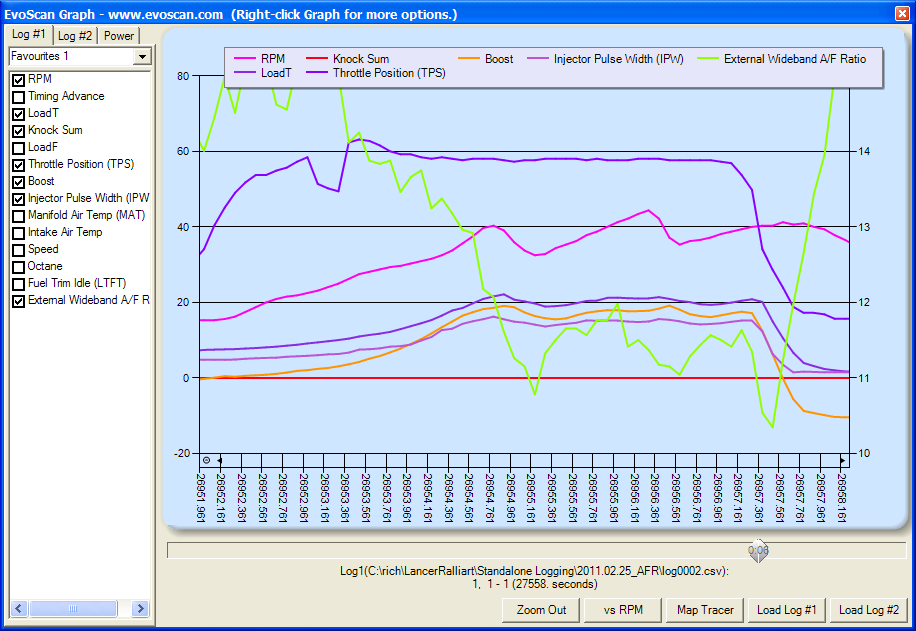
The little rich dip at the end when the throttle closes... is finally in line with the throttle closing.
AFR heads north as the IPW drops right down... not well after.
Previously, via LC-1 serial link, I had this...
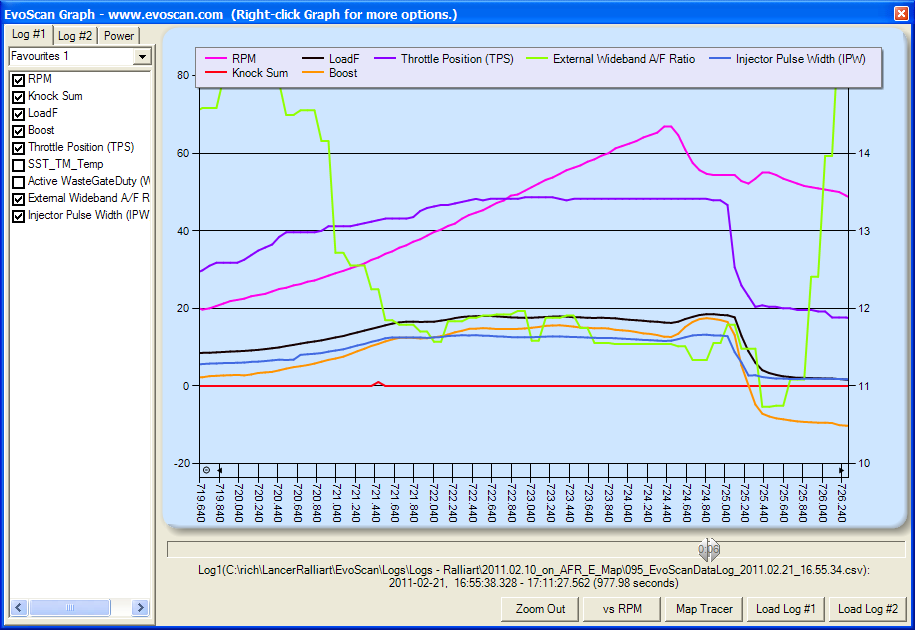
Note the apparent 11:1 mixture while IPW was scraping the floor. AFR readings were always late to the party.
The new method achieves twice the wbo2 sample rate too - zigzags instead of steps.
Now the only thing on my to-do list (apart from the mixtures themselves) is to reinstall the LC-1 to make absolutely sure the grounding is top quality... and then calibrate voltages to AFRs as closely as the LC-1 config allows. Which should be pretty close!
[edit] Final note... the "new" data is only being displayed in EvoScan - not logged via EvoScan. I had to stuff around quite a lot with the OP2.0 standalone CSV to get it in a format EvoScan would accept and display. Got it in the end...
Rich
The little rich dip at the end when the throttle closes... is finally in line with the throttle closing.
AFR heads north as the IPW drops right down... not well after.
Previously, via LC-1 serial link, I had this...
Note the apparent 11:1 mixture while IPW was scraping the floor. AFR readings were always late to the party.
The new method achieves twice the wbo2 sample rate too - zigzags instead of steps.
Now the only thing on my to-do list (apart from the mixtures themselves) is to reinstall the LC-1 to make absolutely sure the grounding is top quality... and then calibrate voltages to AFRs as closely as the LC-1 config allows. Which should be pretty close!
[edit] Final note... the "new" data is only being displayed in EvoScan - not logged via EvoScan. I had to stuff around quite a lot with the OP2.0 standalone CSV to get it in a format EvoScan would accept and display. Got it in the end...
Rich
good job - and a new method well done.
I still prefer to log via the ECU, but I might change eventually.
still do the voltage step check to make sure you are outputting 0,1,2,3,4,5 volts and the logger is reading 0,1,2,3,4,5 volts...
I still prefer to log via the ECU, but I might change eventually.
still do the voltage step check to make sure you are outputting 0,1,2,3,4,5 volts and the logger is reading 0,1,2,3,4,5 volts...
Thread Starter
Evolved Member
Joined: Oct 2010
Posts: 2,447
Likes: 14
From: Australia
As I understand it, if it doesn't line up nicely, I've got three things to try...
- Investigate any dodgy grounding causing the offset, and "fix".
- If it's out by a fixed amount throughout, raise or lower the LC-1 analog-out programming to line it up.
- Adjust the post-sampling scaling if anything is required beyond that.
Too easy...
Rich
Thread Starter
Evolved Member
Joined: Oct 2010
Posts: 2,447
Likes: 14
From: Australia
Having got my wideband logging 100% sorted, I've been able to nail some areas pretty accurately, cell by cell.
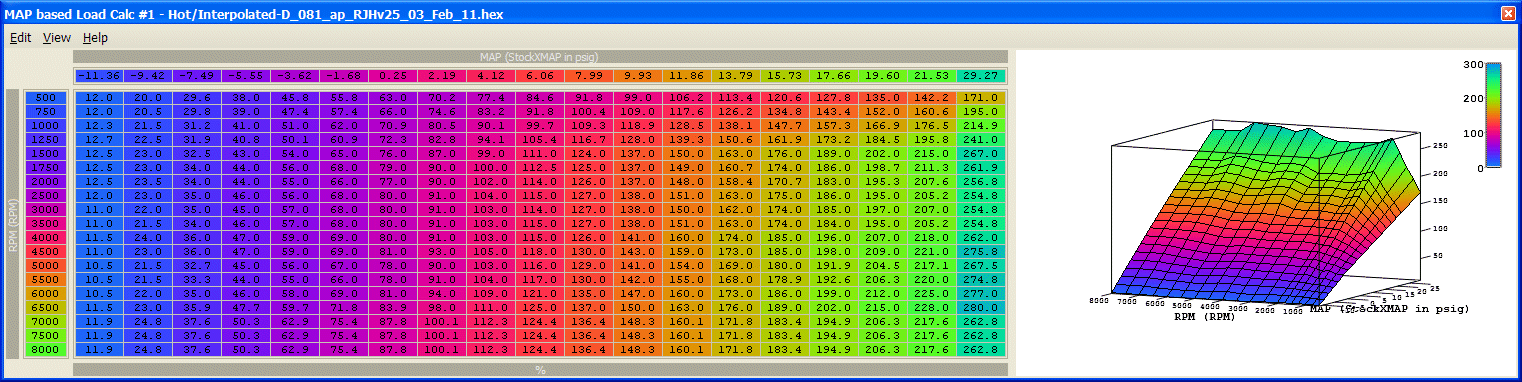
Consequently, I'm now revisiting this 3xMAP table thing... because - as you folks said - it does seem to have an awful lot to do with the final fuel delivery! Here's what I've found...
Around the 140-160 load point on, the 3000rpm to 4000rpm area of my fuel map is a bit of a joke.
Based on my latest wbo2 measurements and fuel tuning, the following High Octane Fuel Map settings are required in order to get a smooth, consistent AFR measured on-road...
2500rpm: 11.1
3000rpm: 10.5
3500rpm: 10.6
4000rpm: 10.0
4500rpm: 10.6
5000rpm: 11.3
I've double-checked this by rolling onto throttle just below each of the above rpm points, in the highest feasible gear, and letting the boost/load build through the map near-horizontally. Each rpm band has its own crazy little sweet spot for correct AFR.
However, this makes for one butt-ugly 3D fuel graph.
Now, if someone can help me get my head around the whys and wherefores, that'd be brilliant.
In the 3xMAP tables, in the same RPM range, similar boost psi level, we have:
2500rpm: 163
3000rpm: 162
3500rpm: 163
4000rpm: 174
4500rpm: 173
5000rpm: 169
So from 3500-4000, there's a load-table jump of +11 units.
And from 4000-4500, it starts back-pedalling... -1 unit, then -4 units.
With all this talk of aggressive MIVEC tuning reshaping egine VE, are we basically saying here that my 3xMAP tables are playing havoc with the ECU's fuelling calculations?
That being the case, if my MAP-Load table ramps up suddenly @4000rpm, what's the relationship between that and needing to "compensate" in the fuel table by enriching suddenly @4000rpm. With my limited grasp of things, this seems backwards to me - I expected it to swing the other way. That tells me I'm not really "getting" it...

Sigh. Nobody told me that when I plugged a sensor into the downpipe, my brain would explode.
Rich
Consequently, I'm now revisiting this 3xMAP table thing... because - as you folks said - it does seem to have an awful lot to do with the final fuel delivery! Here's what I've found...
Around the 140-160 load point on, the 3000rpm to 4000rpm area of my fuel map is a bit of a joke.
Based on my latest wbo2 measurements and fuel tuning, the following High Octane Fuel Map settings are required in order to get a smooth, consistent AFR measured on-road...
2500rpm: 11.1
3000rpm: 10.5
3500rpm: 10.6
4000rpm: 10.0
4500rpm: 10.6
5000rpm: 11.3
I've double-checked this by rolling onto throttle just below each of the above rpm points, in the highest feasible gear, and letting the boost/load build through the map near-horizontally. Each rpm band has its own crazy little sweet spot for correct AFR.
However, this makes for one butt-ugly 3D fuel graph.
Now, if someone can help me get my head around the whys and wherefores, that'd be brilliant.
In the 3xMAP tables, in the same RPM range, similar boost psi level, we have:
2500rpm: 163
3000rpm: 162
3500rpm: 163
4000rpm: 174
4500rpm: 173
5000rpm: 169
So from 3500-4000, there's a load-table jump of +11 units.
And from 4000-4500, it starts back-pedalling... -1 unit, then -4 units.
With all this talk of aggressive MIVEC tuning reshaping egine VE, are we basically saying here that my 3xMAP tables are playing havoc with the ECU's fuelling calculations?
That being the case, if my MAP-Load table ramps up suddenly @4000rpm, what's the relationship between that and needing to "compensate" in the fuel table by enriching suddenly @4000rpm. With my limited grasp of things, this seems backwards to me - I expected it to swing the other way. That tells me I'm not really "getting" it...
Sigh. Nobody told me that when I plugged a sensor into the downpipe, my brain would explode.
Rich
well not changing the 3xMAP's isn't the end of the world.
You can probably improve the look of your fuel map if you do change it thou...
personally mine at stock.. Because I change ROM's all the time, and start from scratch fairly often I prefer to have as few changes todo... If I forget to change a particular map it could be curtains for my 4b11
You can probably improve the look of your fuel map if you do change it thou...
personally mine at stock.. Because I change ROM's all the time, and start from scratch fairly often I prefer to have as few changes todo... If I forget to change a particular map it could be curtains for my 4b11