


IAT Sensor Placement with Meth Injection


IAT Sensor Placement with Meth Injection
Well there has been a bit of discussion but nothing really conclusive, at least not in my opinion, about IAT sensor placement when using Meth Injection.
Assume that your meth nozzles are in the UICP between the BOV and the TB as this is the most common place for them on an Evo.
Also, assume that you are running speed density and the ECU uses the IAT to determine the amount of fuel to inject.
If you post, please backup your thoughts with as much evidence or theory as possible, I want to keep this topic free from what people have "heard works."
Assume that your meth nozzles are in the UICP between the BOV and the TB as this is the most common place for them on an Evo.
Also, assume that you are running speed density and the ECU uses the IAT to determine the amount of fuel to inject.
If you post, please backup your thoughts with as much evidence or theory as possible, I want to keep this topic free from what people have "heard works."

I would put the sensor in the UICP before the meth nozzle.
One reason is that the alcohol hitting the sensor will result in measuring the temperature of the alcohol and not the temperature of the air.
A second reason is that the alcohol on the AIT sensor could delay a reading of increased air temperature.
A third reason is that the temperature of the charge pre-nozzle will provide an accurate indication of the amount of air entering the intake manifold. If the temperature in the UICP goes up, the amount of air goes down and vise-versa.
Additionally, another location sometimes suggested is the intake manifold. This location can result in the sensor reading incorrectly due to the heat of the intake manifold. During high-boost and high-RPM operation the flow rate through the intake manifold is high enough that the intake manifold will not significantly heat the charge. If the intake manifold does have a significant amount of heat stored in it it could artificially raise the temperature reading beyond the actual charge temperature.
-Paul
One reason is that the alcohol hitting the sensor will result in measuring the temperature of the alcohol and not the temperature of the air.
A second reason is that the alcohol on the AIT sensor could delay a reading of increased air temperature.
A third reason is that the temperature of the charge pre-nozzle will provide an accurate indication of the amount of air entering the intake manifold. If the temperature in the UICP goes up, the amount of air goes down and vise-versa.
Additionally, another location sometimes suggested is the intake manifold. This location can result in the sensor reading incorrectly due to the heat of the intake manifold. During high-boost and high-RPM operation the flow rate through the intake manifold is high enough that the intake manifold will not significantly heat the charge. If the intake manifold does have a significant amount of heat stored in it it could artificially raise the temperature reading beyond the actual charge temperature.
-Paul

If you spray methanol on the sensor, you will be measuring a form of the "wet bulb" temperature of the charge.
This is the temperature that the liquid evaporates at, and it is generally much cooler then actual air temperature of the air. The temperature measured will vary between actual air temperature and the evaporation temperature, depending on the concentration of the methanol.
A liquid on the sensor should actually make it react more quickly to temperature changes of the fluid because of the higher energy transfer that you get from liquids.
If you get a low thermal mass sensor that can react quickly, you shouldn't have any problems with putting the sensor in the UICP before the nozzles. It may require a little more through coolant temp compensation tuning though. Coolant temps will really mess with low load tuning because the intake manifold does add a lot of heat to the charge under these conditions. It bleeds off quickly with increased throttle position though.
This is the temperature that the liquid evaporates at, and it is generally much cooler then actual air temperature of the air. The temperature measured will vary between actual air temperature and the evaporation temperature, depending on the concentration of the methanol.
A liquid on the sensor should actually make it react more quickly to temperature changes of the fluid because of the higher energy transfer that you get from liquids.
If you get a low thermal mass sensor that can react quickly, you shouldn't have any problems with putting the sensor in the UICP before the nozzles. It may require a little more through coolant temp compensation tuning though. Coolant temps will really mess with low load tuning because the intake manifold does add a lot of heat to the charge under these conditions. It bleeds off quickly with increased throttle position though.

Evolving Member

Joined: Mar 2007
Posts: 434
Likes: 1
From: Mexico
I have it in the 1-1/4" pipe between UICP and BOV...
I decided to install it here because it is not affecting air flow in main UICP...
I know it is relative measurement but since most of us have Tephra patch, it works good to get Temperature on regular map (no WI) and see when WI is ON (lower temp, but my nozzle is right after IC)...
The problem I found is that my sensor is not very reactive to pretend any serious analysis but if you want it just to verify both operations, it works.
Tell me if you want picts...
C>
I decided to install it here because it is not affecting air flow in main UICP...
I know it is relative measurement but since most of us have Tephra patch, it works good to get Temperature on regular map (no WI) and see when WI is ON (lower temp, but my nozzle is right after IC)...
The problem I found is that my sensor is not very reactive to pretend any serious analysis but if you want it just to verify both operations, it works.
Tell me if you want picts...
C>
Last edited by Vigman; Nov 17, 2008 at 12:24 AM.
I think I would need the sesnor to react faster than it could if it were in that pipe that you describe. The reason is that I plan to use the sensor in the future to run speed density. With speed density and accurate IAT sensor is very important.

I have a AEM EMS and run speed density. I have my meth nozzle right before the thorttle body. My air temp. sensor is located before the meth nozzle but after the blow off valve. I've done some logging but I haven't payed attention to the air temps after a run. I wonder if others will chime in on this topic.

Any updates on this threa?
I've been running into an issue lately where after pulls down the track my partial throttle afr's get lean and wacky. I'm starting to think I have the AIT sensor plumbed too close to the meth nozzles. I have it plumbed before before the nozzles to the TB, but only about 3-4 inches distance.
For those of you with AIT sensors and meth nozzles in the UICP, how far down is your sensor plumbed in before the nozzles?
I've been running into an issue lately where after pulls down the track my partial throttle afr's get lean and wacky. I'm starting to think I have the AIT sensor plumbed too close to the meth nozzles. I have it plumbed before before the nozzles to the TB, but only about 3-4 inches distance.
For those of you with AIT sensors and meth nozzles in the UICP, how far down is your sensor plumbed in before the nozzles?
Trending Topics


Evolved Member
Joined: Mar 2008
Posts: 1,392
Likes: 2
From: uk
NO FACTS just imo.
i don't know the evo inlet tract too well but when i was using water injection the consensus was to install the jet further back if poss from the TB giving more time for the mist to fully mix with the air and the iat would give a true er indication of temps. after all the ecu needs to know what they are! not pre nossle temps but agree imediately after will have evaporation cooling possibly giving a colder reading than a full mixed air flow temp?
its a intresting topic that many ppl will have to give there 2p altho it asks for tested facts!!!
i don't know the evo inlet tract too well but when i was using water injection the consensus was to install the jet further back if poss from the TB giving more time for the mist to fully mix with the air and the iat would give a true er indication of temps. after all the ecu needs to know what they are! not pre nossle temps but agree imediately after will have evaporation cooling possibly giving a colder reading than a full mixed air flow temp?
its a intresting topic that many ppl will have to give there 2p altho it asks for tested facts!!!
Last edited by leecavturbo; Jan 7, 2009 at 07:21 AM.

bringing this thread back from the dead...for those running the stock uicp with stock bov configuration, when you switched to SD, have you encountered any problems placing the iat sensor between your meth nozzle and the bov? I ask this because I'm about to get my sensor installed but the space to work with is very limited...my meth nozzle is about 1/2" right before the rubber elbow that goes to the tb but the space between the nozzle and the bov is no more than 3-1/2"...do you think this is enough space for the iat sensor. I'm in the process of switching over the SD, what would be the effect if I placed the sensor a little further downstream like behind the bov?


 AIT install option
I think like most of us running meth have the nozzle installed on the UICP.
I am planning to install the AIT sensor in the intake manifold as SHOWN HERE.

Paul pointed out that "another location sometimes suggested is the intake manifold. This location can result in the sensor reading incorrectly due to the heat of the intake manifold. During high-boost and high-RPM operation the flow rate through the intake manifold is high enough that the intake manifold will not significantly heat the charge. If the intake manifold does have a significant amount of heat stored in it it could artificially raise the temperature reading beyond the actual charge temperature."
In order to mitigate this issue, I ordered a P2R Thermal Intake Manifold Gasket.
"P2R Thermal Intake Manifold Gaskets will help reduce intake air temperatures by removing the direct connection of the intake manifold to the cylinder head. Made out of our proprietary heat dissipating material the P2R thermal intake gasket creates a thermal barrier that isolates power-robbing heat from traveling to your intake manifold through the cylinder head. Less heat soak means cooler air and more consistent power delivery." - Import Drag Performance
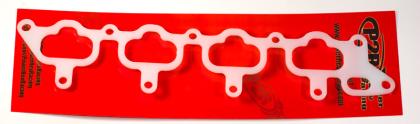
Anyone else consider this setup? Thoughts?
Thanks,
Jay
I am planning to install the AIT sensor in the intake manifold as SHOWN HERE.
Paul pointed out that "another location sometimes suggested is the intake manifold. This location can result in the sensor reading incorrectly due to the heat of the intake manifold. During high-boost and high-RPM operation the flow rate through the intake manifold is high enough that the intake manifold will not significantly heat the charge. If the intake manifold does have a significant amount of heat stored in it it could artificially raise the temperature reading beyond the actual charge temperature."
In order to mitigate this issue, I ordered a P2R Thermal Intake Manifold Gasket.
"P2R Thermal Intake Manifold Gaskets will help reduce intake air temperatures by removing the direct connection of the intake manifold to the cylinder head. Made out of our proprietary heat dissipating material the P2R thermal intake gasket creates a thermal barrier that isolates power-robbing heat from traveling to your intake manifold through the cylinder head. Less heat soak means cooler air and more consistent power delivery." - Import Drag Performance
Anyone else consider this setup? Thoughts?
Thanks,
Jay
Last edited by churchja; Oct 28, 2009 at 10:46 PM.