


ISCV control system disassembly


Thread Starter
EvoM Guru
iTrader: (50)
Joined: Mar 2006
Posts: 9,675
Likes: 132
From: Tri-Cities, WA // Portland, OR
Good work!
I tell you one adjustment that I have been searching for..... Power Steering ISCV Increase. You may have hit the nail on the head with the X-axis of the stepper lookup table too, because I can now see that the P/S input must shift this value up a little because I have found no other references to a 1D or 2D that cause the steps to increase.
A little info I noticed about the 3D table. It seems to be a min value table. Raising the values raises the minimum steps that ISCV will go to. Lowering the values does not necesarily lower the steps. Also most people have the axis backward. Y=8 X=27. It has the same Y axis header at the beginning of the table as do the other 3D tables.
I tell you one adjustment that I have been searching for..... Power Steering ISCV Increase. You may have hit the nail on the head with the X-axis of the stepper lookup table too, because I can now see that the P/S input must shift this value up a little because I have found no other references to a 1D or 2D that cause the steps to increase.
A little info I noticed about the 3D table. It seems to be a min value table. Raising the values raises the minimum steps that ISCV will go to. Lowering the values does not necesarily lower the steps. Also most people have the axis backward. Y=8 X=27. It has the same Y axis header at the beginning of the table as do the other 3D tables.
ISCV does have a learned trim just like the fuel trims and will compensate for bad choices in stepper table settings under some circumstances. Its not always used though so it won't fix bad choices 100% of the time. I didn't not explore it that much this time around, but I may dig into it in the future.

Evolved Member
Joined: Apr 2008
Posts: 604
Likes: 0
From: Sydney, Australia
The P/S input increases the steps and I am pretty sure it is not from a change in load. You can very lightly turn the steering wheel (just enough to trip the input) and watch the steps jump around 11 steps. It is not an important thing to bother about, just it has annoyed me for so long that it is there but I cant find what triggers it. 
There is definitely a learning element to the idle. An easy way to prove it is to turn in your BISS and within a few minutes the idle will be back to normal, even after a restart. The only way to do that is to learn an offset step amount. For my vehicle there are 4 of these trims that are active, Neutral, In gear, Neutral with A/C, and In Gear with A/C. You can make the system learn one of them such as Neutral, then kick it into gear and watch the idle control go bananas trying to relearn for that condition. Have you found any RAM addresses or MUTs to track any of this?
I believe MUT 09 is related to the learning procedure. It will shift above and below 128 depending on increasing or decreasing steps.
There is definitely a learning element to the idle. An easy way to prove it is to turn in your BISS and within a few minutes the idle will be back to normal, even after a restart. The only way to do that is to learn an offset step amount. For my vehicle there are 4 of these trims that are active, Neutral, In gear, Neutral with A/C, and In Gear with A/C. You can make the system learn one of them such as Neutral, then kick it into gear and watch the idle control go bananas trying to relearn for that condition. Have you found any RAM addresses or MUTs to track any of this?
I believe MUT 09 is related to the learning procedure. It will shift above and below 128 depending on increasing or decreasing steps.
Thread Starter
EvoM Guru
iTrader: (50)
Joined: Mar 2006
Posts: 9,675
Likes: 132
From: Tri-Cities, WA // Portland, OR
The P/S input increases the steps and I am pretty sure it is not from a change in load. You can very lightly turn the steering wheel (just enough to trip the input) and watch the steps jump around 11 steps. It is not an important thing to bother about, just it has annoyed me for so long that it is there but I cant find what triggers it.
...
...
Evolved Member
Joined: Apr 2008
Posts: 604
Likes: 0
From: Sydney, Australia
You can correctly log the P/S trigger input from MUT B8 on the 2nd bit (evoscan eval = "x bit 4"). I suppose it will be a matter of finding where this fits in with the idle control routines.

Good stuff. I don't really have time to look at it all right now. Just want to add the comment that as these cars age things will need cleaned to keep a proper idle. Throttle bodies, intake manifolds, etc... The proper fix is to clean the parts to get the idle back. However if you change hard parts such as throttle bodies, cams, pistons, cylinder head work then these tables will need to be adjusted to suit.
Thread Starter
EvoM Guru
iTrader: (50)
Joined: Mar 2006
Posts: 9,675
Likes: 132
From: Tri-Cities, WA // Portland, OR
Are you sure that its MUT B8? I see no connection, direct or indirect, between MUTB8 and the ISCV routines.
Evolved Member
Joined: Apr 2008
Posts: 604
Likes: 0
From: Sydney, Australia
Add it into Evoscan and you can see it function. It exactly logs the instant the power steering is turned enough to trigger the idle function.
You can see why this has been driving me crazy trying to track it down. I have even been trying to see if it triggers off another idle subroutine but I too just saw dead-ends.
You can see why this has been driving me crazy trying to track it down. I have even been trying to see if it triggers off another idle subroutine but I too just saw dead-ends.

Thread Starter
EvoM Guru
iTrader: (50)
Joined: Mar 2006
Posts: 9,675
Likes: 132
From: Tri-Cities, WA // Portland, OR
Add it into Evoscan and you can see it function. It exactly logs the instant the power steering is turned enough to trigger the idle function.
You can see why this has been driving me crazy trying to track it down. I have even been trying to see if it triggers off another idle subroutine but I too just saw dead-ends.
You can see why this has been driving me crazy trying to track it down. I have even been trying to see if it triggers off another idle subroutine but I too just saw dead-ends.
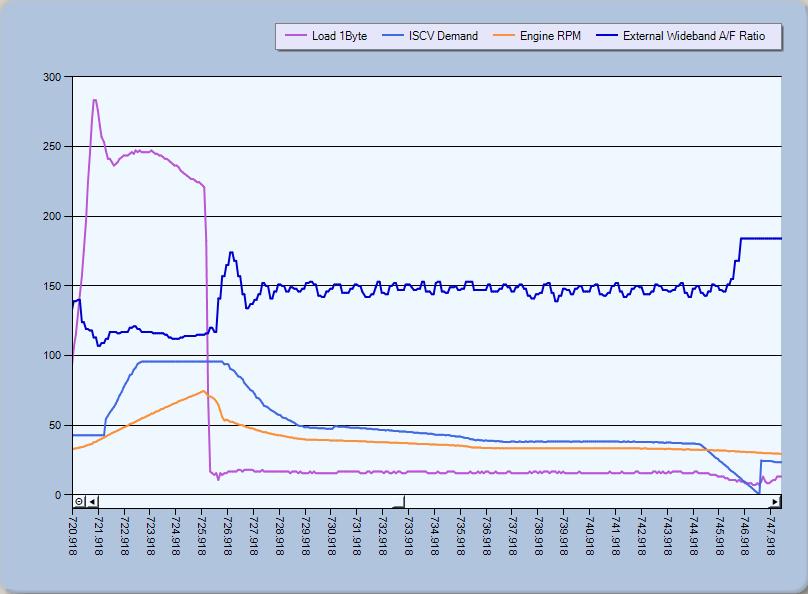
Based on that log, it looks like the ISCV gets ramped up as RPMs increase (probably one of the ISCV Demand vs RPM tables), and then there is a timer that has to decay before the ISCV can start dropping. If want to figure out which table(s) control the increase in ISCV Demand, then I can find the decay timer(s) that go with the table(s).
I think the Target idle ISCV trim adjust frequency may just be a demand polling interval.
Mrfred, can you verify? If so, i think i may have found which table is the adder for the pull i took. During the pull I noticed the ISCV was about 43% different in a 1 second interval. ISCV Demand RPM Adder* (sub_1EFC0) numbers sort of fit that if the polling interval lines up.
Mrfred, can you verify? If so, i think i may have found which table is the adder for the pull i took. During the pull I noticed the ISCV was about 43% different in a 1 second interval. ISCV Demand RPM Adder* (sub_1EFC0) numbers sort of fit that if the polling interval lines up.
Last edited by MR Turco; May 26, 2009 at 10:58 AM.
Thread Starter
EvoM Guru
iTrader: (50)
Joined: Mar 2006
Posts: 9,675
Likes: 132
From: Tri-Cities, WA // Portland, OR
I think the Target idle ISCV trim adjust frequency may just be a demand polling interval.
Mrfred, can you verify? If so, i think i may have found which table is the adder for the pull i took. During the pull I noticed the ISCV was about 43% different in a 1 second interval. ISCV Demand RPM Adder* (sub_1EFC0) numbers sort of fit that if the polling interval lines up.
Mrfred, can you verify? If so, i think i may have found which table is the adder for the pull i took. During the pull I noticed the ISCV was about 43% different in a 1 second interval. ISCV Demand RPM Adder* (sub_1EFC0) numbers sort of fit that if the polling interval lines up.
ok i lowered the values in the RPM table i suspect, hopefully i will see a different ramp rate at the least.
Evolved Member
Joined: Apr 2008
Posts: 604
Likes: 0
From: Sydney, Australia
Have you played with the Decel Cut Delay maps? They are actually vs TPS not Load as was first posted. Fortunately, my car being an auto, I dont have any issues with the throttle hanging but the first issue that would cause throttle hang is the fuel not cutting on deceleration.
Of course the stepper motor is being found out to a high step amount too which is something we need to gain control of, and find exactly what triggers it.
Of course the stepper motor is being found out to a high step amount too which is something we need to gain control of, and find exactly what triggers it.