


Stock EVO9 turbo for comparison purposes


I say its just another option to offer consumers. In the hands of a capable tuner the stock 9 will do just as well in most areas as it seems the hks and hta green or whatever ( from my perspective). In the end there are several factors that play into a build and what the customer wants to use the car for, using a dyno sheet to compare two turbos on the same build only shows what its making on that car with that tune does nothing for me in terms of useable data for road racing or drag or whatever I would use it for. There is no one size fits all to any build imo.



Sounds great.
Would it be possible for a moderator to do something similar and go through that other thread as well on the HKS turbo and repost it so the data is available? There was a wealth of good data in that thread, outside of the arguments.
This could be a great summary thread of the max/min/average performance of the stock IX turbo. Obviously the data is out there, but it is an impressive turbo and deserves to have a solid, well organized RESULTS thread for it.
Would it be possible for a moderator to do something similar and go through that other thread as well on the HKS turbo and repost it so the data is available? There was a wealth of good data in that thread, outside of the arguments.
This could be a great summary thread of the max/min/average performance of the stock IX turbo. Obviously the data is out there, but it is an impressive turbo and deserves to have a solid, well organized RESULTS thread for it.
Just to get the ball rolling on data again, here is what happens when you disregard spool/response all together and target top end HP on a small turbo. I will be changing several items in the future, this was mostly just an experiment to see how the car reacted to this build mentality. It is by no means what I would recommend a normal parts list to look like. I literally wanted to see what happened with a half assed "big turbo" setup with a little turbo in the way.
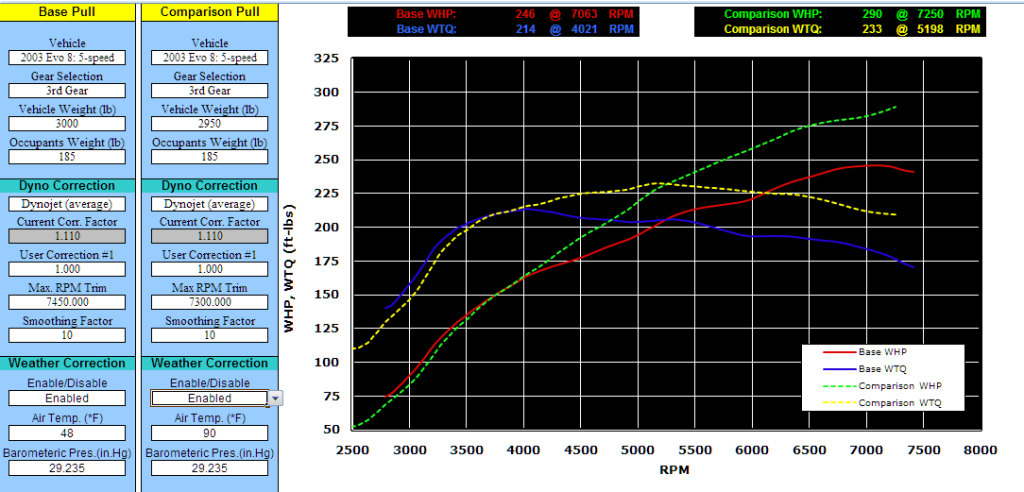
The car is 2950 lbs, so that probably isn't helping spool at all as the car doesn't fell laggy under normal spirited driving but it sure looks laggy on the VDR chart. Third gear road pulls, these are average numbers with lots of runs to verify this is typical performance for the car. Compared to when the car was full weight and mildly modified, the current setup only lost about 200 PRM in spool as well.
4200' Elevation, run conditions in the settings block are accurate for the time of pull.
91 Octane Fuel26 psi (dropping to 18 psi at 7500 RPM) vs 23 PSI (dropping to 16 psi by 7500 RPM)
Engine Mods:
Mild head work (mild bowl work, stock valves, FP Beehive Springs)
FP/Comp 280+ Cams (0/0 cam timing provided best powerband, -4/0 picked up ~15 WHP from these charts)
Ported Intake Manifold (similar to work done on Wilson V2.3 manifold from what I can tell)
3" IC piping and some POS 26x12x4 intercooler (works fine at this level for IATs though and has virtually no pressure drop at this airflow)
3" custom exhaust (3" O2 housing)
Large Runner Tubular exhaust manifold
3.5" forward facing turbo inlet with bell mouth inlet
Lots of other things, but those are the main power makers
Uncorrected

SAE Corrected

The car is 2950 lbs, so that probably isn't helping spool at all as the car doesn't fell laggy under normal spirited driving but it sure looks laggy on the VDR chart. Third gear road pulls, these are average numbers with lots of runs to verify this is typical performance for the car. Compared to when the car was full weight and mildly modified, the current setup only lost about 200 PRM in spool as well.
4200' Elevation, run conditions in the settings block are accurate for the time of pull.
91 Octane Fuel26 psi (dropping to 18 psi at 7500 RPM) vs 23 PSI (dropping to 16 psi by 7500 RPM)
Engine Mods:
Mild head work (mild bowl work, stock valves, FP Beehive Springs)
FP/Comp 280+ Cams (0/0 cam timing provided best powerband, -4/0 picked up ~15 WHP from these charts)
Ported Intake Manifold (similar to work done on Wilson V2.3 manifold from what I can tell)
3" IC piping and some POS 26x12x4 intercooler (works fine at this level for IATs though and has virtually no pressure drop at this airflow)
3" custom exhaust (3" O2 housing)
Large Runner Tubular exhaust manifold
3.5" forward facing turbo inlet with bell mouth inlet
Lots of other things, but those are the main power makers
Uncorrected
SAE Corrected
03white, if you can read this and I'm not on ignore. What were the changes in that comparison? Just the cam timing? The charts are basically identical up to 4500, they should both feel the same just driving around, like you said.


Looks like a solid stock turbo. I think that it will work just fine, it looks like you made some really good numbers with it. I am still amazed at the power level and the times people keep doing with a stock turbo. It seems like a lot of guys are really pushing the envelope.
Vehicle Wrap
Vehicle Wrap
Last edited by slow5.0.; Dec 14, 2010 at 05:51 PM.


That is just the difference between 23 and 26 psi. 22-23 psi peak was about the turning point where I had to start pulling a disproportionate amount of timing and adding fuel to keep the motor happy so peak torque didn't go up much. 3 PSI higher peak only gave about 1 psi more above 5500 RPM.
I post this knowning full well people are going to take these numbers differently then the way i look at them. It also comes with a complete admission that this setup is a terrible idea as it would be much easier just to get a red, have similar response and make a lot more power. As I said, I was curious what would happen if I built a setup around maximizing a stock turbo for peak HP on ****ty gas. I know, that goal makes NO SENSE and I admit it fully.
For a before and after, I only have a wastegate pressure comparision and on 91 octane.
Changes
Baseline
Ported stock manifold, megan O2 housing, helix 3" downpipe, stock cat and catback with no rear muffler, 3" 45 degree bend turbo inlet pipe, Speed density but still had the stock MAF on
Comparision
tubular exhaust manifold, 3" O2 housing, 3" downpipe and exhaust, mil.spec 100 cell cat, 3.5" forward facing turbo inlet pipe, Speed density (no MAF), only tuning above the baseline was to correct AFRs
All told, it was an 18% gain in peak power. I'm sure a good deal was just getting the stock cat and catback out of there. For anybody commenting on the lower power, go run a stock turbo at 160 kPa absolute pressure and let me know what you make (seriosuly, I'm curious).
Cam timing:
This is at wastegate pressure (160kPa absolute) on the older setup listed above as the baseline. Just cam timing changes, no tuning changes. I beleive I had trouble with "transitional knock" on the 0,0 setting and had to start the pulls later because of it. Despite the later start point, you can see a pretty clear cut powerband winner.
This is the average of 4 pulls over a 15-20 minute time for the entire test. Ran 2 in each direction to null out grade and wind. I don't have a dyno, so it's the best I can do. I have gotten to the point where I can reliably detect changes in curves easily and would say repeatability is within 5-10 HP overall. The absolute difference in power may not be exact, but the shift in the power curve I feel is very real.
The -4,0 was not a shot in the dark. It was the results of probably 50 different pulls trying timing changes indepentently on the intake and exhaust (0/0, 2/0, -2/0, -4/0, 0/2, -2/2, -2/4, etc...) and it was the best HP curve without KILLING midrange. Messing with the exhaust got a little more top end but it detroyed midrange (-20 ft/lbs or more).

I post this knowning full well people are going to take these numbers differently then the way i look at them. It also comes with a complete admission that this setup is a terrible idea as it would be much easier just to get a red, have similar response and make a lot more power. As I said, I was curious what would happen if I built a setup around maximizing a stock turbo for peak HP on ****ty gas. I know, that goal makes NO SENSE and I admit it fully.
For a before and after, I only have a wastegate pressure comparision and on 91 octane.
Changes
Baseline
Ported stock manifold, megan O2 housing, helix 3" downpipe, stock cat and catback with no rear muffler, 3" 45 degree bend turbo inlet pipe, Speed density but still had the stock MAF on
Comparision
tubular exhaust manifold, 3" O2 housing, 3" downpipe and exhaust, mil.spec 100 cell cat, 3.5" forward facing turbo inlet pipe, Speed density (no MAF), only tuning above the baseline was to correct AFRs
All told, it was an 18% gain in peak power. I'm sure a good deal was just getting the stock cat and catback out of there. For anybody commenting on the lower power, go run a stock turbo at 160 kPa absolute pressure and let me know what you make (seriosuly, I'm curious).
Cam timing:
This is at wastegate pressure (160kPa absolute) on the older setup listed above as the baseline. Just cam timing changes, no tuning changes. I beleive I had trouble with "transitional knock" on the 0,0 setting and had to start the pulls later because of it. Despite the later start point, you can see a pretty clear cut powerband winner.
This is the average of 4 pulls over a 15-20 minute time for the entire test. Ran 2 in each direction to null out grade and wind. I don't have a dyno, so it's the best I can do. I have gotten to the point where I can reliably detect changes in curves easily and would say repeatability is within 5-10 HP overall. The absolute difference in power may not be exact, but the shift in the power curve I feel is very real.
The -4,0 was not a shot in the dark. It was the results of probably 50 different pulls trying timing changes indepentently on the intake and exhaust (0/0, 2/0, -2/0, -4/0, 0/2, -2/2, -2/4, etc...) and it was the best HP curve without KILLING midrange. Messing with the exhaust got a little more top end but it detroyed midrange (-20 ft/lbs or more).
Last edited by 03whitegsr; Oct 21, 2010 at 11:54 AM.


26 psi (dropping to 18 psi at 7500 RPM) vs 23 PSI (dropping to 16 psi by 7500 RPM)