


2.5" VS 3" IC piping


Evolved Member
Joined: Aug 2010
Posts: 1,426
Likes: 2
From: The Universe
Just flipping through one of my books I found a section on intercooling that should help. Its a list of maximum recommended HP for charge pipe diameters.
2in - 255 hp
2.25in - 345 hp
2.5 in - 450 hp
2.75 in - 565 hp
3 in - 690 hp
3.5 in - 970 hp
*decrease max HP per 90-deg bend. three 30-deg bends equal one 90-deg bend.
The book is Forced Induction Performance Tuning by A. Gram Bell on page 155.
I assume he just calculated head loss per each diameter and flow rate (generally 9.5-10.5 lbm/min of air are required to make 100 hp), but at least it gives you a rough estimate
2in - 255 hp
2.25in - 345 hp
2.5 in - 450 hp
2.75 in - 565 hp
3 in - 690 hp
3.5 in - 970 hp
*decrease max HP per 90-deg bend. three 30-deg bends equal one 90-deg bend.
The book is Forced Induction Performance Tuning by A. Gram Bell on page 155.
I assume he just calculated head loss per each diameter and flow rate (generally 9.5-10.5 lbm/min of air are required to make 100 hp), but at least it gives you a rough estimate

Chad - So, could you actually eliminate most of the couplers using wiggins clamps or v bands - would they prevent boost leaks as well. I know it works for exhaust, but that would be cool.

are new FMIC setup i want the same. 3.0 in/out on the fmic but still not sure if i should do 2.5 2.75 3.0 piping.
701whp going to a 75mm TB, 5" IC, and 3" piping was worth 9whp.
I have the same combo as the aforementioned car (basically) and with 2.5" pipes, STOCK throttle body, 4" intercooler, made 794.
Our drag cars use 3" but alot of that has to do with the min outlet size off of a 4202 and we use Q45 TBs. I dont think that on those cars it makes sense to run less than 3" but we have no plans on going larger either. If I wasnt so lazy I'd calculate the CFM a 2.5" pipe can move vs a 3" and the amount of air an 800whp car is actually consuming in CFM.
aaron
I have the same combo as the aforementioned car (basically) and with 2.5" pipes, STOCK throttle body, 4" intercooler, made 794.
Our drag cars use 3" but alot of that has to do with the min outlet size off of a 4202 and we use Q45 TBs. I dont think that on those cars it makes sense to run less than 3" but we have no plans on going larger either. If I wasnt so lazy I'd calculate the CFM a 2.5" pipe can move vs a 3" and the amount of air an 800whp car is actually consuming in CFM.
aaron
car 1. whp going to a 75mm TB, 5" IC, and 3" piping was worth 9whp.
car 2. with 2.5" pipes, STOCK throttle body, 4" intercooler, made 794.
what did the ''car 1'' have before the upgrade? and your saying car 2 is what should be run? im confused. as usual.


It all depends on the individual packaging.
I honestly think youd gain more going to solid couplers than upping pipe diameter..
we just saw 750ish whp on our dyno with 2.5" piping with some 90 degree bends..
our TA car makes jus shy of 600whp on 93 octane with 2.5" IC piping, under 30psi... with all quick disconnects.. and we've never ONCE had a leak issue because of it!
cheers
cb
I honestly think youd gain more going to solid couplers than upping pipe diameter..
we just saw 750ish whp on our dyno with 2.5" piping with some 90 degree bends..
our TA car makes jus shy of 600whp on 93 octane with 2.5" IC piping, under 30psi... with all quick disconnects.. and we've never ONCE had a leak issue because of it!
cheers
cb



I have 2.5" piping, we tried 3" on a 700whp car and I would say the results werent fantastic. That being said both of the race cars run 3" but they are north of 1000whp as well.
Aaron
Aaron

i think its pretty simple... its just setup related. If you're running a ported stock intake manifold/tbody combo, then running a 2.5~2.75" piping makes sense. Also, moving up to 3" w/ this combo probably wouldnt do much since it has to go through the smaller tbody anyways. Im sure this is good for 400-800+whp as proven on many street cars.
Now, if you're running a custom plenum intake manifold, 75mm tbody or larger etc... then 3" piping would be your "norm". Obviously, It wouldnt make sense to run a smaller dia pipe into a 75mm(3") tbody. This combo is usually reserved for larger T4 turbos making 800-1200whp+.
I also agree w/ the elimination of silicone couplers to improve flow. Im using the Hargett quick release clamps and the Accufab wiggins. They give you free play w/ an o-ring seal... and you wont blow them off or have boost leaks etc.
-Tom
Now, if you're running a custom plenum intake manifold, 75mm tbody or larger etc... then 3" piping would be your "norm". Obviously, It wouldnt make sense to run a smaller dia pipe into a 75mm(3") tbody. This combo is usually reserved for larger T4 turbos making 800-1200whp+.
I also agree w/ the elimination of silicone couplers to improve flow. Im using the Hargett quick release clamps and the Accufab wiggins. They give you free play w/ an o-ring seal... and you wont blow them off or have boost leaks etc.
-Tom
Last edited by TakaseEVOIXSE; Jan 12, 2011 at 01:49 PM.
i think its pretty simple... its just setup related. If you're running a ported stock intake manifold/tbody combo, then running a 2.5~2.75" piping makes sense. Also, moving up to 3" w/ this combo probably wouldnt do much since it has to go through the smaller tbody anyways. Im sure this is good for 400-800+whp as proven on many street cars.
Now, if you're running a custom plenum intake manifold, 75mm tbody or larger etc... then 3" piping would be your "norm". Obviously, It wouldnt make sense to run a smaller dia pipe into a 75mm(3") tbody. This combo is usually reserved for larger T4 turbos making 800-1200whp+.
I also agree w/ the elimination of silicone couplers to improve flow. Im using the Hargett quick release clamps and the Accufab wiggins. They give you free play w/ an o-ring seal... and you wont blow them off or have boost leaks etc.
-Tom
Now, if you're running a custom plenum intake manifold, 75mm tbody or larger etc... then 3" piping would be your "norm". Obviously, It wouldnt make sense to run a smaller dia pipe into a 75mm(3") tbody. This combo is usually reserved for larger T4 turbos making 800-1200whp+.
I also agree w/ the elimination of silicone couplers to improve flow. Im using the Hargett quick release clamps and the Accufab wiggins. They give you free play w/ an o-ring seal... and you wont blow them off or have boost leaks etc.
-Tom
Tom,
glad to see you are on the same boat as us with couplers..
people wonder why our TA car could make 580whp at 28psi on 93... with a smaller than 35R turbo....
it was plain and simple, efficiency... no swelling, no leaks, consistency... and short route piping.
cb


For $100+ a clamp, they are cost prohibitive for most. Who's going to add $500 in clamps to a $600 intercooler system?
Also, I wouldn't be surprised if a straight silicon coupler has a lower pressure drop then the quick disconnects.
Reliability wise, yes the quick disconnects own.
Also, I wouldn't be surprised if a straight silicon coupler has a lower pressure drop then the quick disconnects.
Reliability wise, yes the quick disconnects own.
For $100+ a clamp, they are cost prohibitive for most. Who's going to add $500 in clamps to a $600 intercooler system?
Also, I wouldn't be surprised if a straight silicon coupler has a lower pressure drop then the quick disconnects.
Reliability wise, yes the quick disconnects own.
Also, I wouldn't be surprised if a straight silicon coupler has a lower pressure drop then the quick disconnects.
Reliability wise, yes the quick disconnects own.
Wiggins used to be the standard..
it depends on whether you want reliability or not... on a track car... not wasting time is more than worth a couple hundred dollars in great couplers..
we put a -4 Staubli disconnect on our clutch line, and that made a big difference the 1-2 times we had to remove the trans to fix something and didnt have to bleed the clutch

cb
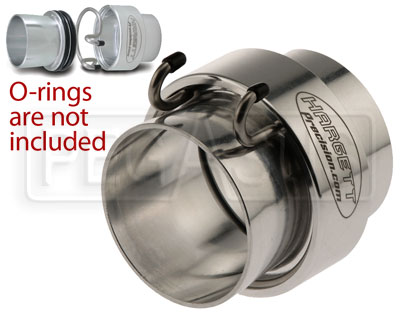
Yeah, I fully agree on a competitive track car it would be worth the money simply from a reliability and service aspect.
The Hargett clamps look kind of heavy? Other then that, they look much easier to use then the wiggins. I've never messed with wiggins, they are out of my price range but I've heard they are a ***** to work with.
I am looking for a more cost effective solution though as I'm sick of crushing aluminum tube with clamps. I have an idea that works out to about $35 a clamp and should be as reliable as the quick disconnects. Not as quick to remove though.
The Hargett clamps look kind of heavy? Other then that, they look much easier to use then the wiggins. I've never messed with wiggins, they are out of my price range but I've heard they are a ***** to work with.
I am looking for a more cost effective solution though as I'm sick of crushing aluminum tube with clamps. I have an idea that works out to about $35 a clamp and should be as reliable as the quick disconnects. Not as quick to remove though.
Last edited by 03whitegsr; Jan 13, 2011 at 08:04 AM.
Chad is right... Hargett for the win! they are only about $85 for the 3" clamps. By the time you subtract the cost of a good silicone coupler, two quality t-bolt clamps... its not bad at all. The wiggins style is way more expensive, which is why i only have one on the tbody. My other 3 connections are the cost effective Hargetts... which btw are 100 times easier to use. You simply slide one end in and release the lock ring. The wiggins style is a pain in the ***. You need like 3 hands to use it, lol!!! The added insurance of no blow offs/leaks is worth the investment alone. Plus it looks alot cleaner. These things can even seal liquid since its o-ringed. These are made of aluminum... and are not heavy. In fact i bet a silicone coupler w/ stainless tbolts would weigh more once these QDC are welded onto the pipe. You have to understand there is an investment here in regards to quality/function.