


Independant height and preload adjustments


Thread Starter
Evolving Member
Joined: Nov 2006
Posts: 117
Likes: 0
Independant height and preload adjustments
I've been researching coilovers and I understand why you would want independant height and preload adjustments. My impression is that on coilovers without this feature, when you lower the spring perch, your also shorten the compression travel. My main question is, when I look at images of cars without independant adjustments (tein ss) and those with (pic, tein flex, etc..) The adjusting mechanism looks the same to me. How do coilovers go about adjusting height without preload?

Evolved Member
Joined: Nov 2003
Posts: 1,496
Likes: 0
From: Bangkok
The difference is at the bottom (lower) part of the strut.
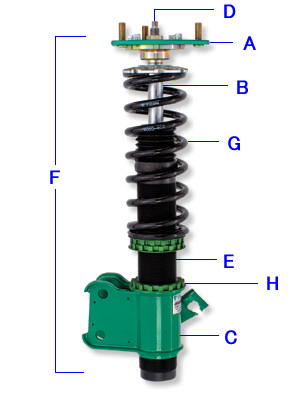
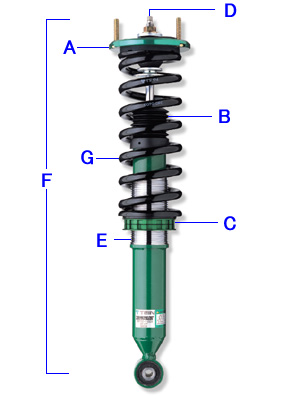
The top/LH one is the Type Flex and the bottom/RH is the SuperStreet.
On the SuperStreet, you can adjust ride height by winding up the things marked 'C'. Stationary, the load on the spring is constant and therfore as you wind 'C' up the body of the damper, 'E' moves away from the top mount 'A' therefore increasing your rideheight. However, as this extends the damper the piston will also move up the damper thus reducing the available extension stroke for the damper (it increases compression stroke, but the spring may bind first). Winding it the other way does the opposite with the danger of the spring leaving its seat when the damper is fully extended. So, all in all, you can change rideheight but it's quite limited. So, the pre-load as it were, increases with the rideheight.
If you look at the Type Flex, you will see that the whole body of the shock, 'E' is theraded, right to the bottom minus a little bit. The key difference here is that you can move the lower mounting point of the damper, 'C' up or down relative to the top mount, 'A' without changing the length of the spring. By not changing the length of the spring, you are therefore leaving the piston where it is intended to be and the spring will have the same preload. So, the pre-load remains constant regardless of rideheight. A much nicer solution.
The top/LH one is the Type Flex and the bottom/RH is the SuperStreet.
On the SuperStreet, you can adjust ride height by winding up the things marked 'C'. Stationary, the load on the spring is constant and therfore as you wind 'C' up the body of the damper, 'E' moves away from the top mount 'A' therefore increasing your rideheight. However, as this extends the damper the piston will also move up the damper thus reducing the available extension stroke for the damper (it increases compression stroke, but the spring may bind first). Winding it the other way does the opposite with the danger of the spring leaving its seat when the damper is fully extended. So, all in all, you can change rideheight but it's quite limited. So, the pre-load as it were, increases with the rideheight.
If you look at the Type Flex, you will see that the whole body of the shock, 'E' is theraded, right to the bottom minus a little bit. The key difference here is that you can move the lower mounting point of the damper, 'C' up or down relative to the top mount, 'A' without changing the length of the spring. By not changing the length of the spring, you are therefore leaving the piston where it is intended to be and the spring will have the same preload. So, the pre-load remains constant regardless of rideheight. A much nicer solution.
Thread Starter
Evolving Member
Joined: Nov 2006
Posts: 117
Likes: 0
Originally Posted by x838nwy
The difference is at the bottom (lower) part of the strut.
The top/LH one is the Type Flex and the bottom/RH is the SuperStreet.
On the SuperStreet, you can adjust ride height by winding up the things marked 'C'. Stationary, the load on the spring is constant and therfore as you wind 'C' up the body of the damper, 'E' moves away from the top mount 'A' therefore increasing your rideheight. However, as this extends the damper the piston will also move up the damper thus reducing the available extension stroke for the damper (it increases compression stroke, but the spring may bind first). Winding it the other way does the opposite with the danger of the spring leaving its seat when the damper is fully extended. So, all in all, you can change rideheight but it's quite limited. So, the pre-load as it were, increases with the rideheight.
If you look at the Type Flex, you will see that the whole body of the shock, 'E' is theraded, right to the bottom minus a little bit. The key difference here is that you can move the lower mounting point of the damper, 'C' up or down relative to the top mount, 'A' without changing the length of the spring. By not changing the length of the spring, you are therefore leaving the piston where it is intended to be and the spring will have the same preload. So, the pre-load remains constant regardless of rideheight. A much nicer solution.
The top/LH one is the Type Flex and the bottom/RH is the SuperStreet.
On the SuperStreet, you can adjust ride height by winding up the things marked 'C'. Stationary, the load on the spring is constant and therfore as you wind 'C' up the body of the damper, 'E' moves away from the top mount 'A' therefore increasing your rideheight. However, as this extends the damper the piston will also move up the damper thus reducing the available extension stroke for the damper (it increases compression stroke, but the spring may bind first). Winding it the other way does the opposite with the danger of the spring leaving its seat when the damper is fully extended. So, all in all, you can change rideheight but it's quite limited. So, the pre-load as it were, increases with the rideheight.
If you look at the Type Flex, you will see that the whole body of the shock, 'E' is theraded, right to the bottom minus a little bit. The key difference here is that you can move the lower mounting point of the damper, 'C' up or down relative to the top mount, 'A' without changing the length of the spring. By not changing the length of the spring, you are therefore leaving the piston where it is intended to be and the spring will have the same preload. So, the pre-load remains constant regardless of rideheight. A much nicer solution.

Thread Starter
Evolving Member
Joined: Nov 2006
Posts: 117
Likes: 0
One more question, if I may. So say I adjust the component that alters the ride height. If I were to move it up or down an inch on the thread, does that directly lower the car an inch up or down? So basically, an inch adjustment on the coilover = an exact inch of ride height alteration?
Evolved Member
Joined: Nov 2003
Posts: 1,496
Likes: 0
From: Bangkok
Don't worry mate, no probs at all...
As for whether it relates directly to ride-height, it's yes and no. I mean, for the strut mechanism like in the front of the evo, it's pretty much one-to-one. On the other hand, if you have another type of suspension setup, it won't be. Basically, if the shock is connected to a place more inboard of the car than the wheel, the increase in ride height will be [change in shock length] x [distance from where wishbone connects to chassis to the wheel]/[distance from where the wishbone connects to the chassis to where the shock connects to the wishbone]. Or similar. Basically, it's similar to the wheel rate vs. spring rate thing. Hope this helps...
As for whether it relates directly to ride-height, it's yes and no. I mean, for the strut mechanism like in the front of the evo, it's pretty much one-to-one. On the other hand, if you have another type of suspension setup, it won't be. Basically, if the shock is connected to a place more inboard of the car than the wheel, the increase in ride height will be [change in shock length] x [distance from where wishbone connects to chassis to the wheel]/[distance from where the wishbone connects to the chassis to where the shock connects to the wishbone]. Or similar. Basically, it's similar to the wheel rate vs. spring rate thing. Hope this helps...
