


Remote Turbo setup anyone???


Thread Starter
Evolving Member
Joined: May 2004
Posts: 137
Likes: 0
From: Denver
Remote Turbo setup anyone???
I'm really wanting to build a remote turbo setup that mounts at the rear of the car.
Check it out.
http://www.mx6.com/forums/showthread.php?t=128168
Has anyone done this yet to their Lancer? I know that everyone is going with RRM or the TSI kit, but a custom remote kit would be pretty nice and make for an awesome sleeper.
Check it out.
http://www.mx6.com/forums/showthread.php?t=128168
Has anyone done this yet to their Lancer? I know that everyone is going with RRM or the TSI kit, but a custom remote kit would be pretty nice and make for an awesome sleeper.




Originally Posted by Go2fast
I would steer u away from them. One good wack from something on the road and game over!!
Trending Topics

Evolving Member
Joined: Jan 2005
Posts: 256
Likes: 0
From: Orlando, FL
Have you ever seen what Fedex can do to a turbo??? Its unbelieveable! LOL! The turbo would get hella hot and so will everything else back there! As for the oil line, can you say 2 8 foot lines! lol Im really wondering what that would do to oil pressure. Poor oil pump.
I would just scrap the idea of a rear mount turbo kit and go with a kit made for our cars!
I would just scrap the idea of a rear mount turbo kit and go with a kit made for our cars!

i know a couple of ford SHOs that run that but they use it mainly cause theres not alot of room in their engine bay and all of them said if they had to do it over they wouldnt have not very efficent


Evolving Member
Joined: Dec 2004
Posts: 497
Likes: 0
From: San Jose, Ca
Originally Posted by HobieKopek
Impractical and inefficient unless you're serious about CARB regulation...in which case you have no business going FI in the first place.
its still illegal if the intake is hooked up! so you can unhook it, and head on down to get smogged with your factory intake in place, then swap it back out. but you can do that with a turbo kit on anyway. it would only take you a couple hours more. but for the decreased spoolup time, increased power, etc. i would rather take an hour or 2 more and have a real turbo kit installed

I wonder how all this heat in the back would with all of the rain getting splashed up when driving in a rainstorm. Doesn't the STS system have a remote oiling system? I've seen their video clips and it sounds like there's a fair amount of turbo lag. No intercooler and the length of the car to travel before boost reaches the engine not to mention what happens when you lift? There's still 8 feet or so of boost heading upstream. I am sure they engineered this so it's safe. But I still wonder if there's "lift lag" 
Dave
Dave

Newbie
Joined: Nov 2011
Posts: 3
Likes: 0
From: Dyer,TN
remote turbo set up
It can be quite time consuming to add a turbo charger to a NASP engine. The biggest problems include avoiding detonation, making space to join the turbo to the exhaust and sorting out the fuelling and mapping.
Although still a big job the remote turbo is being hailed as the simple bolt on solution for NASP engines.
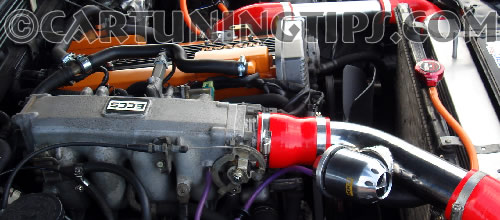
A remote turbo, so called because of it’s remote location is generally fitted at the back of the car near or instead of the rear silencer. It can also be mounted part way along the exhaust but this can be prone to damage and reduces the cars ground clearance.
The remote location ensures that the exhaust gases are substantially cooler than they would be in the exhaust headers. Due to the catalyst and expansion box the exhaust gases are also flowing a little slower. These two factors make it a lot easier to add a remote turbo.
 The lower boost they produce and cooler temperatures they run at help the simplify the installation. The long pipe run back to the air intake will act as an intercooler negating the need for an additional intercooler.
Your remote turbo will need a very good supply of oil and we would recommend fitting an oil pump and taking an oil feed from the engine sump. An inline oil cooler can help if temperature issues ensue.
Although remote turbo kits are available you can actually source suitable turbos from breakers yards and salvage agents. Go with a small turbo set to low boost with a wastegate and diverter valve for best results, unless you are prepared to lower the compression of the engine.
You will need to adjust the fuelling and the engine mapping to cope with the additional supply of air and this is best done on a rolling road.
Avoid detonation by running a low boost, using high octane fuel and adding a water injection system if you do not want the expense and inconvenience of an engine rebuild
Although still a big job the remote turbo is being hailed as the simple bolt on solution for NASP engines.
A remote turbo, so called because of it’s remote location is generally fitted at the back of the car near or instead of the rear silencer. It can also be mounted part way along the exhaust but this can be prone to damage and reduces the cars ground clearance.
The remote location ensures that the exhaust gases are substantially cooler than they would be in the exhaust headers. Due to the catalyst and expansion box the exhaust gases are also flowing a little slower. These two factors make it a lot easier to add a remote turbo.
The lower boost they produce and cooler temperatures they run at help the simplify the installation. The long pipe run back to the air intake will act as an intercooler negating the need for an additional intercooler.Your remote turbo will need a very good supply of oil and we would recommend fitting an oil pump and taking an oil feed from the engine sump. An inline oil cooler can help if temperature issues ensue.
Although remote turbo kits are available you can actually source suitable turbos from breakers yards and salvage agents. Go with a small turbo set to low boost with a wastegate and diverter valve for best results, unless you are prepared to lower the compression of the engine.
You will need to adjust the fuelling and the engine mapping to cope with the additional supply of air and this is best done on a rolling road.
Avoid detonation by running a low boost, using high octane fuel and adding a water injection system if you do not want the expense and inconvenience of an engine rebuild