


Building a GT Wing


If you were going to be putting together multi element wing, how does that change what wing elements you would choose?
Thanks,
Dave

Not a wing expert here, but I would assume you'd want a less cambered large element with a 2nd element about 1/3- 1/4 the size of the first. From my limited knowledge, a dual element design should allow similar or higher Cl with a lower Cd. . . or use the same highly cambered single element along with a 2nd element to gain a much higher Cl with only minimal Cd increase. . .
Email David and he can tell you what he found out in his initial wind tunnel testing back in his days of FSAE regarding overlap, AOA of 2nd element, spacing between the two, etc . . .
Email David and he can tell you what he found out in his initial wind tunnel testing back in his days of FSAE regarding overlap, AOA of 2nd element, spacing between the two, etc . . .

Evolved Member
Joined: Jan 2007
Posts: 671
Likes: 0
From: Dallas / Fort Worth
In other words you don't have extra mass to accelerate (except for the drag created by the wing), decelerate, rotate, or to deal with in a lateral change of direction.
You do have a point in that it will affect the verticle tracking of the wheels over an uneven surface. But because you're not increasing mass in the verticle axis, the wing will quickly push the wheel back down to the road faster than if it was to have to rebound (up against the spring and back down again) on its own. And that's where the wheel needs to be for maximum grip right - on the road again!
Disclaimer - This is the way I have had it explained to me and the way I percieve it to work. I have no hard evidence or measurable results to support any of this. I would like to see how (and if) it really does work in practice though...

It is very effective, but hardly any sanctioning body allows it.
d


I assume by "optimal" you mean maximum downforce. If so, as much load as possible is carried on the first half to 2/3's (roughly) of the airfoil, then the velocity (suction) is decreased rapidly towards the trailing edge. This it not to say the airfoil won't have significant camber, but it may not look as pleasing to the eye as the airfoil in question. Finally, there are a broad range of airfoils that will perform well, the difference in max downforce between a good airfoil and the optimum airfoil for a particular car will not be great.


if you're only going to do a single element wing the selig 1223 profile is tough to beat.
http://www.ae.uiuc.edu/m-selig/ads/coord_database.html
RE: finding the stall angle of the wing. tuft testing will lead to false conclusions because the tape/tufts will cause the flow to separate early on the bottom side of the wing. oil dot testing is FAR more effective for stall indication. mix up some 3-in-1 oil with something to color it(chalk powder works well if you're testing a carbon colored wing). put dots of your mixed up oil in rows across the wing. cord-wise streaks tell you the flow is attached and span-wise or reversing streaks tell you the air is not attached.
also, this place is pretty cool for getting cores cut. he has tons of wing profiles already in his database. you just tell him what profile and how big and it shows up in the mail.
http://www.flyingfoam.com/CustomMain.html
http://www.ae.uiuc.edu/m-selig/ads/coord_database.html
RE: finding the stall angle of the wing. tuft testing will lead to false conclusions because the tape/tufts will cause the flow to separate early on the bottom side of the wing. oil dot testing is FAR more effective for stall indication. mix up some 3-in-1 oil with something to color it(chalk powder works well if you're testing a carbon colored wing). put dots of your mixed up oil in rows across the wing. cord-wise streaks tell you the flow is attached and span-wise or reversing streaks tell you the air is not attached.
also, this place is pretty cool for getting cores cut. he has tons of wing profiles already in his database. you just tell him what profile and how big and it shows up in the mail.
http://www.flyingfoam.com/CustomMain.html
Last edited by griceiv; Jan 26, 2009 at 11:41 AM.
if you're only going to do a single element wing the selig 1223 profile is tough to beat.
http://www.ae.uiuc.edu/m-selig/ads/coord_database.html
RE: finding the stall angle of the wing. tuft testing will lead to false conclusions because the tape/tufts will cause the flow to separate early on the bottom side of the wing. oil dot testing is FAR more effective for stall indication. mix up some 3-in-1 oil with something to color it(chalk powder works well if you're testing a carbon colored wing). put dots of your mixed up oil in rows across the wing. cord-wise streaks tell you the flow is attached and span-wise or reversing streaks tell you the air is not attached.
http://www.ae.uiuc.edu/m-selig/ads/coord_database.html
RE: finding the stall angle of the wing. tuft testing will lead to false conclusions because the tape/tufts will cause the flow to separate early on the bottom side of the wing. oil dot testing is FAR more effective for stall indication. mix up some 3-in-1 oil with something to color it(chalk powder works well if you're testing a carbon colored wing). put dots of your mixed up oil in rows across the wing. cord-wise streaks tell you the flow is attached and span-wise or reversing streaks tell you the air is not attached.
As for oil dots, I agree this is an excellent form of flow visualization - great suggestion. Tufts can be made to be nearly nonintrusive, but then they're hard to see. An advantage of tufts is that they don't have to be reapplied between runs, unlike oil. However, reapplying oil to a wing is no big deal.

Im suprised noone has talked about wicker bills (Gurney flap) yet
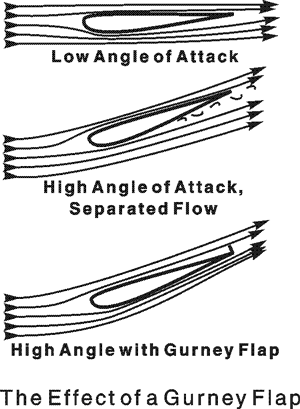
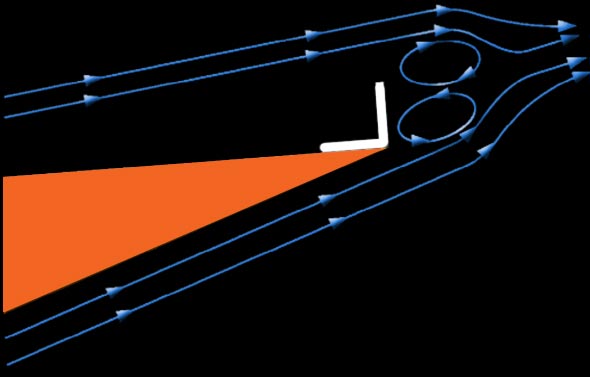
If you want to run a fairly high angle of attack, you should think about a gurney flap. to keep the flow attached to the wing, the gurney flap creates a low pressure twin vortex behind the wing, basically pulling the lower flow back onto the surface of the wing. less drag, more downforce is achieved.
If you want to run a fairly high angle of attack, you should think about a gurney flap. to keep the flow attached to the wing, the gurney flap creates a low pressure twin vortex behind the wing, basically pulling the lower flow back onto the surface of the wing. less drag, more downforce is achieved.
Thread Starter
Evolved Member
iTrader: (62)
Joined: Feb 2004
Posts: 3,336
Likes: 6
From: Redmond - Lake Tapps ,WA
I go skiing for 4 days and this thread blows up! Some good stuff in here.
In terms of the wing position on the car, it is a factor based on the cars CG. Any force applied to the rear actually creates lift in the front based on the car pivoting around the CG. That's why changes to rear down force need to be balanced with additions to front down force.
I'll read up on some of the suggested airfoil shapes tomorrow.
In terms of the wing position on the car, it is a factor based on the cars CG. Any force applied to the rear actually creates lift in the front based on the car pivoting around the CG. That's why changes to rear down force need to be balanced with additions to front down force.
I'll read up on some of the suggested airfoil shapes tomorrow.

In terms of the wing position on the car, it is a factor based on the cars CG. Any force applied to the rear actually creates lift in the front based on the car pivoting around the CG. That's why changes to rear down force need to be balanced with additions to front down force.
...right?
...and if you apply force between the front and rear axle planes, there should be none of this effect at all...
Did I miss a day of school somewhere?

d
Last edited by donour; Jan 26, 2009 at 11:03 PM.


Whoa whoa whoa. How is this true? The pivot action will be around a fixed point, specifically the mount points of the rear suspension. A Seesaw doesn't pivot around the CG, it's pivot's around the fixed point. If you push really hard on the trunk (well it'll collapse) the front wheels will come up, as will the CG, but the rear wheels will remained fixed.
...right?
...and if you apply force between the front and rear axle planes, there should be none of this effect at all...
Did I miss a day of school somewhere?
d
...right?
...and if you apply force between the front and rear axle planes, there should be none of this effect at all...
Did I miss a day of school somewhere?
d
Last edited by griceiv; Jan 27, 2009 at 09:10 AM.
