


square spring rates vs "traditional" stagger


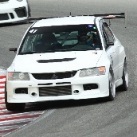
Well, here is the vid from this past weekend, best lap at Barber. Two places to note:
At 40 seconds I enter the 'Spider turn' near off camber segmented 180. I spent the weekend chasing a guy in Danny Popp's old Blue Vette running TT2. He noted this was one corner where I was way better. I get back on the power real early and just hang on. The slide towards the end is almost dead neutral, front and rear. No plowing understeer, no snappy rear end.
Then at 1:10 I enter the high speed dogleg on the back end of the track. The car is actually loose on that exit but I only have to just breathe on the wheel. The front and the rear are in balance.
I am a rank novice. I only know I am going way faster now in TT than I was before and it is much easier to approach the limit with the car.
At 40 seconds I enter the 'Spider turn' near off camber segmented 180. I spent the weekend chasing a guy in Danny Popp's old Blue Vette running TT2. He noted this was one corner where I was way better. I get back on the power real early and just hang on. The slide towards the end is almost dead neutral, front and rear. No plowing understeer, no snappy rear end.
Then at 1:10 I enter the high speed dogleg on the back end of the track. The car is actually loose on that exit but I only have to just breathe on the wheel. The front and the rear are in balance.
I am a rank novice. I only know I am going way faster now in TT than I was before and it is much easier to approach the limit with the car.





Evolved Member

Joined: Jun 2011
Posts: 725
Likes: 13
From: san antonio
Or maybe it's just autocross.......
Of the 3 most recent cars I had a hand in, all 3 were podiums in open wheel formula series. Don't ever for a second think a good autox setup is anywhere near optimal for a road course
But I digress. Camber and roll couple manifest themselves in completely different ways. And this argument is stupid since you're insinuating I'm allowing more than 1 variable to change at a time.

You have pretty limited control over roll couple in the EVO though as there really isn't any parts to even allow adjustment to roll center. There are the Whiteline parts that do VERY LITTLE for roll center on the front then ride height adjustments and that's about it.


Is there anyone willing to walk me through taking measurements of my car? I would like to figure out where my CG is, roll center, etc.
without this information I'm pretty much make my changes based on feel and the knowledge of others which seems to be working but I would rather have hard data to back everything up.
I have no problem paying for the time and information.
without this information I'm pretty much make my changes based on feel and the knowledge of others which seems to be working but I would rather have hard data to back everything up.
I have no problem paying for the time and information.
I have also done the opposite experiment, where I kept the lateral load transfer distribution constant after accounting for the change in roll center height before and after a rake change, with the results still showing substantial balance changes with changes in rake even though the load transfer was the same.
so if you really are constraining your testing to 1 variable at a time and still think that the roll center change is the dominant factor in the change of balance with rake changes on an evo then I guess we'll just have to agree to disagree.

Evolved Member

Joined: Jul 2003
Posts: 638
Likes: 7
The big problem with evaluating the effects of roll center is that so many other variables are affected at the same time like camber curve, roll couple, roll axis, etc. which in turn relate to roll resistance and how that effects the need for springs and bars. The multivariate modeling required is exceedingly complex and I don't see a possible way of looking at that one variable in isolation.
Regardless, given my experience with roll center compensation and the difference it makes in driving different types of lowered cars on anything but a smooth track I am surprised it is not more universally embraced and there not more kits available that address this - Whiteline ideally is for a car that is only lowered 5/8".
Regardless, given my experience with roll center compensation and the difference it makes in driving different types of lowered cars on anything but a smooth track I am surprised it is not more universally embraced and there not more kits available that address this - Whiteline ideally is for a car that is only lowered 5/8".
Where are the parts available to do it is my question?
I know you are working on something. I'm just saying currently the parts don't exist unless you get them custom made.
Sure...well, I question if their is enough room for the tie rod to do that much correction...but that wasn't my point.
Where are the parts available to do it is my question?
I know you are working on something. I'm just saying currently the parts don't exist unless you get them custom made.
Where are the parts available to do it is my question?
I know you are working on something. I'm just saying currently the parts don't exist unless you get them custom made.
You are right about the steering be a limiting factor. Without changing the steering ratio, zero bump steer limits the correction to about 2.5" if you want to put the steering link in double shear.
In my model I iterated on the factory suspension to find the needed position of the tie rod pivot. Maybe I just couldn't find the right info elsewhere and this is common knowledge, but it just so happened to be that most linear bump steer and at the inflection point came from the steering link equal in length to the lower control arm and parallel.
If I'm correct, and assuming we cant change the steering arm length without changing ackerman, then we need to move the steering joint as much as the ball joint.
In my model I iterated on the factory suspension to find the needed position of the tie rod pivot. Maybe I just couldn't find the right info elsewhere and this is common knowledge, but it just so happened to be that most linear bump steer and at the inflection point came from the steering link equal in length to the lower control arm and parallel.
If I'm correct, and assuming we cant change the steering arm length without changing ackerman, then we need to move the steering joint as much as the ball joint.
It looks like the OEM tie-rod sits a little lower then the control arm (from parallel) so that with the rear steer geometry, the car toes in under compression.
You really want to just be able to adjust tie-rod height since caster, camber, and tow adjustments all impact the bumpsteer curve to some degree.
Looking at the racefab arms, it doesn't look like the balljoint is on the right angle for use with the factory hub carrier?
You really want to just be able to adjust tie-rod height since caster, camber, and tow adjustments all impact the bumpsteer curve to some degree.
Looking at the racefab arms, it doesn't look like the balljoint is on the right angle for use with the factory hub carrier?
Last edited by 03whitegsr; Nov 8, 2015 at 05:35 PM.