


Indepth study of WAI injection systems


Finally, you've caught ...some...snap. I absolutely agree with you that the spring is there to hold the initial pressure on the upstream side of the valve to whatever the spring value is. But that is not called pressure drop. The friction of the fluid as it travels through the orifice (i.e. the inside restrictions in the valve) for a specific flow rate is called pressure drop. The entire basis for my original disagreement with Richard was not flow, but the required pressure to maintain a 30# pressure at the nozzle for proper atomization. As flow (gpm if you will) increase so does the pressure drop across the valve. Just as it does for fluid traveling along the inside of some type of conduit (pipe, tubing, etc). Can you see that there is a greater pressure drop in a pipe that is 1 mile long as a opposed to a pipe 1 foot long? The spring in this case acts as a backpressure regulator to maintain a minimum of "X" amount of pressure. As soon as you overcome that resistance and the ball is unseated, the downstream side of the valve become pressurized to a value that is equal to the upstream side minus pressure losses due to valves, pipe and fittings. Now...go spank yourself you silly Chem E.!
We can agree to disagree. Abner's test has the original answer we were looking for.
Last edited by dubbleugly01; Sep 4, 2007 at 08:51 PM.

For whatever the reason that caused the flow drop, the spring-loaded checkvalve has a definite influence on the outcome.
Call it what you will... pressure or flow. I just happened to illustrate the effect of CV in "pressure" units to simply the chart as the crack pressure of CV was specified in pressure.
I will post the video tonight and should see everything in the form of "PRESSURE" or pressure drop.
The case for the CV should be closed after this.
Call it what you will... pressure or flow. I just happened to illustrate the effect of CV in "pressure" units to simply the chart as the crack pressure of CV was specified in pressure.
I will post the video tonight and should see everything in the form of "PRESSURE" or pressure drop.
The case for the CV should be closed after this.
Last edited by Richard L; Sep 5, 2007 at 04:09 AM.


Richard, I was under the impression that (concerning my first post) that you were trying to determine the correct amount of pump "pressure" to properly atomoze the fluid at the spray nozzle. That desired "pressure" was 30psi. Is that correct? If that is true, let me pose this question/scenario. If the spring pressure is 25psi, if you were to put 26psi at the inlet face of the valve, does anyone truly believe there will only be 1psi of pressure downstream? If that is what everyone believes, I'm out of this thread!
Now, to respond to Abner's experiment. What he performed was a flow test for volume of water with "no" restrictions in the line, with "one" restriction and finally with two restrictions. He did not perform a pressure test. If volume is your only concern, you can increase the volume by simply increasing the line size as a 1/4" line is very restrictive and imparts a high coefficient of friction on anything passing through it. It is entirely possible to have a large volume of water at the nozzle without sufficient pressure to properly atomize the fluid.
To respond to the gentleman student of engineering, you are absolutely correct that the formula I provided did not take into account the I/C pipe internal pressure as the turbo builds pressure in that pipe. We're still trying to get past the check valve let alone the complexity of an everchanging pump head pressure. One dragon at a time please.
Finally, Mr. dubbleugly01, your definition of pressure drop is spot on. Your error is in thinking that the pressure downstream of the valve will not try to equalize once the valve is opened.
Now, to respond to Abner's experiment. What he performed was a flow test for volume of water with "no" restrictions in the line, with "one" restriction and finally with two restrictions. He did not perform a pressure test. If volume is your only concern, you can increase the volume by simply increasing the line size as a 1/4" line is very restrictive and imparts a high coefficient of friction on anything passing through it. It is entirely possible to have a large volume of water at the nozzle without sufficient pressure to properly atomize the fluid.
To respond to the gentleman student of engineering, you are absolutely correct that the formula I provided did not take into account the I/C pipe internal pressure as the turbo builds pressure in that pipe. We're still trying to get past the check valve let alone the complexity of an everchanging pump head pressure. One dragon at a time please.
Finally, Mr. dubbleugly01, your definition of pressure drop is spot on. Your error is in thinking that the pressure downstream of the valve will not try to equalize once the valve is opened.
I define pressure drop as the pressure before the check valve minus the pressure after the check valve. Everything missing is pressure drop, no? Whether it is caused by piping design, elbows, friction, restrictions, turds, springs or *****. Any pressure missing from the inlet to the check valve to the exit of the check valve is pressure drop. When the ball is unseated, there will still be less pressure downstream of the valve (compared to the valve inlet) that is equal to spring pressure PLUS pumping losses. But to say that once the ball is unseated, the spring is totally out of the equation just isn't right.
We can agree to disagree. Abner's test has the original answer we were looking for.
We can agree to disagree. Abner's test has the original answer we were looking for.
Last edited by Whoosh; Sep 5, 2007 at 07:22 AM.
whoosh:you are making mole hill into mountain...
Case 1: pump -> nozzle
pressure-flow/atomization from hago chart:
http://www.hagonozzles.com/documents...M%20&%20MW.pdf
Case 2: pump -> checkvalve -> nozzle
pressure-flow/atomization ( between checkvalve -> nozzle ) from hago chart:
http://www.hagonozzles.com/documents...M%20&%20MW.pdf
Case 3: pump -> checkvalve<->checkvalve -> nozzle
pressure-flow/atomization ( between checkvalve<->checkvalve -> nozzle ) from hago chart:
http://www.hagonozzles.com/documents...M%20&%20MW.pdf
Case 1: pump -> nozzle
pressure-flow/atomization from hago chart:
http://www.hagonozzles.com/documents...M%20&%20MW.pdf
Case 2: pump -> checkvalve -> nozzle
pressure-flow/atomization ( between checkvalve -> nozzle ) from hago chart:
http://www.hagonozzles.com/documents...M%20&%20MW.pdf
Case 3: pump -> checkvalve<->checkvalve -> nozzle
pressure-flow/atomization ( between checkvalve<->checkvalve -> nozzle ) from hago chart:
http://www.hagonozzles.com/documents...M%20&%20MW.pdf


Originally Posted by Whoosh;
Richard, I was under the impression that (concerning my first post) that you were trying to determine the correct amount of pump "pressure" to properly atomoze the fluid at the spray nozzle. That desired "pressure" was 30psi. Is that correct? If that is true, let me pose this question/scenario. If the spring pressure is 25psi, if you were to put 26psi at the inlet face of the valve, does anyone truly believe there will only be 1psi of pressure downstream? If that is what everyone believes, I'm out of this thread!
2) 26psi - 25psi =1psi yes this is what I am saying. For the same reason, 100psi pump with a 50psi checkvalve - nozzle will see 50psi.
I think you want to explain yourself an bit better on Abner's video. A combination of pressure and flow after the checkvalve has yielded a lesser flow - why? please explain this again.
Last edited by Richard L; Sep 5, 2007 at 02:25 PM.
Originally Posted by C6C6CH3vo;
Datalogs from some of the systems would be good too

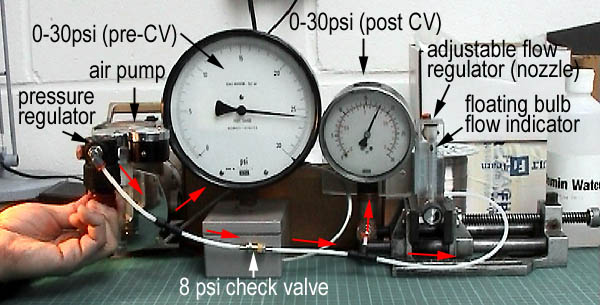
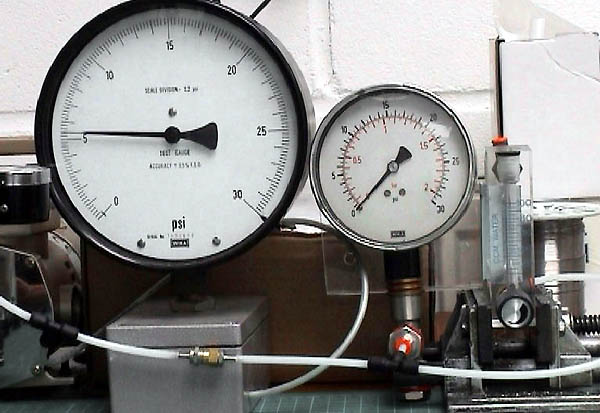
CV pressure drop test set up
Here is the set up of the day to perform the Checkvalve pressure drop test. A video will be available to view or download as soon as I finish rendering it (4MB)
Last edited by Richard L; Sep 5, 2007 at 03:56 PM.