


No knock, ECU pulls timing - why?


Welcome to the world of Open Source. Al, no disrespect intended, there is no doubt you are a great tuner. This issue will not take the open source community 2 years to figure out. I give it a maximum of 2 days before it's public knowledge. So, instead of tooting your own horn, just give up the information, and be a hero instead of a nay sayer.


Originally Posted by AlwaysinBoost
wow that was helpful...
Its something you will figure out, its just something that comes with time and understanding of how different factors affect the car..
The S-AFC comment was a hint if you didn't notice..


Al is talking about putting an SAFC on a car which would trim MAF readings which would indicate a problem with MAF output. I'm not sure we're talking about the same thing because it has never been an issue, only on this particular modified car. I'll try to walk through the scenario so we can all learn and or figure this out.
Out of all the cars that I've seen/dynoed this is the second car that is doing this. The first was a bone stock car that was untouched and unflashed. It would pull random timing all over the place. We've built and tuned high hp flashed cars (500whp) with no issues at all. So if anything, this is an isolated issue to these two particular cars and one of them was untouched.
My timing logging is consistant and you can see the drop in horsepower on the dyno in sync with timing being pulled, so timining is being logged correctly..
This is not related to intake air temps as I watched them vary from 95deg to 140deg and it would not correlate to timing, same with coolant temps.
We eliminated the knock sensor as the culprit as we basically removed it out of the block and had it hanging and isolated. To corect Markus, when we unplugged the knock sensor and it threw the code, then the ECU pulled extra timing (limp mode)
Also for experimentation purposes only, we set the low and high octane maps the same and the timing is still going lower (at random) than the highest load level timing we have specified. Meaning even if it was on the highest load level it should still follow that load line. Unless....
What we know
1. Swaped MAF sensors to make sure nothing in there wasn't goofed (BAP).
2. Not knock sensor related
3. Not Intake temp related
4. Not coolant temp related
5.
What I'm still thinking it could be related to
1. Manifold Pressure diff sensor ?? not likely but I'll look into it.
2. Maf reading. For example we could be on the highest load cells in the map. The O3 goes to 260 on the map but for calculaton purposes the ECU might have an algorithom to remove more timing if the load goes higher than that. The only thing that doesn't make sense is that I've run many cars to way beyond this power level and maxing out the load cells and this has never happened before.
I've got a nice 8 hour drive each way to BeaveRun this weekend (Time trials) so I'll think about this some more.
-Martin
Out of all the cars that I've seen/dynoed this is the second car that is doing this. The first was a bone stock car that was untouched and unflashed. It would pull random timing all over the place. We've built and tuned high hp flashed cars (500whp) with no issues at all. So if anything, this is an isolated issue to these two particular cars and one of them was untouched.
My timing logging is consistant and you can see the drop in horsepower on the dyno in sync with timing being pulled, so timining is being logged correctly..
This is not related to intake air temps as I watched them vary from 95deg to 140deg and it would not correlate to timing, same with coolant temps.
We eliminated the knock sensor as the culprit as we basically removed it out of the block and had it hanging and isolated. To corect Markus, when we unplugged the knock sensor and it threw the code, then the ECU pulled extra timing (limp mode)
Also for experimentation purposes only, we set the low and high octane maps the same and the timing is still going lower (at random) than the highest load level timing we have specified. Meaning even if it was on the highest load level it should still follow that load line. Unless....
What we know
1. Swaped MAF sensors to make sure nothing in there wasn't goofed (BAP).
2. Not knock sensor related
3. Not Intake temp related
4. Not coolant temp related
5.
What I'm still thinking it could be related to
1. Manifold Pressure diff sensor ?? not likely but I'll look into it.
2. Maf reading. For example we could be on the highest load cells in the map. The O3 goes to 260 on the map but for calculaton purposes the ECU might have an algorithom to remove more timing if the load goes higher than that. The only thing that doesn't make sense is that I've run many cars to way beyond this power level and maxing out the load cells and this has never happened before.
I've got a nice 8 hour drive each way to BeaveRun this weekend (Time trials) so I'll think about this some more.
-Martin
If there is a way to get the MAF reading from the sensor during a pull, I'm thinking the reading is way higher, The only reason I suggest this is I can reproduce this on my car by bumping my MAF reading with my blowthrough sensor.. This also makes sense with troublesome intakes you can see unusually high or low readings..
I can clearly see an unusually high reading to be the trigger on my car, +1400hz at 3000-4000rpm is pretty high for that region.. The one thing I forgot to check was to see what the calculated load is..
There are some circumstances where the Baro sensor or AIT sensor could also trigger a weird reading, but both would be a dead giveaway as a OBD Error code..
I can clearly see an unusually high reading to be the trigger on my car, +1400hz at 3000-4000rpm is pretty high for that region.. The one thing I forgot to check was to see what the calculated load is..
There are some circumstances where the Baro sensor or AIT sensor could also trigger a weird reading, but both would be a dead giveaway as a OBD Error code..
If you get a chance, look closer at the MAF size setting in the ECU, I wonder if they may differ on some cars.. same with some of the other compensation settings under the fuel parameters on ECUFlash..

Originally Posted by MalibuJack
If there is a way to get the MAF reading from the sensor during a pull, I'm thinking the reading is way higher, The only reason I suggest this is I can reproduce this on my car by bumping my MAF reading with my blowthrough sensor.. This also makes sense with troublesome intakes you can see unusually high or low readings..
I can clearly see an unusually high reading to be the trigger on my car, +1400hz at 3000-4000rpm is pretty high for that region.. The one thing I forgot to check was to see what the calculated load is..
There are some circumstances where the Baro sensor or AIT sensor could also trigger a weird reading, but both would be a dead giveaway as a OBD Error code..
I can clearly see an unusually high reading to be the trigger on my car, +1400hz at 3000-4000rpm is pretty high for that region.. The one thing I forgot to check was to see what the calculated load is..
There are some circumstances where the Baro sensor or AIT sensor could also trigger a weird reading, but both would be a dead giveaway as a OBD Error code..
Yes there is, through an AFC or another logger option I'm working that will be able to log in real time, timing, knock sensor output, MAF hz, ect.
A good test would be to set your highest load cells to a certain ign adv, and then modify the MAF output by increasing it dramatically and seeing if your timing start dropping below what you have specified in the timing map. Again I've run MAF cars to 500whp without this problem so unless it's something specific to this car and or the calibration file it has I'm not sure this is the solution but we have to try.
Originally Posted by Agent-Smith
It could have to do with the coolent temp?
We've already ruled that out by monitoring the coolant temp. I'm sure if the coolant temp got too high it would start pulling timing but we never saw it get hot. Also it would run low timing even with it was on the cold side (<170 deg)
-Martin

Thread Starter
Evolved Member
iTrader: (17)
Joined: Apr 2004
Posts: 6,224
Likes: 0
From: 41° 59' N, 87° 54' W
Originally Posted by Agent-Smith
It could have to do with the coolent temp?

l8r)
Originally Posted by Agent-Smith
It could have to do with the coolent temp?
The more I look at the knock filter tables, the more they look like frequency discrimination tables, each one representing a different frequency range and each cell representing a threshold for the different load/rpm regions....
I made a connection when I was looking at the different tables and frequency ranges I would see what would sometimes show up as a high knock sensor voltage, but not be interpretted by the ECU as knock..
Anyway back on topic..
I am leaning towards the MAF reading very high for one reason or another (either induced by turbulence or something else) but its hard to know for sure until you can catch it in logs, If you can capture the MAF reading in G/S (or Hz would be better) and calculated Load value in those regions, I do know those values should be relevent enough to give you a little insight.. I'm sure air temp and coolant temp could have a significant affect on how the ECU handles the MAF reading, but nothing you stated previously indicated either of those being unusually high or low.
Originally Posted by AMS
Yes there is, through an AFC or another logger option I'm working that will be able to log in real time, timing, knock sensor output, MAF hz, ect.
A good test would be to set your highest load cells to a certain ign adv, and then modify the MAF output by increasing it dramatically and seeing if your timing start dropping below what you have specified in the timing map. Again I've run MAF cars to 500whp without this problem so unless it's something specific to this car and or the calibration file it has I'm not sure this is the solution but we have to try.
A good test would be to set your highest load cells to a certain ign adv, and then modify the MAF output by increasing it dramatically and seeing if your timing start dropping below what you have specified in the timing map. Again I've run MAF cars to 500whp without this problem so unless it's something specific to this car and or the calibration file it has I'm not sure this is the solution but we have to try.
As an example, if I do the same run, with the same settings, but don't go completely WOT, the symptoms can go away... The two common things are TPS voltage and MAF reading..
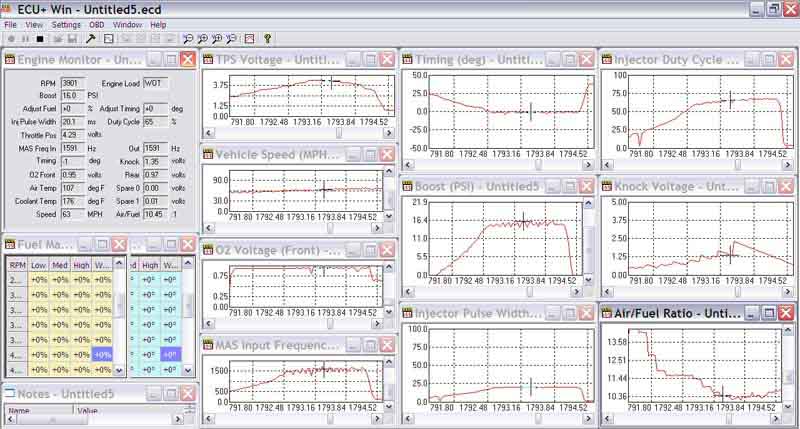
See if anything here looks familiar to you..
The MAF reading was intentionally set 30% higher than stock (at idle it was almost 60hz vs 30hz which is normal)
There was only 1 incident of the knock sensor voltage going over 2.0v, notice it was a fairly warm day (107 degree intake temp, but I was running this temp all day long) but the entire "short run" was done in 4th gear, through about 5500rpm or so.. But notice that everything but ignition timing and MAF reading are fairly normal..


Malibu,
Why is your timing totally flat?
Also, that one big knock event at the end. When it holds like that, I have found that is a real knock event. Usually the little spikes are ok but when the it holds like that it's bad news.
The voltage amount usually isn't a good indicator of knock, but more how long it takes for the spike to dissipate.
Can you post the actual log file?
Why is your timing totally flat?
Also, that one big knock event at the end. When it holds like that, I have found that is a real knock event. Usually the little spikes are ok but when the it holds like that it's bad news.
The voltage amount usually isn't a good indicator of knock, but more how long it takes for the spike to dissipate.
Can you post the actual log file?