


Ecuflash tuning basics......


Originally Posted by bhcevo
My bad. The Karman-Vortex style MAF sensor output is indeed proportional just to the airflow, and not the mass airflow. As you say, the temperature correction is needed to get mass. I take back what I said earlier.
Assume gas mass is still inversely proportional to Temp in a moving airstream. Assume the load tables are normalized say to 300 K (room temp), then the correction takes into account any deviations from 300 K.
Using standard first order error propagation techniques, the percent change in n, or mass airflow, or load, is roughly equal to the percent change in T from 300K. The biggest swings your temps will see are a few tens of kelvin, say 30 K.
So 30 K/ 300 K is 10%. So your load value could be up to 10% off WITHOUT a temp correction. 10% of 240 is 24, which is basically one entire column up or down.
Seems likely that the lack of a temp correction could throw your calculated load off by up to one column no problem. Probably not more than that.
Assume gas mass is still inversely proportional to Temp in a moving airstream. Assume the load tables are normalized say to 300 K (room temp), then the correction takes into account any deviations from 300 K.
Using standard first order error propagation techniques, the percent change in n, or mass airflow, or load, is roughly equal to the percent change in T from 300K. The biggest swings your temps will see are a few tens of kelvin, say 30 K.
So 30 K/ 300 K is 10%. So your load value could be up to 10% off WITHOUT a temp correction. 10% of 240 is 24, which is basically one entire column up or down.
Seems likely that the lack of a temp correction could throw your calculated load off by up to one column no problem. Probably not more than that.
Don't forget barometric pressure.
But, I do agree that the calculations won't be that far off. That's why I came up with the equation to find load in the first place, with the constant of 852.
Obviously, it isn't a constant, but it gets you close....at least close enough to find the correct constant for the baro and temp at time of your own logs.
Eric

Newbie
Joined: Jan 2006
Posts: 66
Likes: 0
Yeah, you could do the same analysis with barometric pressure variations.
A fractional change in baro should give the same fractional change in mass airflow, per the above analysis. Weather related baro variations are quite small compared to altitude related ones. Hmm.
Looks like every 1000ft in elevation increase drops baro by 30mm Hg, where
sea level is nominally 760 mm Hg.
so 30/760 is 4%. So every 1000 feet in elevation increase means you need
to correct your airflow by 4% downwards. 4% is about 10 out of 240, so just about half a load column.
Btw I use your load equation all the time. Its incredibly useful.
I don't log my boost sensor so figuring out any boost changes mid-drive is a pain. However, load is proportional to boost at WOT, everything else being equal. So observing if load changes at WOT I can determine where or if I changed my in-cabin MBC.
A fractional change in baro should give the same fractional change in mass airflow, per the above analysis. Weather related baro variations are quite small compared to altitude related ones. Hmm.
Looks like every 1000ft in elevation increase drops baro by 30mm Hg, where
sea level is nominally 760 mm Hg.
so 30/760 is 4%. So every 1000 feet in elevation increase means you need
to correct your airflow by 4% downwards. 4% is about 10 out of 240, so just about half a load column.
Btw I use your load equation all the time. Its incredibly useful.
I don't log my boost sensor so figuring out any boost changes mid-drive is a pain. However, load is proportional to boost at WOT, everything else being equal. So observing if load changes at WOT I can determine where or if I changed my in-cabin MBC.

Originally Posted by bhcevo
I don't log my boost sensor so figuring out any boost changes mid-drive is a pain. However, load is proportional to boost at WOT, everything else being equal. So observing if load changes at WOT I can determine where or if I changed my in-cabin MBC.
Load is more proportional to mass airflow/revolution, that's why I want someone to find the request to log this with EvoScan. I know I could come up with a near perfect load forumla using the mass airflow/rev.
Eric
Newbie
Joined: Jan 2006
Posts: 66
Likes: 0
Originally Posted by l2r99gst
Load is proportional to boost only if the mass airflow/rev is not dropping, which it most likely is on a stock Evo. Cams, intake manifold, or anything that increases VE will elimnate that to an extent, but you probably already know this.
Load is more proportional to mass airflow/revolution, that's why I want someone to find the request to log this with EvoScan. I know I could come up with a near perfect load forumla using the mass airflow/rev.
Eric
Load is more proportional to mass airflow/revolution, that's why I want someone to find the request to log this with EvoScan. I know I could come up with a near perfect load forumla using the mass airflow/rev.
Eric
However, the whole trace will move up or down with boost. So its useful for determining if you changed boost, and which direction. And if the change was noticeable from an airflow point of view.
For example, lets say I do some pulls and my calc load drop from 220 to 200
across the rpm range. Now I crank on my in-cabin boost controller a bit. How much did I increase boost, if at all? Possible nothing due to mechanical backlash. My apexi electronic boost gauge is near useless because it lacks the resolution at this level, even using the peak memory function.
This is where looking at load becomes useful for me.
Another pull and my load value again goes from 220 to 200. Haha. Boost is effectively the same.
Crank on the in-cabin controller a bit more and pull. Okay, my trace goes from 228 to 206. Yes, my boost went up.
I'm finding that my tune is sensitive to boost changes smaller than my high quality apexi gauge can resolve. So this sort of thing is very useful.
The real solution is an electronic boost sensor that logs boost voltage directly to my laptop...zeitronix or aem or whatever. And a high quality electronic boost controller with memory buttons and stuff so I can just hit a button and go back to "exactly" some previous boost level I tuned for. But in the interim this is what I do.
Newbie
Joined: Jan 2006
Posts: 66
Likes: 0
Originally Posted by vboy425
bhcevo damn bro you're smart.  i was goin gto post a straightforward answer, but nah i like yours.
i was goin gto post a straightforward answer, but nah i like yours.
Originally Posted by bhcevo
Yeah, you could do the same analysis with barometric pressure variations.
A fractional change in baro should give the same fractional change in mass airflow, per the above analysis. Weather related baro variations are quite small compared to altitude related ones. Hmm.
Looks like every 1000ft in elevation increase drops baro by 30mm Hg, where
sea level is nominally 760 mm Hg.
so 30/760 is 4%. So every 1000 feet in elevation increase means you need
to correct your airflow by 4% downwards. 4% is about 10 out of 240, so just about half a load column.
Btw I use your load equation all the time. Its incredibly useful.
I don't log my boost sensor so figuring out any boost changes mid-drive is a pain. However, load is proportional to boost at WOT, everything else being equal. So observing if load changes at WOT I can determine where or if I changed my in-cabin MBC.
A fractional change in baro should give the same fractional change in mass airflow, per the above analysis. Weather related baro variations are quite small compared to altitude related ones. Hmm.
Looks like every 1000ft in elevation increase drops baro by 30mm Hg, where
sea level is nominally 760 mm Hg.
so 30/760 is 4%. So every 1000 feet in elevation increase means you need
to correct your airflow by 4% downwards. 4% is about 10 out of 240, so just about half a load column.
Btw I use your load equation all the time. Its incredibly useful.
I don't log my boost sensor so figuring out any boost changes mid-drive is a pain. However, load is proportional to boost at WOT, everything else being equal. So observing if load changes at WOT I can determine where or if I changed my in-cabin MBC.
You also have to factor in other weather affects. The barometer will be changing due to the weather. Example we had a lot of rain over the last few days here in socal so I didnt even try messing with my car. The closer you tune your car to the edge the more important it is to watch the weather for changes affecting your tune.


A wideband is essential for tuning. You should not be attempting to tune your car without one. Attempts to tune w/out knowing your AFR may prove to be disastrous... In other words, if your tune ends up being way too lean, you probably won't be too worried about your knock count as you're frantically trying to scoop your freshly liberated piston out of your lap... 
l8r)
l8r)

I basically added a little timing and pulled a little fuel at a time for power seen on charted rpm vs time logs. I had no idea what my A:F was, look how rich my A:F is - like down into the 9's!
Look at the dips in torque as the engine is being over vaporized with fuel.
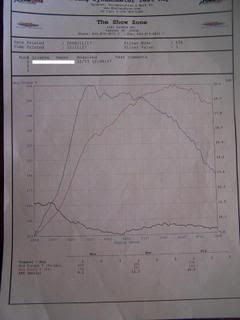 It was so rich with fuel vapor I had to flood it with timing. Even though 305/304 aint bad at all on a dyno that reads less than 210 for stock 8's, what a waste of $120 for 3 pulls.
Since then I probably picked up 35 whp just from purchacing a WB and tuning unblind. I will go again to see the difference once I have some spare change
You need a wideband to tune, it took my stubborn cheap *** 6 months of tuning to realize that.
Last edited by C6C6CH3vo; Mar 2, 2007 at 05:51 AM.


The short answer is would you walk blindfolded through a hallway of razor blades and salt??
What does that mean? Well, if your lucky you can make it through with only a little pain, but the odds are pretty good its gonna hurt BADLY if you make an error..
Short answer.. Its unbelievably unwise to tune blindly.. Just because "The DSM Guys" have been tuning by narrowband O2 voltage for years, doesn't make it right, or safe.. At the least your leaving a huge amount of power on the table that could be tapped if you had the right instrumentation, at worst you will do damage.. Is this the kind of risk worth taking, or is the $200 or so for a proper wideband a good investment?

A dyno also uses a wideband.. Only you don't have to provide your own at most shops.
ECUFlash is a tool for reflashing the ECU, most tuners are using it regardless of how the car gets tuned, whether its on the street or dyno.. If you street tune, then you have to have a unit available to you installed in the car.. On the dyno, most will put one in your tailpipe.
ECUFlash is a tool for reflashing the ECU, most tuners are using it regardless of how the car gets tuned, whether its on the street or dyno.. If you street tune, then you have to have a unit available to you installed in the car.. On the dyno, most will put one in your tailpipe.
A wideband is bare minimum too, you could be filthy rich with too much timing, misfire or knock and the WB reads high from other gases that contain O(-2) from incorrect fuel burn. So eventually a 5 gas on a dyno is needed, and I just found this out myself