


94170008 ROM 2 byte load mod for dummies (like me :)


Actually, LW3 has a better method than that.
Go to Tools->Marker Lines->Channel name in the log window. You will see 2 movable marker lines. Each channel has its own set but only the set of one channel is shown at a time. But their position for each channel is preserved. You can move them to whatever point in the scale by grabbing them with the triangular handle on the right end of the line and moving them up and down.
A shortcut to invoke the marker lines is to click on the channels current value in the measurement pane to the right of the graph pane. Clicking on the empty area below the measurements in the pane switches marker lines off.
As for scales. Using the magnifier tool on the scale of a trace itself allows you to "magnify" the scale of a trace to your liking to see details. You can then move the channel trace or scale up and down with the hand tool.
Another LW3 trick:
To get your log data into for example excel, select the area in the log you want to copy. Select Edit->Copy in the log window. Then open Excel (or whatever, including a text editor) and click on the upper left cell you want the log data to be in. Select Edit->Paste and you are done.
- Klaus
Go to Tools->Marker Lines->Channel name in the log window. You will see 2 movable marker lines. Each channel has its own set but only the set of one channel is shown at a time. But their position for each channel is preserved. You can move them to whatever point in the scale by grabbing them with the triangular handle on the right end of the line and moving them up and down.
A shortcut to invoke the marker lines is to click on the channels current value in the measurement pane to the right of the graph pane. Clicking on the empty area below the measurements in the pane switches marker lines off.
As for scales. Using the magnifier tool on the scale of a trace itself allows you to "magnify" the scale of a trace to your liking to see details. You can then move the channel trace or scale up and down with the hand tool.
Another LW3 trick:
To get your log data into for example excel, select the area in the log you want to copy. Select Edit->Copy in the log window. Then open Excel (or whatever, including a text editor) and click on the upper left cell you want the log data to be in. Select Edit->Paste and you are done.
- Klaus

Newbie
Joined: Jan 2007
Posts: 28
Likes: 0
Re) 2 Byte load. The spikes are an inherent problem with the way 2 Byte values are read. Nothing prevents the ECU from updating the 2 Byte value in between the low and high byte read. There are principally 3 ways to fix that:
1. Change the ECU code so it does not update the value between a for example low and high byte read.
2. In the logger code, throw away sample values that differ by bigger than x amount from the previous sample. Probably the current solution in some loggers. Has the disadvantage that if the value hovers around 0xxxFF, a lot of samples can be thrown away.
3. Change the way 2 Byte values are stored in the ECU from straight binary to grey-code. This has the advantage that resulting errors from non-atomic reads stay small.
- Klaus


I've seen that rich spot near 7000 rpm on another log before, is that intentional? I try to keep mine the same from 5000 on up which is OK I guess
The rich spot at peak happens to me to however, good to see another log with the resolution I'm used to - I was wondering if others had this
The rich spot at peak happens to me to however, good to see another log with the resolution I'm used to - I was wondering if others had this

I've seen that rich spot near 7000 rpm on another log before, is that intentional? I try to keep mine the same from 5000 on up which is OK I guess
The rich spot at peak happens to me to however, good to see another log with the resolution I'm used to - I was wondering if others had this
The rich spot at peak happens to me to however, good to see another log with the resolution I'm used to - I was wondering if others had this
Here is 2 byte load (thanks jscbanks and others)
My dip in AFR is much more pronounced, but notice how it all follows suit with MAF, load, and IPW - IPW and AFR kind of mirror each other too
Finally can see the actual load the ECU uses If you rotate the load 90 deg and superimpose (on scale) to the map I bet you can have a good idea of the trail the ECU used

I also get a log of loadmsb and lsb that I have to hide, is that normal?
Also, am I supposed to have to use the math calc to get 2 byte every log - doesn't do it automatic (I know, stupid question)?
Timing doesnt look so blocky now
My dip in AFR is much more pronounced, but notice how it all follows suit with MAF, load, and IPW - IPW and AFR kind of mirror each other too
Finally can see the actual load the ECU uses
If you rotate the load 90 deg and superimpose (on scale) to the map I bet you can have a good idea of the trail the ECU usedI also get a log of loadmsb and lsb that I have to hide, is that normal?
Also, am I supposed to have to use the math calc to get 2 byte every log - doesn't do it automatic (I know, stupid question)?
Timing doesnt look so blocky now
Last edited by C6C6CH3vo; May 24, 2007 at 10:04 PM.
Originally Posted by C6C6CH3vo
I've seen that rich spot near 7000 rpm on another log before, is that intentional? I try to keep mine the same from 5000 on up which is OK I guess
The rich spot at peak happens to me to however, good to see another log with the resolution I'm used to - I was wondering if others had this
I've seen that rich spot near 7000 rpm on another log before, is that intentional? I try to keep mine the same from 5000 on up which is OK I guess
The rich spot at peak happens to me to however, good to see another log with the resolution I'm used to - I was wondering if others had this
I've always seen the richspot at peak load as fuel compensation caused by load/boost spike. The higher the spike the higher the dip and viceversa.
The day I made that datalog was Hot and very humid and was after my work cummute in stop N go traffic. I have observed that if I get 1-2 counts of knock after 7000 rpm it will get .3-.5richer before timing gets pulled. Target AFR is 11.1-11.0 after 7000rpm . I also have not touched the leanspool, it also could have something to do with it.
I've always seen the richspot at peak load as fuel compensation caused by load/boost spike. The higher the spike the higher the dip and viceversa.
I've always seen the richspot at peak load as fuel compensation caused by load/boost spike. The higher the spike the higher the dip and viceversa.
Newbie
Joined: Jan 2007
Posts: 28
Likes: 0
Hi Jorge T,
Just as a suggestion:
If you have knock counts at ~7000 RPM you are probably over-advanced in the first place in that area. Your VE is on the way down because you are past the torque peak, where mixture density and peak cyl. pressure is highest (therefore highest knock probability).
As a general observation:
Many OEM Turbo cars run very rich at WOT, with the Evo being a good example.
These rich mixtures create less cylinder pressure, burn cooler and result in lower EGTs, but cost power. The reasons OEMs are doing them anyway are threefold:
1. Head cooling. If the head does not have adequate cooling, valves can overheat at sustained high RPM/loads.
2. Plug cooling. The plugs have to also work at low/idle loads. A plug with the correct heat range for sustained high RPM/load would be too cold and load up at idle/cruise.
3. Cat overheat prevention.
The most common reason. Sustained high RPM high load at the AFRs for max power would melt down the cat.
Depending on how your car is used you can possibly get more power by leaning out a little and retarding the timing a little at high RPM. Though this is not recommenended if you run the car in Germany on the Autobahn or track it (road racing). Leaner mixtures burn faster and require less ign. advance. The burn speed of gasoline has a max between 12 and 13 AFR. Leaner or richer causes slower burns and require therefore more advance. But the resulting power output is less if more advance is needed for several reasons. One of which is more "negative" torque from the pressure buildup BTDC.
BTW, contrary to popular belief, EGTs and CHTs max out at stoich (14.7) and fall off steeply when leaner than that. The AFRs with max knock probability for most engines is between 13 and 15.
- Klaus
Just as a suggestion:
If you have knock counts at ~7000 RPM you are probably over-advanced in the first place in that area. Your VE is on the way down because you are past the torque peak, where mixture density and peak cyl. pressure is highest (therefore highest knock probability).
As a general observation:
Many OEM Turbo cars run very rich at WOT, with the Evo being a good example.
These rich mixtures create less cylinder pressure, burn cooler and result in lower EGTs, but cost power. The reasons OEMs are doing them anyway are threefold:
1. Head cooling. If the head does not have adequate cooling, valves can overheat at sustained high RPM/loads.
2. Plug cooling. The plugs have to also work at low/idle loads. A plug with the correct heat range for sustained high RPM/load would be too cold and load up at idle/cruise.
3. Cat overheat prevention.
The most common reason. Sustained high RPM high load at the AFRs for max power would melt down the cat.
Depending on how your car is used you can possibly get more power by leaning out a little and retarding the timing a little at high RPM. Though this is not recommenended if you run the car in Germany on the Autobahn or track it (road racing). Leaner mixtures burn faster and require less ign. advance. The burn speed of gasoline has a max between 12 and 13 AFR. Leaner or richer causes slower burns and require therefore more advance. But the resulting power output is less if more advance is needed for several reasons. One of which is more "negative" torque from the pressure buildup BTDC.
BTW, contrary to popular belief, EGTs and CHTs max out at stoich (14.7) and fall off steeply when leaner than that. The AFRs with max knock probability for most engines is between 13 and 15.
- Klaus

How many of you are actually seeing a noteworthy difference between the 1 byte and 2 byte loads? Mine appear to be soo close that it doesn't really matter which one I look at.
As for AFR tuning ..... I actually like the lean spool as it does work and I see no knock even though my AFR is 12.X:1 through 4000 rpm. I like the fairly lean peak torque and fatter (10.8:1) topend.
As for AFR tuning ..... I actually like the lean spool as it does work and I see no knock even though my AFR is 12.X:1 through 4000 rpm. I like the fairly lean peak torque and fatter (10.8:1) topend.

EvoM Guru
iTrader: (50)
Joined: Mar 2006
Posts: 9,675
Likes: 132
From: Tri-Cities, WA // Portland, OR
How many of you are actually seeing a noteworthy difference between the 1 byte and 2 byte loads? Mine appear to be soo close that it doesn't really matter which one I look at.
As for AFR tuning ..... I actually like the lean spool as it does work and I see no knock even though my AFR is 12.X:1 through 4000 rpm. I like the fairly lean peak torque and fatter (10.8:1) topend.
As for AFR tuning ..... I actually like the lean spool as it does work and I see no knock even though my AFR is 12.X:1 through 4000 rpm. I like the fairly lean peak torque and fatter (10.8:1) topend.
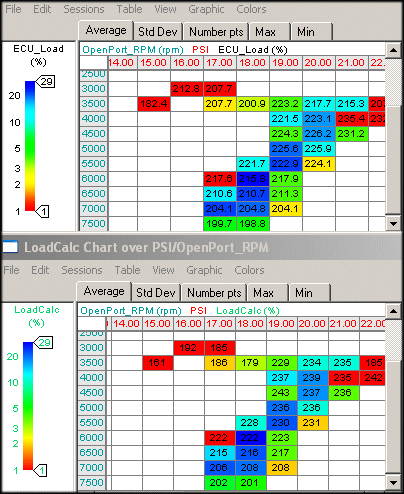
The big difference is knowing your on target with map changes, one column off on a cell is (load calc) devestating to accuracy imo. I'm just impressed with how close Jack's math was with the actual load
Hi Jorge T,
Just as a suggestion:
If you have knock counts at ~7000 RPM you are probably over-advanced in the first place in that area. Your VE is on the way down because you are past the torque peak, where mixture density and peak cyl. pressure is highest (therefore highest knock probability).
As a general observation:
Many OEM Turbo cars run very rich at WOT, with the Evo being a good example.
These rich mixtures create less cylinder pressure, burn cooler and result in lower EGTs, but cost power. The reasons OEMs are doing them anyway are threefold:
1. Head cooling. If the head does not have adequate cooling, valves can overheat at sustained high RPM/loads.
2. Plug cooling. The plugs have to also work at low/idle loads. A plug with the correct heat range for sustained high RPM/load would be too cold and load up at idle/cruise.
3. Cat overheat prevention.
The most common reason. Sustained high RPM high load at the AFRs for max power would melt down the cat.
Depending on how your car is used you can possibly get more power by leaning out a little and retarding the timing a little at high RPM. Though this is not recommenended if you run the car in Germany on the Autobahn or track it (road racing). Leaner mixtures burn faster and require less ign. advance. The burn speed of gasoline has a max between 12 and 13 AFR. Leaner or richer causes slower burns and require therefore more advance. But the resulting power output is less if more advance is needed for several reasons. One of which is more "negative" torque from the pressure buildup BTDC.
BTW, contrary to popular belief, EGTs and CHTs max out at stoich (14.7) and fall off steeply when leaner than that. The AFRs with max knock probability for most engines is between 13 and 15.
- Klaus
Just as a suggestion:
If you have knock counts at ~7000 RPM you are probably over-advanced in the first place in that area. Your VE is on the way down because you are past the torque peak, where mixture density and peak cyl. pressure is highest (therefore highest knock probability).
As a general observation:
Many OEM Turbo cars run very rich at WOT, with the Evo being a good example.
These rich mixtures create less cylinder pressure, burn cooler and result in lower EGTs, but cost power. The reasons OEMs are doing them anyway are threefold:
1. Head cooling. If the head does not have adequate cooling, valves can overheat at sustained high RPM/loads.
2. Plug cooling. The plugs have to also work at low/idle loads. A plug with the correct heat range for sustained high RPM/load would be too cold and load up at idle/cruise.
3. Cat overheat prevention.
The most common reason. Sustained high RPM high load at the AFRs for max power would melt down the cat.
Depending on how your car is used you can possibly get more power by leaning out a little and retarding the timing a little at high RPM. Though this is not recommenended if you run the car in Germany on the Autobahn or track it (road racing). Leaner mixtures burn faster and require less ign. advance. The burn speed of gasoline has a max between 12 and 13 AFR. Leaner or richer causes slower burns and require therefore more advance. But the resulting power output is less if more advance is needed for several reasons. One of which is more "negative" torque from the pressure buildup BTDC.
BTW, contrary to popular belief, EGTs and CHTs max out at stoich (14.7) and fall off steeply when leaner than that. The AFRs with max knock probability for most engines is between 13 and 15.
- Klaus