


Timing : Fuel?


Account Disabled
Joined: Nov 2006
Posts: 174
Likes: 0
From: Akron, Ohio
Info on water/meth injection
Hi guys,
Mabey a month ago I posted up some information about my tuning strategey and injection in the below hyperlinked thread.
https://www.evolutionm.net/forums/sh...=269658&page=2
If you have any questiosn just let me know!
C6, I have read a lot of your post, Keep it up man! You have a good grasp on things, and are an asset to the community. I have a hard time finding time to post since im always busy with customer cars, but should be on a bit more since I just got my Vendor Status!
Mabey a month ago I posted up some information about my tuning strategey and injection in the below hyperlinked thread.
https://www.evolutionm.net/forums/sh...=269658&page=2
If you have any questiosn just let me know!
C6, I have read a lot of your post, Keep it up man! You have a good grasp on things, and are an asset to the community. I have a hard time finding time to post since im always busy with customer cars, but should be on a bit more since I just got my Vendor Status!
Last edited by DeiPro; Jul 24, 2007 at 02:12 PM.
Account Disabled
Joined: Nov 2006
Posts: 174
Likes: 0
From: Akron, Ohio
Injection information
* I just pulled this from another thread I posted it in. Take a look!
The Direct link to the thread is in my post above.
Personally I like to run a water/methanol mixture, with a bit more water than methanol, like a 60% 40% mixture.
There are really two approaches to injection as far as tuning goes as I see it. But before I describe them, I would like to take a chance to talk about injection in general, as some people know a lot about it and some do not.
It all goes back the the principle that we only use 1 part fuel for 14.7 parts air during combustion. If there is less air than 14.7 part per 1 part fuel, we have a rich condition. Not all of this extra fuel will be burned during combustion. It is use to control combustion temperatures and hence cool the mixture. The more fuel you add past where the engine makes the most power between 12:1 and 13:1, the slower the flame propagation speed becomes.
-- Latent Heat of Vaporization is a term used to describe how much heat energy per unit mass it take to take that unit of mass from a liquid to a vapor state.
Basically, this says that it takes a certain amount of energy (heat) to make a liquid turn to a gas.
For those confused by the units, dont worry about it, and just look at the numbers that I am about to list. I am a mech. engineer and I like SI units instead of english, but again, dont worry about the units.
For XXXXX it takes xxxxx amount of heat energy to change this mass from water to liquid.
Gasoline..........350 KJ/Kg
Alcohol............896 KJ/Kg
Ethanol...........904 KJ/Kg
Methanol........1109 KJ/Kg
Water.............2257 KJ/Kg
As you can see, gasoline takes the least amount of heat energy to do this. The more heat it takes, the more cooling effect.
The Primary Reason that we inject our car is for cooling, no matter whether we inject alcohol or methanol (both of which are fuels). It is a common misconception to think that the primary reason we inject our car is for the added "octane". While this does happen, only a small percent of what is injected actually boosts the octane rating of the total mixture in the cylinder (I have heard that it is somewhere around 15%). Again, the reason is to help keep combustion temps under control.
So now back to the tuning approaches with injection.
Note: It is assumed that timing is being adjusted to MBT for all of the following strategies.
1) One can argue that because we are injecting a fluid that cools the combustion process much better than the excess gas we are throwing in, why not just take away some gas since it is no longer needed for cooling.
This is a good strategy. One important thing to remember though is that an engine will make about the same amount of power within a pretty big range of AFR's, but once outside of this window, the power will drop off quickly.
Since an engine makes the best power between 12:1 and 13:1 AFR, with this method, you can lean the car out to somewhere between the two. When following this method, I typically shoot for an AFR near 12.2:1. Then ignition can be advanced to MBT.
........ But what happens if a pump fails, or we run out of spray?
We will be running much to lean for the amount of ignition advance we are using, which will pretty much cause instant irregular combustion, aka knock, detonation etc. Not Good. What we need is a fail safe. There are many forms, some of which will alert you that there is a problem with the system, and some that can alter to fuel and ignition maps back to an acceptable level for running with out injection. Clearly this depends on what ecu you are using and is not the case with the factory Ecu currently (mabey the ecu gurus will help this to happen some time ).
2) The other approach I consider good is running the same AFR you would tune to without injection and adjusting the timing to MBT with the spray on.
This will allow for quite a bit more timing advance (higher than strategie #1 typically), but again if something with the system fails, you will still be running way to much timing for the AFR without injection. Again I encourage a fail safe.
-- Which is better?
Well, I think it really depends on the cars set up, purpose, and mods. With a pump gas street car, with moderate modifications, I would probably go with #2, running a Target AFR from right before peak torque to redline of about 11.5:1 and advance timing to MBT. But then again it depends.
Remember that injection does a very good job of suppressing detonation, and can allow you to run much more aggressive fuel and ignition. It is an excellent way to get more power out of your setup and is a relatively inexpensive mod, but it is important to be careful as always! Remember to check those reservoirs!
The Direct link to the thread is in my post above.
Personally I like to run a water/methanol mixture, with a bit more water than methanol, like a 60% 40% mixture.
There are really two approaches to injection as far as tuning goes as I see it. But before I describe them, I would like to take a chance to talk about injection in general, as some people know a lot about it and some do not.
It all goes back the the principle that we only use 1 part fuel for 14.7 parts air during combustion. If there is less air than 14.7 part per 1 part fuel, we have a rich condition. Not all of this extra fuel will be burned during combustion. It is use to control combustion temperatures and hence cool the mixture. The more fuel you add past where the engine makes the most power between 12:1 and 13:1, the slower the flame propagation speed becomes.
-- Latent Heat of Vaporization is a term used to describe how much heat energy per unit mass it take to take that unit of mass from a liquid to a vapor state.
Basically, this says that it takes a certain amount of energy (heat) to make a liquid turn to a gas.
For those confused by the units, dont worry about it, and just look at the numbers that I am about to list. I am a mech. engineer and I like SI units instead of english, but again, dont worry about the units.
For XXXXX it takes xxxxx amount of heat energy to change this mass from water to liquid.
Gasoline..........350 KJ/Kg
Alcohol............896 KJ/Kg
Ethanol...........904 KJ/Kg
Methanol........1109 KJ/Kg
Water.............2257 KJ/Kg
As you can see, gasoline takes the least amount of heat energy to do this. The more heat it takes, the more cooling effect.
The Primary Reason that we inject our car is for cooling, no matter whether we inject alcohol or methanol (both of which are fuels). It is a common misconception to think that the primary reason we inject our car is for the added "octane". While this does happen, only a small percent of what is injected actually boosts the octane rating of the total mixture in the cylinder (I have heard that it is somewhere around 15%). Again, the reason is to help keep combustion temps under control.
So now back to the tuning approaches with injection.
Note: It is assumed that timing is being adjusted to MBT for all of the following strategies.
1) One can argue that because we are injecting a fluid that cools the combustion process much better than the excess gas we are throwing in, why not just take away some gas since it is no longer needed for cooling.
This is a good strategy. One important thing to remember though is that an engine will make about the same amount of power within a pretty big range of AFR's, but once outside of this window, the power will drop off quickly.
Since an engine makes the best power between 12:1 and 13:1 AFR, with this method, you can lean the car out to somewhere between the two. When following this method, I typically shoot for an AFR near 12.2:1. Then ignition can be advanced to MBT.
........ But what happens if a pump fails, or we run out of spray?
We will be running much to lean for the amount of ignition advance we are using, which will pretty much cause instant irregular combustion, aka knock, detonation etc. Not Good. What we need is a fail safe. There are many forms, some of which will alert you that there is a problem with the system, and some that can alter to fuel and ignition maps back to an acceptable level for running with out injection. Clearly this depends on what ecu you are using and is not the case with the factory Ecu currently (mabey the ecu gurus will help this to happen some time ).
2) The other approach I consider good is running the same AFR you would tune to without injection and adjusting the timing to MBT with the spray on.
This will allow for quite a bit more timing advance (higher than strategie #1 typically), but again if something with the system fails, you will still be running way to much timing for the AFR without injection. Again I encourage a fail safe.
-- Which is better?
Well, I think it really depends on the cars set up, purpose, and mods. With a pump gas street car, with moderate modifications, I would probably go with #2, running a Target AFR from right before peak torque to redline of about 11.5:1 and advance timing to MBT. But then again it depends.
Remember that injection does a very good job of suppressing detonation, and can allow you to run much more aggressive fuel and ignition. It is an excellent way to get more power out of your setup and is a relatively inexpensive mod, but it is important to be careful as always! Remember to check those reservoirs!

I disagree that under load you only need 1 part of fuel to 14.7 parts of air. That would be ***-u-me (drop the e add ing) that you have a perfect homogeneous mixture. Same as the massless frictionless pulley, it isn't going to happen. If you run that lean its very hard to light off the mixture properly and you get lean misfires (or at least my car does). Over the years I've learned to listen to the noise the motor makes under load and you can tell what AFR it likes to run at. Most 4 valve per cylinder motors like it in the 12's. They sound nice and tinny on the top end that way, detonation is low, and timing needed is low (which is good). Once you drop into the 11's it starts to sound fat and blubbery. In the 10's and it feels like its choking and sometimes you start to get misfires again but since the engine is so blubber its harder to feel than the brick wall style explosions of a lean misfire.


I see some ppl running less timing with a leaner A/F and others that like to run more timing with more fuel. Both claim good results.
My main question is: Where is that balance between timing and fuel?
What is the optimum choice? Is it whatever works for your car? Personal preference?
My main question is: Where is that balance between timing and fuel?
What is the optimum choice? Is it whatever works for your car? Personal preference?
It's what your car likes better, man. Start logging and you will see.
Tune for safe AFR's and tweak timing for what it likes.
And pay less attention to crazy ideas and "i do this and this and it works, so do the same" type advices.
I searched for this pulley on ebay and couldn't find it
Another reason I enjoy 0.85 O2 - it sounds so much better, makes an over rich tractor sounding evo scream like an indy car
Another reason I enjoy 0.85 O2 - it sounds so much better, makes an over rich tractor sounding evo scream like an indy car
The sound I go for is what the incar of a NASCAR sounds like on the straightaway. I started associating that sound with my better timeslips and made the connection that things were working in harmony. You can just feel it when you slam into third and that sound comes in that your going to go for a sweet ride.
I would guess NASCAR runs a decent tune considering the fuel conservation needed to win furthermore remote 5 gas bench technology. Weird thing is when I watched some of the ALMS cars, particularily the ferrari's an panoz's, and on practice runs, they sounded crappy, like they were rich or something. They also didn't fare to well against the porshes. But this was just one experience and the teams themselves I believe don't mess with the tune - but maybe during practice


surely dyno results would be a better indicator of tune rather than sound coming out the exhaust?!?!
Today, on my stock (3" exhaust + EBC only) IX, I noticed I was in the high 12's for 3-4krpm @ 200+ load...
I was a bit shocked at the lean-ness of those figures!
Today, on my stock (3" exhaust + EBC only) IX, I noticed I was in the high 12's for 3-4krpm @ 200+ load...
I was a bit shocked at the lean-ness of those figures!
Clearly the dyno will show where you stand. Last winter before I knew much (not saying I know much now - just more) and before my car was wideband equipped I put it on a Mustang Dyno to see the AFR for the methanol injection.
It was as rich 10.1 -1 even 9.8-1!
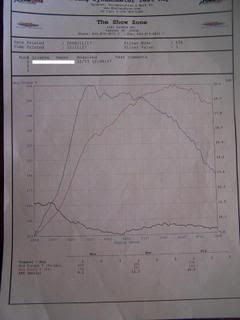
Filthy rich, I only managed 305 wtq/304whp on a Mustang Dyno (stock VIII's run 220), but my timing was 9* peak and like 23 peak at 25 psi. Also, as a significant point I will soon point out, time splits for 4000 rpm to 6000 rpm with 3rd gear runs were about 2.3 seconds (with VIII 5 speed and 245/45/R17 tires).
Now to try to make a point, currently peak timing may land on 3* peak, 11* just after 6000 rpm, and no more than 19* redline. This is with AFR 12.7 to 12.0, and boost 28 psi, but my times have been over 0.3 seconds faster now in the 90+F summer compared to the 2.3 seconds last fall 40 degrees colder.
I will dyno again this fall, there has got to be at least over 45whp gained there I hope
 . But watch it be lower with my luck
 but naah
Just wanted to share my experience wether it matters or not, honestly though - I'm one satisfied evo owner but I wasn't before.
I think I posted over my share for this thread, later
Last edited by C6C6CH3vo; Jul 25, 2007 at 06:35 AM.
Less is more. Less timing less fuel.
Three years ago I was "dyno" tuned. With 11.0-11.5 AFR I managed 314whp and 320tq knock limited at 28psi. At the track this yeilded 12.9's at 111mph.
Later that year I leaned it out to 12.6 AFR and kept the boost and timing the same. I got to 12.3 at 124mph. The next season (last year) with more tuning and the same exact setup minus 50lbs of weight in the car I reduced the timing advance and ran consistent mid 11's at 130 with my best pass being 11.5 at 130mph.
This year I built the motor and ran 12.0 at 122 on the 14b with 12.4 AFR, 4 degrees timing at peak torque and 10 degrees at 6K rpm (where I shift on the small turbo). I have yet to make any numbers on my 50 trim turbo because so far I've bent an axle and the cam angle sensor can't keep up with engine speed causing horrible misfires (the RPM graph is now all spikey and pointy where before it was smooth when I was only runnin 130mph traps).
EDIT: this was on my 1g fwd dsm
Three years ago I was "dyno" tuned. With 11.0-11.5 AFR I managed 314whp and 320tq knock limited at 28psi. At the track this yeilded 12.9's at 111mph.
Later that year I leaned it out to 12.6 AFR and kept the boost and timing the same. I got to 12.3 at 124mph. The next season (last year) with more tuning and the same exact setup minus 50lbs of weight in the car I reduced the timing advance and ran consistent mid 11's at 130 with my best pass being 11.5 at 130mph.
This year I built the motor and ran 12.0 at 122 on the 14b with 12.4 AFR, 4 degrees timing at peak torque and 10 degrees at 6K rpm (where I shift on the small turbo). I have yet to make any numbers on my 50 trim turbo because so far I've bent an axle and the cam angle sensor can't keep up with engine speed causing horrible misfires (the RPM graph is now all spikey and pointy where before it was smooth when I was only runnin 130mph traps).
EDIT: this was on my 1g fwd dsm


You guys with less timing and higher AFR's, is this something I should try to aim for if I autocross the car also? I do like the fact that it consumes less fuel with leaner AFRs.

My friend has a stroker borg werner Evo 8 with 12.0 AFR's and moderate timing and he's happy with it for autocrossing. Our autocrosses last at least 60 seconds and go into 80 seconds for extended course days. I've never lapped an evo but many normally aspirated cars are consistent performers running the same type of AFR's. I would run half an AFR richer for extended lapping just due to the possibility of a sensor or fueling failure so running 12.0 with conservative timing would work great IMO. Running richer than needed means more fuel that has to be burnt which means more heat. Even if it is burning in the exhaust manifold (where it doesn't make power) that is still heat the engine bay has to deal with.

I've personally found that peak power on my car is attained by spooling lean starting out at 12.5:1 @ 3000 richening to 11.5:1 at full spool (max 2byte load) 4* timing, and then gradually richening to 11.1 at redline (7800 in my car) @ 15* timing. Any less fuel up top and power decreases and so does the knock threshhold.