


Well set-up ECU-controlled boost


Thread Starter


Joined: Aug 2003
Posts: 14,094
Likes: 1,093
From: Mid-Hudson, NY
For the activation/deactivation I use:
ecunumber.xml:
<table name="Wastegate Solenoid Re/De-Activation RPM" address="1668" level="1" scaling="RPMStatLimit">
<table name="Condition" elements="4"/>
</table>
base.xml:
<table name="Wastegate Solenoid Re/De-Activation RPM" category="Turbo" type="2D" level="1" scaling="RPMStatLimit">
<table name="Condition" type="Static Y Axis" elements="4">
<data>Reactivate On</data>
<data>Reactivate Off</data>
<data>Deactivate On</data>
<data>Deactivate Off</data>
</table>
</table>
Thread Starter
Joined: Aug 2003
Posts: 14,094
Likes: 1,093
From: Mid-Hudson, NY
I just ran into the same issue. I've got the four activation/deactivation variables defined in four boxes, and three of them don't have any data in them to edit. Here's the definitions (88590015 ROM):
<table name="Wastegate Solenoid Activation RPM-Active" address="1668"/>
<table name="Wastegate Solenoid Activation RPM-De-activate" address="166a"/>
<table name="Wastegate Solenoid De-activation RPM-De-activate" address="166c"/>
<table name="Wastegate Solenoid De-activation RPM-Re-activate" address="166e"/>
<table name="Wastegate Solenoid Activation RPM-Active" address="1668"/>
<table name="Wastegate Solenoid Activation RPM-De-activate" address="166a"/>
<table name="Wastegate Solenoid De-activation RPM-De-activate" address="166c"/>
<table name="Wastegate Solenoid De-activation RPM-Re-activate" address="166e"/>

Thread Starter
Joined: Aug 2003
Posts: 14,094
Likes: 1,093
From: Mid-Hudson, NY
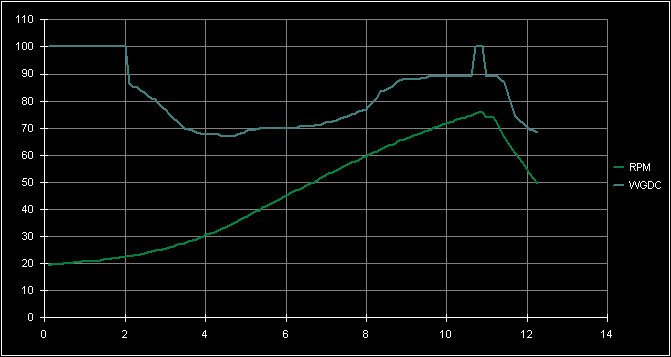
If you are running a 3port or something that allows more boost up top, sometimes you end up running less than 100% WGDC at 7,000-7,600 rpm. If you keep the deactivate at 7500 then the WGDC jumps from whatever % you have at 7k to 100% WGDC. Setting it to 8000 rpm this will not happen.
here is an example:

I meant to post this awhile ago but it had slipped through the cracks. I wanted to post this so others can see how to maximize the stock turbo on a Evo 9.
The current 91 oct Evo 9 stock turbo record holder on our mustang dyno is making 339whp. To put this number in perspective, most Evo 9's with a upgraded FPgreen turbo do not hit this number on 91 octane. (usually around 325-350whp for a FPgreen)
The key to this great power is not only a great mod list and well ported bits but it is also the well thought out boost control system on the car.
This Evo is running this system for boost control:
Forced Performance 18psi upgraded actuator
GM 3-port Boost solenoid
Ecu-controlled boost
Which makes this boost plot possible:
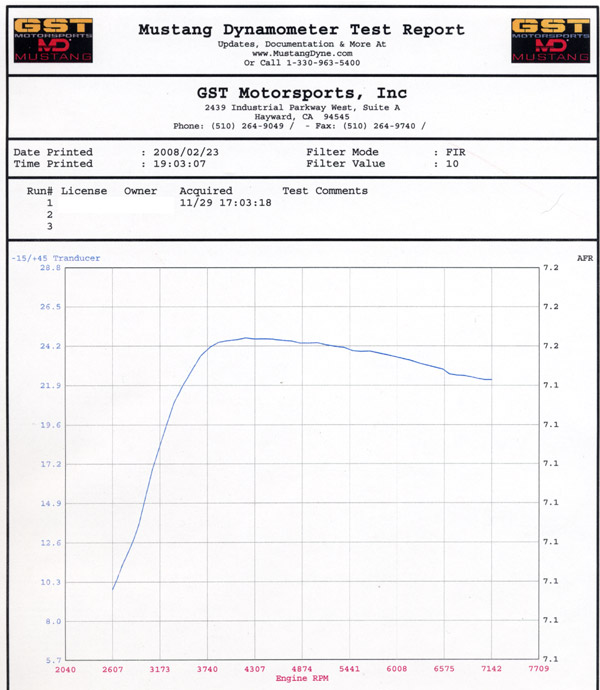
Notice it is still over 22psi at 7100rpm. This is also not maxed out as on 100oct it held about 1.5psi more. Without the FP actuator, the ported bits, and stock solenoid instead of the GM 3 port, I usually see max of 20psi at 7k.
The following full mod list for this Evo where all planned out for maximum efficiency with the stock turbo. This allows for the slightly elevated boost levels on 91 oct pump gas with no traces of knock and 100% consistency.
Mods:
WORKS throttle body
3" Turboback exhaust with TP
Cosworth 272 IX cams
HKS exhaust adjustable cam gear
SAMCO IC hoses
Nisei LICP
Denso 720cc Injectors
GM solenoid
Perrin FMIC
Hyperforce System
GST open air filter
Titek tubular 02 housing
Ported stock exhaust manifold
Ported and coated hotside
ARP head studs
FP actuator
Stock evo 9 turbo
The current 91 oct Evo 9 stock turbo record holder on our mustang dyno is making 339whp. To put this number in perspective, most Evo 9's with a upgraded FPgreen turbo do not hit this number on 91 octane. (usually around 325-350whp for a FPgreen)
The key to this great power is not only a great mod list and well ported bits but it is also the well thought out boost control system on the car.
This Evo is running this system for boost control:
Forced Performance 18psi upgraded actuator
GM 3-port Boost solenoid
Ecu-controlled boost
Which makes this boost plot possible:
Notice it is still over 22psi at 7100rpm. This is also not maxed out as on 100oct it held about 1.5psi more. Without the FP actuator, the ported bits, and stock solenoid instead of the GM 3 port, I usually see max of 20psi at 7k.
The following full mod list for this Evo where all planned out for maximum efficiency with the stock turbo. This allows for the slightly elevated boost levels on 91 oct pump gas with no traces of knock and 100% consistency.
Mods:
WORKS throttle body
3" Turboback exhaust with TP
Cosworth 272 IX cams
HKS exhaust adjustable cam gear
SAMCO IC hoses
Nisei LICP
Denso 720cc Injectors
GM solenoid
Perrin FMIC
Hyperforce System
GST open air filter
Titek tubular 02 housing
Ported stock exhaust manifold
Ported and coated hotside
ARP head studs
FP actuator
Stock evo 9 turbo
Thread Starter
Joined: Aug 2003
Posts: 14,094
Likes: 1,093
From: Mid-Hudson, NY


You probably are aware of this but one thing to keep in mind with most garden-variety EGTs probes is that they've got a quite a bit of thermal mass, which causes two things to happen. One is that there is sensor lag.
The second, and probably more diabolical, is that the metal around the probe soaks up a bunch of the heat and prevents it from reaching the sensing element. This makes the displayed temperature read lower than actual, unless you heatsoak the sensor.
On the occasions where you have a car with an EGT sensor, do you run several back-to-back dyno pulls in quick succession to give the probe a chance to stabilize? What peak EGTs do you see with the kind of boost and timing we're talking about?

There are sensors out there that are designed to work right. I just don't know if any are available that are designed specifically for cars. We use fast responding stuff that gets installed in thermowells all the time at the nuke plant. The thermowell helps to transfer the actual sample temperature and isolate the sensor from the heat mass of the piping. Problem is, the sensors are a couple of thousand dollars each. You might be able to find turbine inlet temperature sensors (they're thermocouples) that are designed for measuring the temperature just after the combustion chamber on gas turbines (jet engines). Those are pretty responsive.
Engine electronics are the bottom of the barrel when it comes to instrumentation.
Anyway, did some more tuning, fixed my overboost on spool problem, now I'm getting oscillations. 6th gear, starting around 2500 RPM, floor it and let boost reach steady state, then I start seeing oscillations, about 2-3 psi up and down. I can think of three ways to fix this:
1) Increase the WGDC correction interval (mine's at 1) to slow down the response time and damp out the oscillations.
2) Decrease the slope of the TBEC table.
3) Zero out the first +0.4 and -0.4 cells in the TBEC table to give it a wider deadband.
I chose #3, but the test will have to wait until tomorrow. I'll let you know how it goes.
Engine electronics are the bottom of the barrel when it comes to instrumentation.
Anyway, did some more tuning, fixed my overboost on spool problem, now I'm getting oscillations. 6th gear, starting around 2500 RPM, floor it and let boost reach steady state, then I start seeing oscillations, about 2-3 psi up and down. I can think of three ways to fix this:
1) Increase the WGDC correction interval (mine's at 1) to slow down the response time and damp out the oscillations.
2) Decrease the slope of the TBEC table.
3) Zero out the first +0.4 and -0.4 cells in the TBEC table to give it a wider deadband.
I chose #3, but the test will have to wait until tomorrow. I'll let you know how it goes.

Thread Starter
Joined: Aug 2003
Posts: 14,094
Likes: 1,093
From: Mid-Hudson, NY
There are sensors out there that are designed to work right. I just don't know if any are available that are designed specifically for cars. We use fast responding stuff that gets installed in thermowells all the time at the nuke plant. The thermowell helps to transfer the actual sample temperature and isolate the sensor from the heat mass of the piping. Problem is, the sensors are a couple of thousand dollars each. You might be able to find turbine inlet temperature sensors (they're thermocouples) that are designed for measuring the temperature just after the combustion chamber on gas turbines (jet engines). Those are pretty responsive.
Engine electronics are the bottom of the barrel when it comes to instrumentation.
Anyway, did some more tuning, fixed my overboost on spool problem, now I'm getting oscillations. 6th gear, starting around 2500 RPM, floor it and let boost reach steady state, then I start seeing oscillations, about 2-3 psi up and down. I can think of three ways to fix this:
1) Increase the WGDC correction interval (mine's at 1) to slow down the response time and damp out the oscillations.
2) Decrease the slope of the TBEC table.
3) Zero out the first +0.4 and -0.4 cells in the TBEC table to give it a wider deadband.
I chose #3, but the test will have to wait until tomorrow. I'll let you know how it goes.
Engine electronics are the bottom of the barrel when it comes to instrumentation.
Anyway, did some more tuning, fixed my overboost on spool problem, now I'm getting oscillations. 6th gear, starting around 2500 RPM, floor it and let boost reach steady state, then I start seeing oscillations, about 2-3 psi up and down. I can think of three ways to fix this:
1) Increase the WGDC correction interval (mine's at 1) to slow down the response time and damp out the oscillations.
2) Decrease the slope of the TBEC table.
3) Zero out the first +0.4 and -0.4 cells in the TBEC table to give it a wider deadband.
I chose #3, but the test will have to wait until tomorrow. I'll let you know how it goes.
Also does your target load closely match the load you are seeing in 6th?

Razor-
How far are you from San Luis Obispo? I would like for you to run my car on your dyno and get my ecu controlled boost set-up. I will be out that way sometime in mid May coming through from San Diego
How far are you from San Luis Obispo? I would like for you to run my car on your dyno and get my ecu controlled boost set-up. I will be out that way sometime in mid May coming through from San Diego

I'm running Mr. Fred's psi target boost control. It actually works really well. I'm shooting for 22.5 psi, and it's oscillating from about 21-24. I logged on the way into work this morning. It looks like zeroing out the +/-0.4 helped a little, but its still not perfect. I guess I'll try increasing the correction interval.

My humble reply to your question if I may, retarded timing increases egt (turbine inlet) but decreases head temps. 91 octane does not directly burn any hotter than higher oct gas, it just lowers knock limit and knock itself is the reason for higher temps.
Sometimes escalating EGTs can put the engine into a death spiral where high coolant temps make the engine more knock-prone, so the ECU retards the timing, EGTs climb, which sends coolant temps even higher, causing more retard, and so on until the thing overheats (SR20s in particular are known for this).
Retarding timing even in the absence of knock increases EGT two ways: one, it puts more of the "meat" of the combustion event later in the cycle (i.e. the exhaust stroke), which increases EGT in a direct fashion.
There's also an indirect way that retarded timing affects EGT--by operating so far from MBT timing, the engine's thermal efficiency is reduced. With less of the total combustion energy going into useful work, there's that much more energy (heat) remaining the exhaust gases when the expansion stroke ends.
Sorry for going OT...