


Hot air causing knock?


Interesting. Touring bubble, I think your seeing increased load in summer because your increasing load in the summer by running more WGDC to correct boost level. I'm actually still not running some of the newer boost control mods (averaging, or load patch) and I def see lower boost in warmer temps and that equates to lower load in warmer temps.
Does that make sense?
Another example: MBC, set at 21psi at 90*, will be 23-24psi at 50*.
Does that make sense?
Another example: MBC, set at 21psi at 90*, will be 23-24psi at 50*.
Last edited by Mr. Evo IX; Jun 15, 2008 at 08:02 AM.

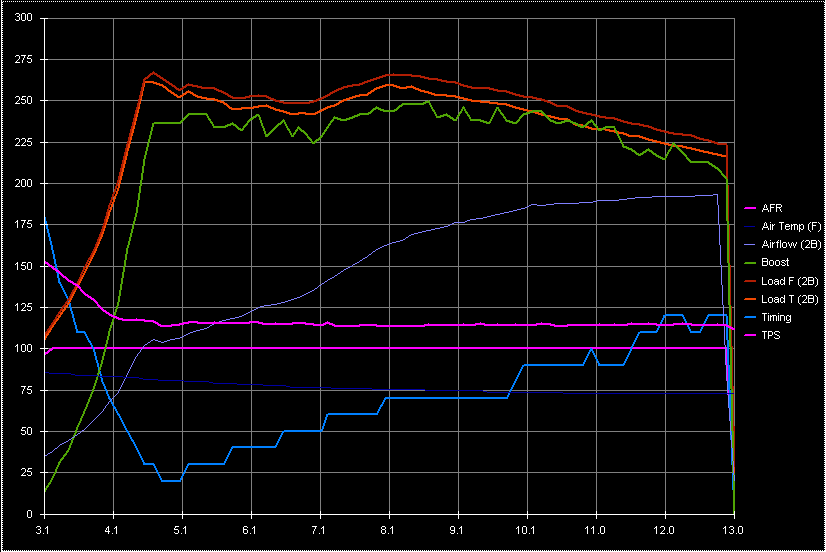
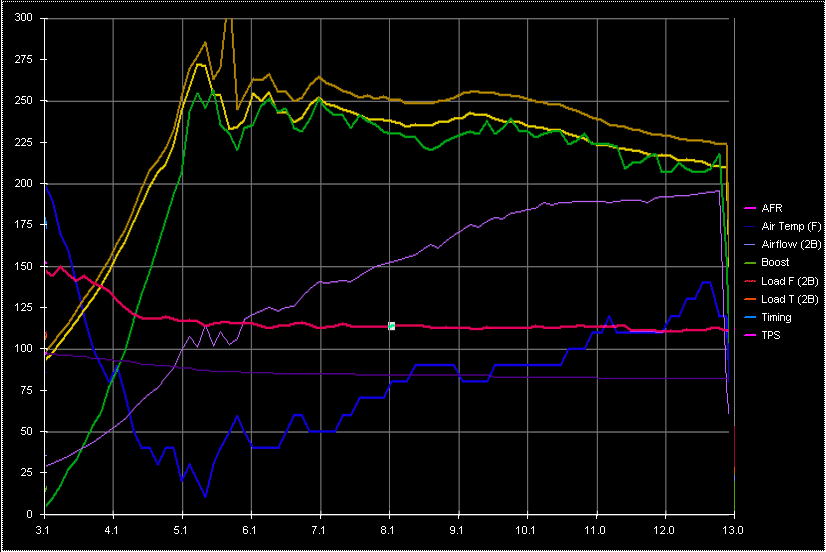
I'm logging 2 different 2-byte loads ... one is corrected (timing) and one isn't (fuel). The fuel load is about the same as winter and the timing load is a bit higher ...
You know .. let me put some graph together just to make sure I'm not making this up ...
You know .. let me put some graph together just to make sure I'm not making this up ...
Actually, it looks like I was backwards ... timing load is actually lower in hot weather ... 2-byte airflow seems to be fairly consistent though.
Forgive the somewhat mismatched comparison here ... boost is also a little wacky on the hot comparison =)
Cooler weather
Hot weather
Comparison
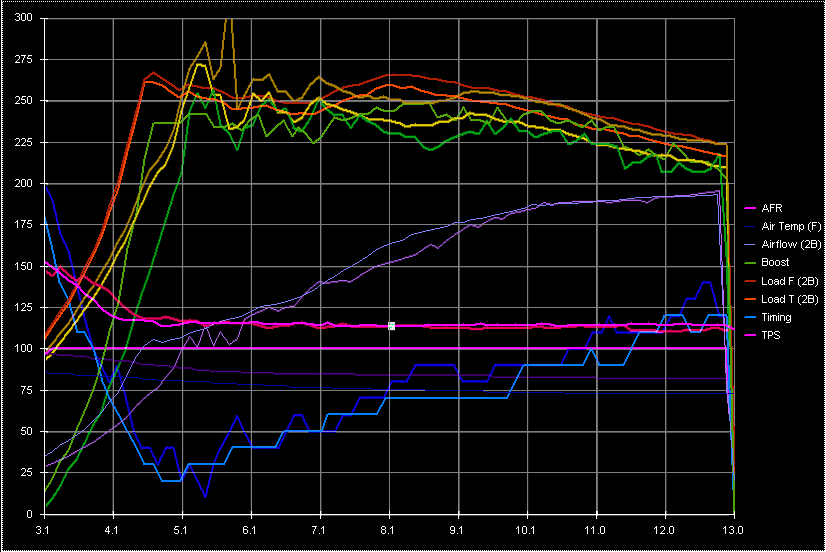
RPM might not be lined up correctly, but it's close enough.
Forgive the somewhat mismatched comparison here ... boost is also a little wacky on the hot comparison =)
Cooler weather
Hot weather
Comparison
RPM might not be lined up correctly, but it's close enough.
The settngs I'm using are doing much less correction (hardly any positive) and I have more weather deviance, which is desirable as I have extreme weather variations where I live. Also, I never could get the engine to respond well to continuously changing wastegate duty cycle so I ended up putting a flat duty cycle through much of the rpm and I utilize correction for 5th and 6th gear boost spikes. Like from 2500-6500 my duty is 72, from 6500 till redline I ramp the duty up to 80 or so, I have my targets set to what it runs naturally so it hardly ever does any upward correction. The smoothness of the solenoid made more power, than holding a steady boost in my case, also too much boost up top and it was blowing hot air and I was loosing power anyhow so I gave up on eliminating taper too. I may have lost a little spoolup but I can hit that 72 any RPM in 1-4 and not need much if any correction, 5th and 6th get immediate negative correction because the boost overuns the set points and it reduces duty.
So in a sense I'm allowing the turbo to do it's thing. During the winter It runs great 25psi, no knock, max power on 93 in my case. During the summer it runs 23.5psi and keeps the turbo in it's efficiency range. It allows a nice safety margin for decreased IC efficiency, etc, that comes with running a turbo car in super hot South Texas conditions in the summer time. I dont mind pushing 20 less WHP when the conditions are not right for max power anyhow.
Note: I've tuned my car with a near complete flat boost. With the Truboost you could completely eliminate the spike and have complete flatness till 6500, but the engine didnt seem to appreciate it as much as the gauge did.
Caveat: I've probably spent more time optimizing the setup I'm running than other methods that I've tried. Essentially I achieved a happy medium that allows me to change boost levels easily. It shares some attributes of an MBC with more adjustability and works with my weather variations. In other words it achieved all of my set goals. I subscribe with attention to the new methods and the stuff you guys are doing with boost control.
I think future experimenting for me will be re-introducing a pill with an aftermarket 3 port solenoid.
So in a sense I'm allowing the turbo to do it's thing. During the winter It runs great 25psi, no knock, max power on 93 in my case. During the summer it runs 23.5psi and keeps the turbo in it's efficiency range. It allows a nice safety margin for decreased IC efficiency, etc, that comes with running a turbo car in super hot South Texas conditions in the summer time. I dont mind pushing 20 less WHP when the conditions are not right for max power anyhow.
Note: I've tuned my car with a near complete flat boost. With the Truboost you could completely eliminate the spike and have complete flatness till 6500, but the engine didnt seem to appreciate it as much as the gauge did.
Caveat: I've probably spent more time optimizing the setup I'm running than other methods that I've tried. Essentially I achieved a happy medium that allows me to change boost levels easily. It shares some attributes of an MBC with more adjustability and works with my weather variations. In other words it achieved all of my set goals. I subscribe with attention to the new methods and the stuff you guys are doing with boost control.
I think future experimenting for me will be re-introducing a pill with an aftermarket 3 port solenoid.
Last edited by Mr. Evo IX; Jun 15, 2008 at 11:47 AM. Reason: Added Caveat and future plans.


I know .. I was just saying that I know where the load is for timing and it's not that I just think there is more timing.
My thought is this ... hotter air will have more pressure in the intake on it's own. This means there is less oxygen in the mix at the same boost level. The mix is less potent and frees up room for more timing/boost/leaner AFR in the summer as opposed to winter. This doens't make any more power though.
My thought is this ... hotter air will have more pressure in the intake on it's own. This means there is less oxygen in the mix at the same boost level. The mix is less potent and frees up room for more timing/boost/leaner AFR in the summer as opposed to winter. This doens't make any more power though.

I've actualy noticed that my maps tend to run 1 degree lower when air temp is over 95*F and 80% humidity.(temp, baro comp. kicking in?) Baro also seems to be at 14.74-14.8 instead of 14.87 -14.9 like on nice crisp 65* day. That is telling me that hot humid air has a lower density than cooler air. What happens is that the cooler air gives a bigger bang than hot humid air. To get the same power in summer you need more boost(and timing if possible). Also the more humidity in the air on a hot day the less power the engine will produce.
I've seen a 30whp difference uncorrected at the dyno between summer and winter. The SAE correction factor accounts for temperature, pressure and humidity and is what makes it possible to compare the two(up to a point, turbocharged engines suffer more imo.)
[snip wikipedia]
The addition of water vapor to air (making the air humid) reduces the density of the air, which may at first appear contrary to logic.
This occurs because the molecular mass of water (18) is less than the molecular mass of air (around 29). For any gas, at a given temperature and pressure, the number of molecules present is constant for a particular volume. So when water molecules (vapor) are introduced to the air, the number of air molecules must reduce by the same number in a given volume, without the pressure or temperature increasing. Hence the mass per unit volume of the gas (its density) decreases.
I've seen a 30whp difference uncorrected at the dyno between summer and winter. The SAE correction factor accounts for temperature, pressure and humidity and is what makes it possible to compare the two(up to a point, turbocharged engines suffer more imo.)
[snip wikipedia]
The addition of water vapor to air (making the air humid) reduces the density of the air, which may at first appear contrary to logic.
This occurs because the molecular mass of water (18) is less than the molecular mass of air (around 29). For any gas, at a given temperature and pressure, the number of molecules present is constant for a particular volume. So when water molecules (vapor) are introduced to the air, the number of air molecules must reduce by the same number in a given volume, without the pressure or temperature increasing. Hence the mass per unit volume of the gas (its density) decreases.

Thread
Thread Starter
Forum
Replies
Last Post
hearnoevo
Evo General
8
Dec 2, 2015 09:12 AM
