


Knock Sum discussion


Thread Starter
Evolved Member
Joined: Mar 2008
Posts: 730
Likes: 3
From: Lattitude 48.38°, Longitude 17.58°, Altitude 146m = Slovakia, for common dude
Knock Sum discussion
Correct me if I am wrong but it seems to me Knock sum is actually ignition retard amount I will try to get it in correct scaling later.
It should be possible to log Knock Sensor Voltage. Once it is sampled at high rate and coverted to wave we should be able to hear the mike.
Has anyone tried to verify it is actually Knock sensor voltage?
Has anyone experienced Knock Sum higher than 36?
Is there any DSP chip within the ECU that processes the RAW Knock sensor input and what we have as Knock sensor ADC value is preprocessed FFT?
It should be possible to log Knock Sensor Voltage. Once it is sampled at high rate and coverted to wave we should be able to hear the mike.
Has anyone tried to verify it is actually Knock sensor voltage?
Has anyone experienced Knock Sum higher than 36?
Is there any DSP chip within the ECU that processes the RAW Knock sensor input and what we have as Knock sensor ADC value is preprocessed FFT?


36 is a actual cap in the ECU. You can change this number to whatever you want with:
05-06 - Address: 1782 , 1D, scaling = uint16
03-04 - Address: 1382, 1D, scaling = uint16
You can log raw voltage in the newer Evoscans.
As far as ignition retard amount. General rule of thumb is every 3 knock sum is -1* retard
05-06 - Address: 1782 , 1D, scaling = uint16
03-04 - Address: 1382, 1D, scaling = uint16
You can log raw voltage in the newer Evoscans.
As far as ignition retard amount. General rule of thumb is every 3 knock sum is -1* retard


The knock voltage logging is just the 0-5v value and doesnt really show any rhyme nor reason since its noise not necessarily knock. If you are good with this form of logging (its the same as the AEM) you can interpret it for what would be real knock and what would be phantom, but I have seen 3.9v and no knock, and seen 10 counts and .9v.
Thread Starter
Evolved Member
Joined: Mar 2008
Posts: 730
Likes: 3
From: Lattitude 48.38°, Longitude 17.58°, Altitude 146m = Slovakia, for common dude
The knock voltage logging is just the 0-5v value and doesnt really show any rhyme nor reason since its noise not necessarily knock. If you are good with this form of logging (its the same as the AEM) you can interpret it for what would be real knock and what would be phantom, but I have seen 3.9v and no knock, and seen 10 counts and .9v.

Evolved Member
Joined: Apr 2008
Posts: 604
Likes: 0
From: Sydney, Australia
Maybe you should also be considering that maybe the knock voltage is not logged fast enough. We are not using a scope here, rather what the ECU is letting you see through its logging output.
Such as, you might get a 4V spike and a true knock, but in the logs only see a value around 1V. The ECU will detect it, but just not report the high voltage to you. What I have tended to notice is that sustained high amplitude knock voltage gets reported as knock sum. But as I was saying, it may be only showing this because it is not fast enough to show the spike inbetween.
Such as, you might get a 4V spike and a true knock, but in the logs only see a value around 1V. The ECU will detect it, but just not report the high voltage to you. What I have tended to notice is that sustained high amplitude knock voltage gets reported as knock sum. But as I was saying, it may be only showing this because it is not fast enough to show the spike inbetween.

the voltage might go through a filter respective to frequency at whatever load/RPM it's in and the outcome retards spark. The frequency for knock might be the same for all intensities, loads and rpm

I've been logging raw knock voltage forever w/ my ECU+ and it is logging right off the sensor's output w/o going through the ECU and I can attest to the fact that magnitude of voltage by itself has very little to do with what the ECU determines is knock. Sometimes it is downright baffling.
Heck, I thought I'd just pull open a random log real quick.
You'll see below that 2.7V is not knock, yet a few seconds later 1V is 6 counts.
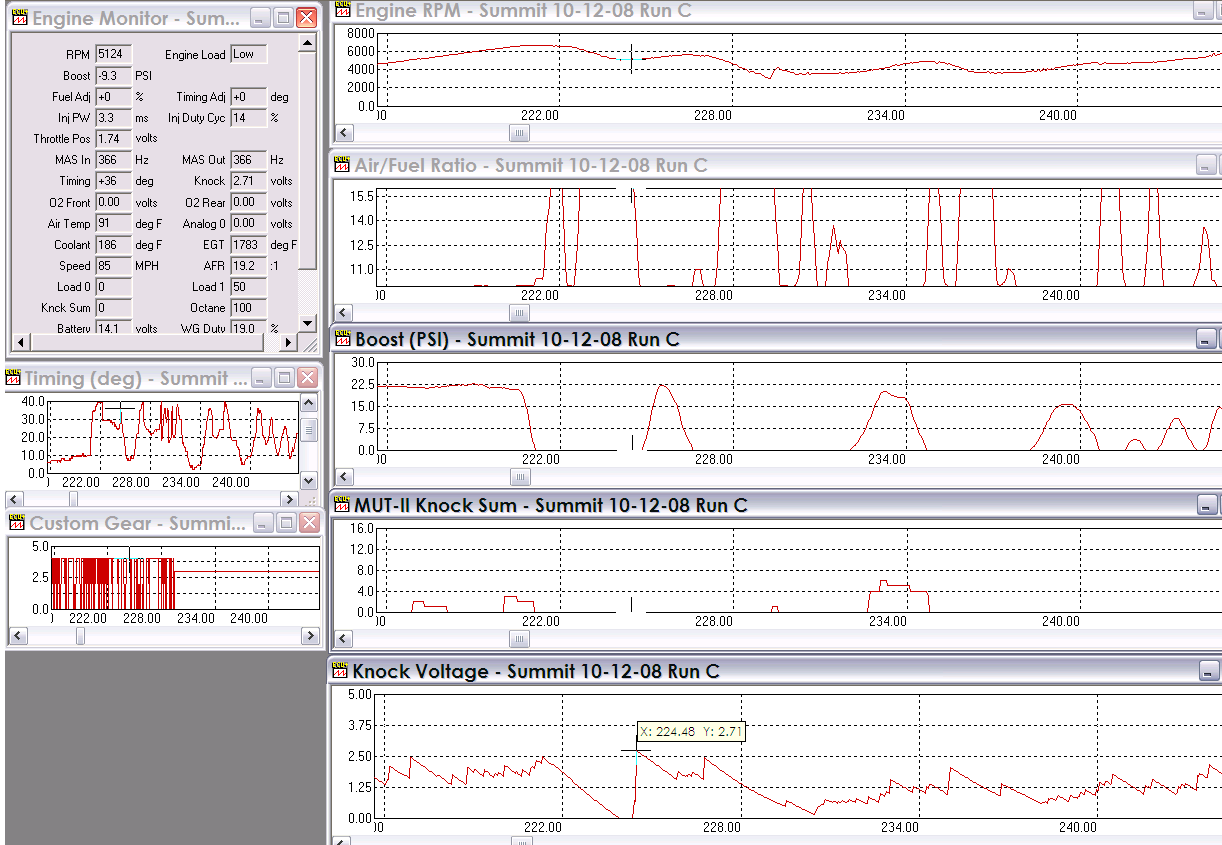
(sorry for the enormity... Shrinking the PNG actually increases the filesize over the limit)
Heck, I thought I'd just pull open a random log real quick.
You'll see below that 2.7V is not knock, yet a few seconds later 1V is 6 counts.
(sorry for the enormity... Shrinking the PNG actually increases the filesize over the limit)
Last edited by honki24; Nov 3, 2008 at 09:26 AM.
Trending Topics

Account Disabled
Joined: Nov 2006
Posts: 1,296
Likes: 2
From: wexford,pa
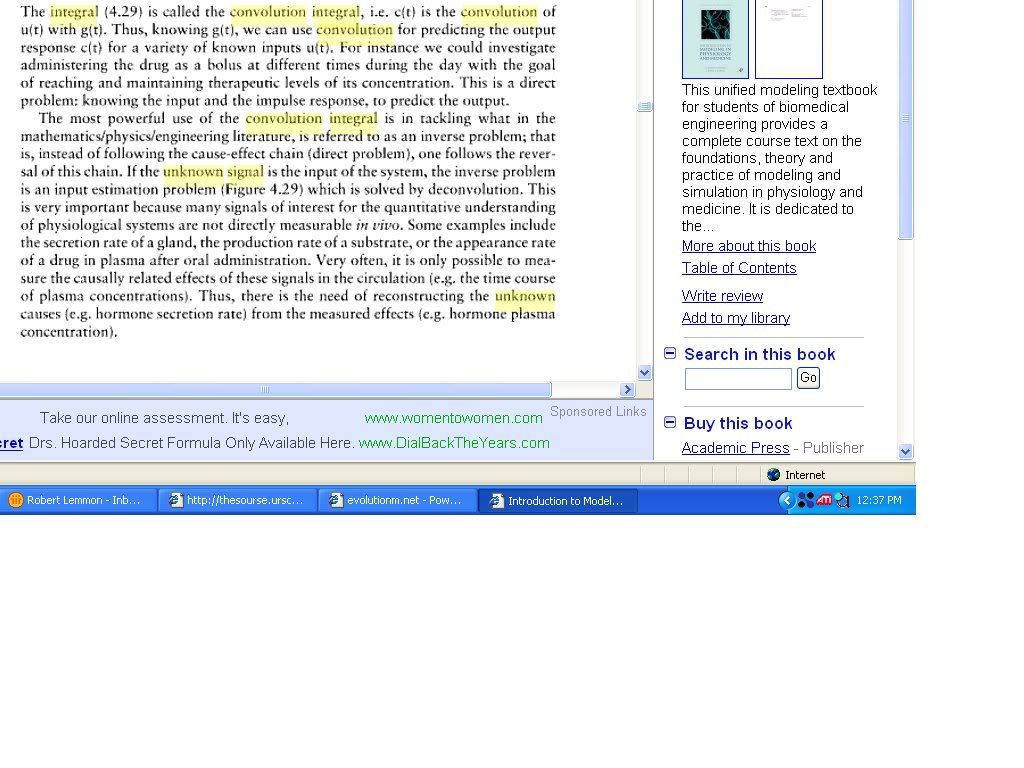
remember in engineering that you can determing an unknown signal by doing a convolution integral. I have a feeling the analog knock sensor voltage probably gets put into a convolution integral with a Known mitsubishi signal. And this is were the magic determines real knock from false knock.

Account Disabled
Joined: Nov 2006
Posts: 1,296
Likes: 2
From: wexford,pa
well the magic lies in the FFT of the convolution integral. Taking the %power of the FFT and if it get higher than that setpoint it is real knock. This is my guess on how to do it. its up to the Dis-assembly gurus to figure out the algorithm of this convolution integral.
im telling you this for sure, just looking at the waveform of the knock voltage will do you NOTHING.
im telling you this for sure, just looking at the waveform of the knock voltage will do you NOTHING.
US patent 4508079. Mitsu's been at it since 1983. Mechanism not too different than the current, except distributor retard .
.
Maybe the voltage (vibration signal) goes through a rpm/load filter, a -10 - 45* expansion stroke filter for each cyl, then a frequency filter.
.Maybe the voltage (vibration signal) goes through a rpm/load filter, a -10 - 45* expansion stroke filter for each cyl, then a frequency filter.
Thread Starter
Evolved Member
Joined: Mar 2008
Posts: 730
Likes: 3
From: Lattitude 48.38°, Longitude 17.58°, Altitude 146m = Slovakia, for common dude
