


Adventures in load-based boost control with the GM 3-port solenoid.


Adventures in load-based boost control with the GM 3-port solenoid.
This is a log of some things I found out about the stock ECU's method of controlling boost with a GM solenoid and a load reference (as opposed to MAP sensor readings). Some or all of this may have been posted before.
* The ECU will not add more than 10% upward correction to the WGDC table values. It has been said before that WGDC isn't actually a 'max', but a baseline. It's true that it is the baseline, but it is also a max in that the ECU will not go more than 10% above it in an attempt to reach desired load. Upward correction is also only applied after 50% throttle is breached.
* The ECU will not apply more than 64% downward correction to the WGDC table values. This means if you run a base WGDC of 75% you will never see less than 11% WGDC. This may vary slightly due to the ECU's own adjustments when transitioning from 85% to 75% in the WGDC table, for example.
* The ECU will only report, and use as a reference, a range of -20/+19.844 load error no matter what you change the table values to.
Because of these limitations it's impossible to tune the map as well as it needs to be to avoid a boost spike when doing a single-gear pull *and* avoid a spike when going WOT at a high RPM, say 4500.
To avoid the spike at 4500 you need a very aggressive reduction in WGDC due to how quickly boost is built. To avoid this spike you might make the corresponding +20 load error value be -30 or something large (stock is -13) to get the gate open as quickly as possible. This sort of works, but then you need a similarly large -20 value to close the gate again after the spike period is over. The problem with this approach is that in other situations, such as doing a single gear pull from low RPM (~2500-3000), way too much boost is pulled out as the gate is opened far more than it needs to be. The result of this is a curious up and down spiking of the WGDC. Too far open, too far closed, repeat. Set it up so that the WG isn't being opened as aggressively and you can't open it quickly enough to avoid that post-shift spike. (I've actually logged cases where 1% WGDC couldn't prevent a high-RPM spike. Yeesh.)
I'd like to find out if anyone more experienced than I at disassembly can figure out a few things:
* Is it possible to change the max WGDC correction beyond -64%/+10%?
* Is it possible to change the max +/- load error values referenced by the ECU?
It's my theory that if the load error table could be expanded more appropriate values could be placed in the corresponding correction cells, and both single-gear and high-RPM spikes could be avoided.
Thoughts?
* The ECU will not add more than 10% upward correction to the WGDC table values. It has been said before that WGDC isn't actually a 'max', but a baseline. It's true that it is the baseline, but it is also a max in that the ECU will not go more than 10% above it in an attempt to reach desired load. Upward correction is also only applied after 50% throttle is breached.
* The ECU will not apply more than 64% downward correction to the WGDC table values. This means if you run a base WGDC of 75% you will never see less than 11% WGDC. This may vary slightly due to the ECU's own adjustments when transitioning from 85% to 75% in the WGDC table, for example.
* The ECU will only report, and use as a reference, a range of -20/+19.844 load error no matter what you change the table values to.
Because of these limitations it's impossible to tune the map as well as it needs to be to avoid a boost spike when doing a single-gear pull *and* avoid a spike when going WOT at a high RPM, say 4500.
To avoid the spike at 4500 you need a very aggressive reduction in WGDC due to how quickly boost is built. To avoid this spike you might make the corresponding +20 load error value be -30 or something large (stock is -13) to get the gate open as quickly as possible. This sort of works, but then you need a similarly large -20 value to close the gate again after the spike period is over. The problem with this approach is that in other situations, such as doing a single gear pull from low RPM (~2500-3000), way too much boost is pulled out as the gate is opened far more than it needs to be. The result of this is a curious up and down spiking of the WGDC. Too far open, too far closed, repeat. Set it up so that the WG isn't being opened as aggressively and you can't open it quickly enough to avoid that post-shift spike. (I've actually logged cases where 1% WGDC couldn't prevent a high-RPM spike. Yeesh.)
I'd like to find out if anyone more experienced than I at disassembly can figure out a few things:
* Is it possible to change the max WGDC correction beyond -64%/+10%?
* Is it possible to change the max +/- load error values referenced by the ECU?
It's my theory that if the load error table could be expanded more appropriate values could be placed in the corresponding correction cells, and both single-gear and high-RPM spikes could be avoided.
Thoughts?


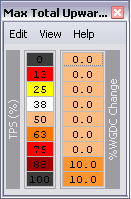
Yes you can change the max upward WGDC correction using this table:
"Max Total Upward WGDC Correction vs TPS"
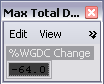
There is also a table for the max downward correction:
I've found that zeroing out the "Max Total Upward WGDC Correction vs TPS" helps a ton in controlling boost spikes and having a normal correction table again (example having +20/-20 with normal correction numbers again instead of very small or 0)
"Max Total Upward WGDC Correction vs TPS"
There is also a table for the max downward correction:
I've found that zeroing out the "Max Total Upward WGDC Correction vs TPS" helps a ton in controlling boost spikes and having a normal correction table again (example having +20/-20 with normal correction numbers again instead of very small or 0)
Last edited by razorlab; Dec 21, 2008 at 04:52 PM.


I find that by lowering the WGDC post spool, you reduce the spike on spool affect at higher RPM's.
At 2500-7000 pull rpms it doesn't really matter since the TBEC will take care of this reduction..
At 2500-7000 pull rpms it doesn't really matter since the TBEC will take care of this reduction..


Trending Topics

Seeing a couple of you guys just now finding out about the max total upward correction. Oh my yes you NEED to edit this table. Else your setting yourself up for a huge overboost if you slowly roll into it in 5th gear at 2000rpm's.
