


Tuning for faster spool


Thread Starter
Evolved Member
iTrader: (22)
Joined: Nov 2003
Posts: 2,408
Likes: 7
From: Northern KY near Cincy
Yeah....porting is great. Millimeters make a lot of difference. The exhaust manifold has a lot of abrupt corners and the internal surface is quite rough. Also, the mating surfaces are much smaller than the gaskets. In all, there is a ton of material that can be removed to make it work much better.
I ported mine myself....several hours with a die grinder and sanding bits. It was worth it for sure.
I think my hotside could use more porting. Maybe I may try it later.
Also, the 02 housing needed porting in my case. The tubular housing was causing boost creep. I had to open up the waste gate side a lot. While I was at it I smoothed all of the edges and polished it up nicely.
In thinking deeper on main topic of this posting.....
Since we now have the capability to have have launch map that uses negative timing and lots of fuel to build boost a question comes to mind....
Which is better for bringing on boost faster.....less timing and more fuel, or more timing and less fuel...or a combination????
My car reacted much better to more fuel and less timing. I was running way too lean....13s at spool and timing was way too high...started in the mid 20s. By giving it more fuel....high 12s and less timing spool came on much faster.
Any thoughts.
I ported mine myself....several hours with a die grinder and sanding bits. It was worth it for sure.
I think my hotside could use more porting. Maybe I may try it later.
Also, the 02 housing needed porting in my case. The tubular housing was causing boost creep. I had to open up the waste gate side a lot. While I was at it I smoothed all of the edges and polished it up nicely.
In thinking deeper on main topic of this posting.....
Since we now have the capability to have have launch map that uses negative timing and lots of fuel to build boost a question comes to mind....
Which is better for bringing on boost faster.....less timing and more fuel, or more timing and less fuel...or a combination????
My car reacted much better to more fuel and less timing. I was running way too lean....13s at spool and timing was way too high...started in the mid 20s. By giving it more fuel....high 12s and less timing spool came on much faster.
Any thoughts.

Which is better for bringing on boost faster.....less timing and more fuel, or more timing and less fuel...or a combination????
My car reacted much better to more fuel and less timing. I was running way too lean....13s at spool and timing was way too high...started in the mid 20s. By giving it more fuel....high 12s and less timing spool came on much faster.
Any thoughts.
Paul, when you retard timing for spool, do you retard the entire spool up area, or just the first couple cells? When I did the lil test, I had retarded the entire spool up area. I have given this another thought, and what if you retard it only in the first coulpe cells it hits, and lead it into your normal timing before peak? (To keep it from feeling weak) Ive read on here that some ppl run 16*, some run 14*. If that makes any sense...
Im running 19* (2500/100 load)
hitting 25psi by 3500 starting @ 2500
I think Im gonna try starting w/ 16*, and retard the next couple cells that I hit, and see how she does...
Last edited by nonschlont; Jan 8, 2010 at 05:18 PM.
Thread Starter
Evolved Member
iTrader: (22)
Joined: Nov 2003
Posts: 2,408
Likes: 7
From: Northern KY near Cincy
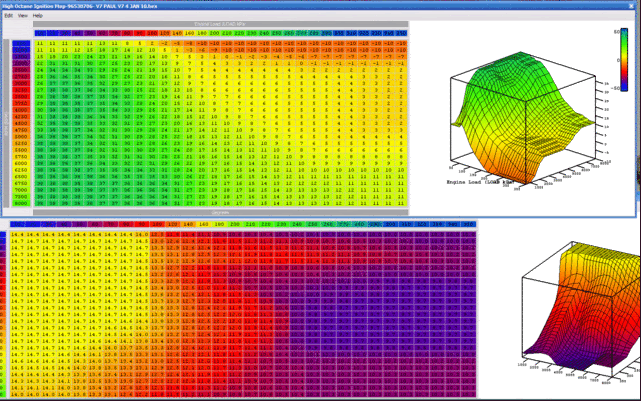
Going out on a limb here....these are my tables as of current. Yes I know my mid range low end is lean. I found that the low end cells in mid range are not hit much, when they are it hits so fast and moves to higher load cells. Allows for really fast get up and go.
it seems like you run your timing retarded towards the end of spool up, and left "normal" @ tip in, which is the opposite of what i was thinking about trying...
which I will try as well...
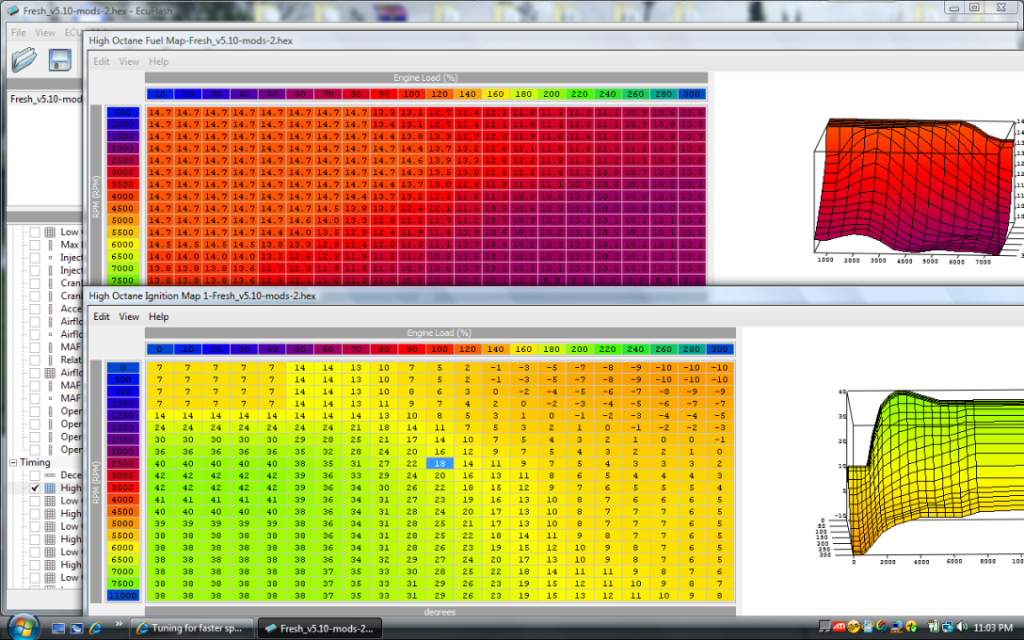
heres what Im currently running and the second pic is the timing map I was gonna play w/. You will see the differences @ tip in (100 load) - 160 load, 1750 - 4000, and same timing from 180 on. My thought on this was to try and prevent the weak feeling I got @ peak (leaving the end of spool, normal) and hoping the retarded timing @ tip in will help out w/ spool...
I was using v7, but had issues... I think I clusterfkd the rom, playing w/ 2 versions of tephra from the same directory... (I did pull out the .xmls ) So I started fresh, and will work my way back to it. runing 5.10 for now... anyways...
current
gonna play w/
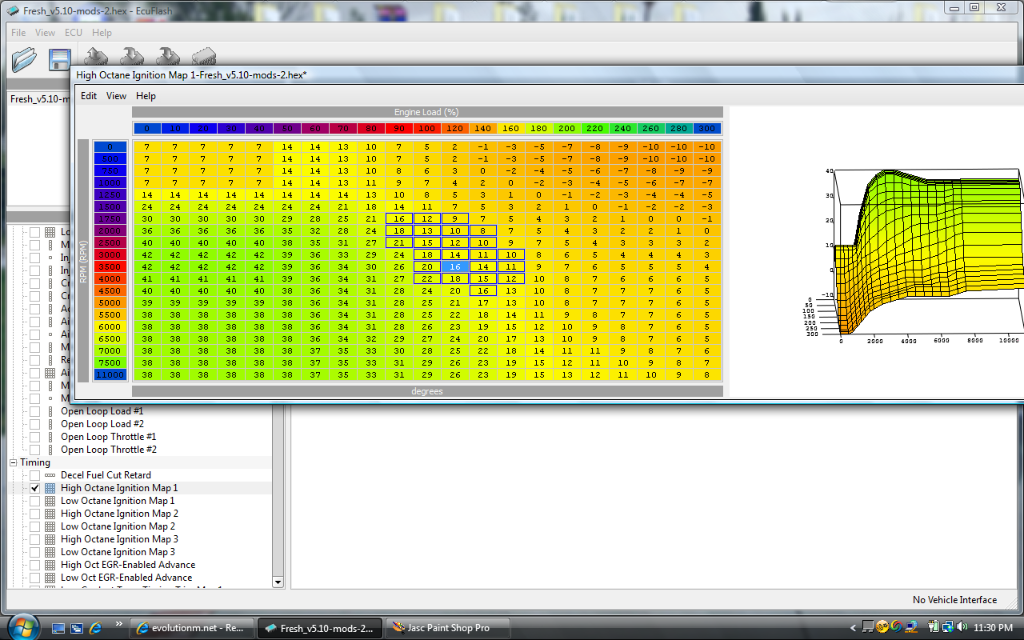
which I will try as well...
heres what Im currently running and the second pic is the timing map I was gonna play w/. You will see the differences @ tip in (100 load) - 160 load, 1750 - 4000, and same timing from 180 on. My thought on this was to try and prevent the weak feeling I got @ peak (leaving the end of spool, normal) and hoping the retarded timing @ tip in will help out w/ spool...
I was using v7, but had issues... I think I clusterfkd the rom, playing w/ 2 versions of tephra from the same directory... (I did pull out the .xmls
) So I started fresh, and will work my way back to it. runing 5.10 for now... anyways...current
gonna play w/

One idea I've been toying with is a side by side intercooler and dual pass radiator setup. Half to reduce weight and polar moment, the other half just to improve overall cooling efficiency.
Garrett makes a 16"x12"x3" intercooler rated to 650 HP. While not the biggest thing out there, my power goals are well below 650 HP and it would leave just about the right amount of room for a cross flow dual pass radiator I came across. The advantage being that the lower IC pipe would be about a 6" long 45 degree bend into a low volume endtank. The intercooler is also smaller to reduce volume but still should provide good cooling. The outlet endtank would also be very low volume and the upper IC pipe would be about 2 1/2' long with a single 90 degree bend.
Garrett makes a 16"x12"x3" intercooler rated to 650 HP. While not the biggest thing out there, my power goals are well below 650 HP and it would leave just about the right amount of room for a cross flow dual pass radiator I came across. The advantage being that the lower IC pipe would be about a 6" long 45 degree bend into a low volume endtank. The intercooler is also smaller to reduce volume but still should provide good cooling. The outlet endtank would also be very low volume and the upper IC pipe would be about 2 1/2' long with a single 90 degree bend.

Evolved Member
Joined: Mar 2004
Posts: 1,635
Likes: 3
From: Butt**** Nowhere
How about sourcing the coolest air possible for the turbo?
That's why I mentioned the cold air intake. A few temps drop in inlet air temps can do alot for torque and spool. The drawback I guess is adding restriction to the top end because of the longer intake runner such as the APS.
That's why I mentioned the cold air intake. A few temps drop in inlet air temps can do alot for torque and spool. The drawback I guess is adding restriction to the top end because of the longer intake runner such as the APS.
Keeping volume as low as possible while keeping the flow very free will give decent gains in response.
The intercooler will be about 40% smaller then my current IC. The piping will probably have 1/4 the volume of my current piping.
Evolved Member
Joined: Mar 2004
Posts: 1,635
Likes: 3
From: Butt**** Nowhere
How much more improvement will a vertical flow IC give? The HKS evo uses a good example.
http://www.superstreetonline.com/fea.../photo_08.html
http://www.superstreetonline.com/fea.../photo_08.html
Thread Starter
Evolved Member
iTrader: (22)
Joined: Nov 2003
Posts: 2,408
Likes: 7
From: Northern KY near Cincy
That is a pretty cool design. I bet it works very well.
Another idea for intercooler efficiency is to angle the it in reference to the oncoming airflow. This increases the surface area.
Another idea for intercooler efficiency is to angle the it in reference to the oncoming airflow. This increases the surface area.

Spooling a turbo has to do a lot with exhaust gas energy, either energy from heat or velocity. Since you have already worked on velocity (bigger exhaust, ported parts, etc), you may wanna look into increasing the heat of the exhaust gas.
Of course, a way to increase EGT is too reduce timing and/or richening the mixture. When you do this, more of the combustion happens outside of the cylinder, on its way to the turbine. This raises EGTs and in theory will spool the turbo faster as the exhaust gasses have more energy.
Of course, a way to increase EGT is too reduce timing and/or richening the mixture. When you do this, more of the combustion happens outside of the cylinder, on its way to the turbine. This raises EGTs and in theory will spool the turbo faster as the exhaust gasses have more energy.

Actually the velocity really has no effect on spooling the turbo. A lot of people think so because they imagine the turbine as being spun like a pinwheel, but it's just not the case.
The turbine is driven by a pressure differential pre and post turbine. That is where the exhaust 'energy' is coming from. Increasing heat increases pressure (PV=nRT), so retarding timing and increasing EGTs increases pressure pre-turbine and spools the turbo faster.
Anything that can increases the pressure pre-turbine or reduce the pressure post turbine will help spool.
The turbine is driven by a pressure differential pre and post turbine. That is where the exhaust 'energy' is coming from. Increasing heat increases pressure (PV=nRT), so retarding timing and increasing EGTs increases pressure pre-turbine and spools the turbo faster.
Anything that can increases the pressure pre-turbine or reduce the pressure post turbine will help spool.
Thread Starter
Evolved Member
iTrader: (22)
Joined: Nov 2003
Posts: 2,408
Likes: 7
From: Northern KY near Cincy
Top 10 notes for FASTER SPOOL
1) Less timing (Start with stock values during spool, tune from there)
2) Richer AFR (mid 12s during spool to max boost, then taper richer)
3) Hot pre turbo exhaust (coat mani)
4) Port head, manifold, turbo, O2 for more flow
5) Free flowing exhaust
6) BOV leak free
7) Free flowing, low pressure drop, high efficient FMIC
8) Waste gate sealed shut until peak boost is achieved
9) Shortest intake pipes as possible
10) No boost or vacuum leaks
1) Less timing (Start with stock values during spool, tune from there)
2) Richer AFR (mid 12s during spool to max boost, then taper richer)
3) Hot pre turbo exhaust (coat mani)
4) Port head, manifold, turbo, O2 for more flow
5) Free flowing exhaust
6) BOV leak free
7) Free flowing, low pressure drop, high efficient FMIC
8) Waste gate sealed shut until peak boost is achieved
9) Shortest intake pipes as possible
10) No boost or vacuum leaks

with less timing what u u mean... less timing in load 100-160 and then whatever the car can take w/o knocking. i usually aim for about 12.5 from 120-200load. then taper to 11.8 or so for the rest of the time... and seems knock free for most of it.