


Coil on ignition problem


Coil on ignition problem
I punched it and did a no lift shift from 1st to 2nd, but in between the shift it back fired and fell flat on its face like I'm running on 3 cylinders. I immediately thought a coupler popped off, but I pulled over and all of them are good.
I then moved onto the spark plugs and they look good but I switched them out with a new set anyways(BR8ES).
I unplugged each coil while the car was running and all but 1 stumbled after I unplugged it. Number 1 cylinder didn't stumble when I unplugged it leading me to believe this coil took a poop. Is this assumption good?
Is there a way to tell if its the coil pack or if its the ignition box? Can a Voltage meter tell me anything?
Thanks in advance.
I then moved onto the spark plugs and they look good but I switched them out with a new set anyways(BR8ES).
I unplugged each coil while the car was running and all but 1 stumbled after I unplugged it. Number 1 cylinder didn't stumble when I unplugged it leading me to believe this coil took a poop. Is this assumption good?
Is there a way to tell if its the coil pack or if its the ignition box? Can a Voltage meter tell me anything?
Thanks in advance.
Last edited by 2.3 Evo 8; May 5, 2007 at 10:00 PM.

Follow this...
Inspection
The service manuals, in section 16 for the 3000GT manuals or in section 8 for the Stealth manuals, offer a few troubleshooting hints plus some service and inspection tests. Under troubleshooting the manuals suggest that malfunctioning coils can lead to one or more of the following symptoms: (1) insufficient or no spark, (2) rough idle or stalls, and (3) poor acceleration. I would add that if a coil is bad, the pair of plugs connected to the coil will both lack spark. Once the coil assembly is off the engine, individual coils can be switched to see if a problem follows a coil. If you have a digital storage oscilloscope (DSO) the newer manuals present example waveforms you can compare to observed waveforms. With an analog or digital volt-ohm meter (VOM) you can perform the two tests shown below.
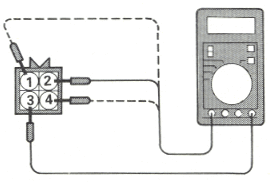
1. Primary coil resistance. Before you start, switch the digital VOM to measure resistance and touch the two leads together. Note the value indicated (mine said 0.6 ohms) and subtract this value from the next three measurements. If using an analog VOM meter, use the zeroing dial for the resistnace setting to eliminate the offset. Connect the VOM positive lead to terminal [3] in the harness connector on the coils bracket. Measure the resistance between between terminal [3] and the remaining terminals by connecting the VOM negative (ground) lead sequentially to terminals [1], [2], and [4]. Note that terminals [1] and [2] are near the release lever catch and terminals [3] and [4] are near the smooth side of the connector. The service manuals indicate a standard value of 0.67 to 0.81 ohms. All of my old (65,000 miles and 11 years) and new ignition coils measured 0.8 ohms (1.4 minus 0.6 ohms).
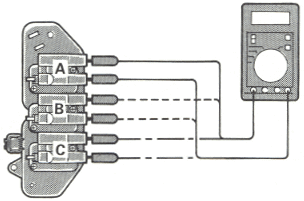
2. Secondary coil resistance. Leaving the VOM set to measure resistance, connect the positive and negative leads to the metal parts inside the two high-voltage terminals on a coil. Repeat for all three coils. The standard value is 11,300 to 15,300 ohms. My old coils measured 13,910, 13,820, and 13,410 ohms for coils A, B, and C, respectively. The new coils measured 13,310, 13,340, and 13,200 ohms for coils A, B, and C, respectively.
Inspection
The service manuals, in section 16 for the 3000GT manuals or in section 8 for the Stealth manuals, offer a few troubleshooting hints plus some service and inspection tests. Under troubleshooting the manuals suggest that malfunctioning coils can lead to one or more of the following symptoms: (1) insufficient or no spark, (2) rough idle or stalls, and (3) poor acceleration. I would add that if a coil is bad, the pair of plugs connected to the coil will both lack spark. Once the coil assembly is off the engine, individual coils can be switched to see if a problem follows a coil. If you have a digital storage oscilloscope (DSO) the newer manuals present example waveforms you can compare to observed waveforms. With an analog or digital volt-ohm meter (VOM) you can perform the two tests shown below.
1. Primary coil resistance. Before you start, switch the digital VOM to measure resistance and touch the two leads together. Note the value indicated (mine said 0.6 ohms) and subtract this value from the next three measurements. If using an analog VOM meter, use the zeroing dial for the resistnace setting to eliminate the offset. Connect the VOM positive lead to terminal [3] in the harness connector on the coils bracket. Measure the resistance between between terminal [3] and the remaining terminals by connecting the VOM negative (ground) lead sequentially to terminals [1], [2], and [4]. Note that terminals [1] and [2] are near the release lever catch and terminals [3] and [4] are near the smooth side of the connector. The service manuals indicate a standard value of 0.67 to 0.81 ohms. All of my old (65,000 miles and 11 years) and new ignition coils measured 0.8 ohms (1.4 minus 0.6 ohms).
2. Secondary coil resistance. Leaving the VOM set to measure resistance, connect the positive and negative leads to the metal parts inside the two high-voltage terminals on a coil. Repeat for all three coils. The standard value is 11,300 to 15,300 ohms. My old coils measured 13,910, 13,820, and 13,410 ohms for coils A, B, and C, respectively. The new coils measured 13,310, 13,340, and 13,200 ohms for coils A, B, and C, respectively.

I punched it and did a no lift shift from 1st to 2nd, but in between the shift it back fired and fell flat on its face like I'm running on 3 cylinders. I immediately thought a coupler popped off, but I pulled over and all of them are good.
I then moved onto the spark plugs and they look good but I switched them out with a new set anyways(BR8ES).
I unplugged each coil while the car was running and all but 1 stumbled after I unplugged it. Number 1 cylinder didn't stumble when I unplugged it leading me to believe this coil took a poop. Is this assumption good?
Is there a way to tell if its the coil pack or if its the ignition box? Can a Voltage meter tell me anything?
Thanks in advance.
I then moved onto the spark plugs and they look good but I switched them out with a new set anyways(BR8ES).
I unplugged each coil while the car was running and all but 1 stumbled after I unplugged it. Number 1 cylinder didn't stumble when I unplugged it leading me to believe this coil took a poop. Is this assumption good?
Is there a way to tell if its the coil pack or if its the ignition box? Can a Voltage meter tell me anything?
Thanks in advance.
Are you sure the internals r OK?


Trending Topics


Thread
Thread Starter
Forum
Replies
Last Post
rysbrnr
General Engine Management / Tuning Forum
11
Jul 31, 2024 12:41 AM
Raceghost
ECU Flash
10
Jun 17, 2016 04:05 PM
