


EcuTek R&D at Precision Dyno

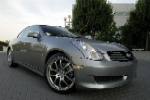
EcuTek R&D at Precision Dyno
This past weekend Nick at Precision decided to really dive into the Ecutek reflashing on a very difficult car, mine!
If you don't know, the only thing that is really stock is the turbo and intercooler. (and clutch )
)
Because of this there are limitations to flashing a car with a moderately ported head, intake, exhaust, oversize valve, the works. I know if we dropped an AEM in the thing would run like a top with about 2 hours worth of work but that's no fun.
The biggest issue was idle and low speed driveability. Because of the 680cc injectors there is quite a bit of work to be done to get a stable idle and good tip-in response. We initially started tuning around 5 PM working on the usual, making power having adjusted the injector scaling, which throws a wrench in the whole tuning process. After a couple of hours we decided to scrap the entire tune.
We started over, only concerned with idle AFR and low speed AFRs. There is not a lot of adjustment you can make in the closed loop areas of the map so the typical tuning in open loop only can not be done because it leaves the closed loop area pig rich and therefore everthing in closed loop suffers.
Not to give any tuning secrets away, we were able to return the car to stock like AFRs at idle and in closed loop. Which lead to the car having a very steady idle with 272 cams and all the porting. It still dips on clutch out and in but I learned to drive around that a long time ago and it is really unavoidable unless you are running an AEM.
Moving back to the open loop maps it siginificantly affected the AFRs, so much so that we had to max out some of the AFR numbers just to get where we needed to be.
A couple of things we drew from this R&D is, we believe the 272 cams are holding the car back, even though I am only on the stock turbo for now. A high lift cam with a shorter duration would probably make considerably more power then the HKS cams with my cylinder head.
The ported head starts to breathe so well at 5000 RPMs we had a hard time getting enough fuel in the engine and we believe that the cams are actually starting to drop off up around 7000 rpms, even given the stock turbo.
We plan on continuing development on the timing maps as soon as Nick gets the KnockLink in, we've been waiting for them for over a month. I believe we can put in a lot more timing. The head is very smooth and the pistons are GoldCoated so at this point there is no detonation so far and I am running a relatively lean AFR, but that is on a Mustang Dyno so the AFR shift is not a concern on the road.
I don't have the Dyno sheet but HP was right at 300 and I think torque was real close. Ideally I would think with timing we might get to 320HP or so. I know on an AEM the car should make 330HP. Remember this is on pump gas with no aids and these are Mustang numbers. We probably did close to 40 dyno pulls in all and the IC was so heatsoaked because we weren't using the good fan at the time, that water was steaming off the IC when we sprayed it for the final run. Ironically the numbers didn't change anyway.
If you don't know, the only thing that is really stock is the turbo and intercooler. (and clutch
)Because of this there are limitations to flashing a car with a moderately ported head, intake, exhaust, oversize valve, the works. I know if we dropped an AEM in the thing would run like a top with about 2 hours worth of work but that's no fun.
The biggest issue was idle and low speed driveability. Because of the 680cc injectors there is quite a bit of work to be done to get a stable idle and good tip-in response. We initially started tuning around 5 PM working on the usual, making power having adjusted the injector scaling, which throws a wrench in the whole tuning process. After a couple of hours we decided to scrap the entire tune.
We started over, only concerned with idle AFR and low speed AFRs. There is not a lot of adjustment you can make in the closed loop areas of the map so the typical tuning in open loop only can not be done because it leaves the closed loop area pig rich and therefore everthing in closed loop suffers.
Not to give any tuning secrets away, we were able to return the car to stock like AFRs at idle and in closed loop. Which lead to the car having a very steady idle with 272 cams and all the porting. It still dips on clutch out and in but I learned to drive around that a long time ago and it is really unavoidable unless you are running an AEM.
Moving back to the open loop maps it siginificantly affected the AFRs, so much so that we had to max out some of the AFR numbers just to get where we needed to be.
A couple of things we drew from this R&D is, we believe the 272 cams are holding the car back, even though I am only on the stock turbo for now. A high lift cam with a shorter duration would probably make considerably more power then the HKS cams with my cylinder head.
The ported head starts to breathe so well at 5000 RPMs we had a hard time getting enough fuel in the engine and we believe that the cams are actually starting to drop off up around 7000 rpms, even given the stock turbo.
We plan on continuing development on the timing maps as soon as Nick gets the KnockLink in, we've been waiting for them for over a month. I believe we can put in a lot more timing. The head is very smooth and the pistons are GoldCoated so at this point there is no detonation so far and I am running a relatively lean AFR, but that is on a Mustang Dyno so the AFR shift is not a concern on the road.
I don't have the Dyno sheet but HP was right at 300 and I think torque was real close. Ideally I would think with timing we might get to 320HP or so. I know on an AEM the car should make 330HP. Remember this is on pump gas with no aids and these are Mustang numbers. We probably did close to 40 dyno pulls in all and the IC was so heatsoaked because we weren't using the good fan at the time, that water was steaming off the IC when we sprayed it for the final run. Ironically the numbers didn't change anyway.

Originally Posted by timzcat
Not to give any tuning secrets away, we were able to return the car to stock like AFRs at idle and in closed loop.
I don't get what you mean, but there is little to no adjustment in the lower load cells (closed loop). Regardless of the number we could have put in the fuel maps we would not have gotten the AFRs back in the 14s was my point.
One other note, we also messed around with stationary launch control and I can tell you it works even though it is not officially released yet. At 6000 the car will make 18 psi of boost!
One other note, we also messed around with stationary launch control and I can tell you it works even though it is not officially released yet. At 6000 the car will make 18 psi of boost!
Are you talking about 14.7 flat or was it bouncing around? I wouldn't expect it to be solid anyway since the ecutek can't compensate for injector battery offset , plus injector advance, plus injector dead time which is solved by injector advance. He probably just hooked up a scantool and looked at the fuel trims and got them as close to as 0 as possible. That's all you can do.
Of course it wasn't a flat AFR, it was closed loop. Point being that if you scale the injectors to thier proper size the closed loop AFR will be way off and changing the fuel map itself will not fix it. And Ecutek does have battery compensation, which is there to compensate for injector dead time or whatever you want to call it.
Scan tools are basically useless because the Mitsu ECU just plain sucks at data rate.
Scan tools are basically useless because the Mitsu ECU just plain sucks at data rate.
Looking at fuel trims on the scan tool doesn't really depend much on data rate. Battery compensation isn't there to compensate for injector dead time, it's there for something else that i'll let you figure out. interesting that the ecutek has that feature. I've only seen that on standalones. Are you sure you're not confusing it with injector scaling?
Yeah, your right. I'd love to hear the explanation on how the injector battery compesation works on the Ecutek since you've never use it.
You'll do anthing to argue with someone whether you know what you are talking about or not.
You'll do anthing to argue with someone whether you know what you are talking about or not.
Trending Topics
Uh, what is your point? Did you not read the thread your are posting in?
I find it funny that you are arguing with me on battery compensation yet you posted this
https://www.evolutionm.net/forums/sh...66&postcount=4
in the other thread about injector scaling and Ecutek just over a week ago.
I find it funny that you are arguing with me on battery compensation yet you posted this
https://www.evolutionm.net/forums/sh...66&postcount=4
in the other thread about injector scaling and Ecutek just over a week ago.

injector battery compensation is to ensure the same fuel flow of the injector in the event that battery voltage falls low. lower voltage as a result of electrical load (fan, lights, ect) creates additional injector dead time resulting in decreased fuel flow (a/f change) which in some cases is enough to stall the engine.
I'll also add that many injectors have different injector battery offsets so if you change from stock, different voltages will cause differences in a/f. Like i said, i don't know how flashes or piggybacks compensate for this.
one thing to note about oem computers is that they have a lot of development time into them as well as a lot of money invested to develop their hardware.
it could be that those parameters that are normally crucial for stand alones, such as adjustable battery compensation depending on injector just isn't that important on oem ecus.
for instance, in do honda obd 1 rom tuning and i frequently run 1000 cc injectors on many setups. there is no parameter in the software to adjust for injector dead time. yet the stock honda ecu with the right software (neptune) can maintain a 14.7 a/f ratio at a 900 rpm idle, exhibiting perfect throttle response, and drivability that rivals my motec box. we have run up to 1600cc injectors on the stock honda ecu without problems.
its kinda disappointing to hear that the Ecutek has trouble with injectors that are just 100cc give or take larger than stock. its actually hard for me to believe.
i have the techtom reflashing gear... and from as far as i can remember off the top of my head there isnt an address for specifically rescaling the fuel map for larger injectors, or any address for battery offset compensation.
i suspect that in order to compensate for larger injectors, all reflash programs do is apply a proportional decrease across the board on the hexidecimal fuel values.
i guess i got to try it for myself... but i just have one too many things going on right now.
it could be that those parameters that are normally crucial for stand alones, such as adjustable battery compensation depending on injector just isn't that important on oem ecus.
for instance, in do honda obd 1 rom tuning and i frequently run 1000 cc injectors on many setups. there is no parameter in the software to adjust for injector dead time. yet the stock honda ecu with the right software (neptune) can maintain a 14.7 a/f ratio at a 900 rpm idle, exhibiting perfect throttle response, and drivability that rivals my motec box. we have run up to 1600cc injectors on the stock honda ecu without problems.
its kinda disappointing to hear that the Ecutek has trouble with injectors that are just 100cc give or take larger than stock. its actually hard for me to believe.
i have the techtom reflashing gear... and from as far as i can remember off the top of my head there isnt an address for specifically rescaling the fuel map for larger injectors, or any address for battery offset compensation.
i suspect that in order to compensate for larger injectors, all reflash programs do is apply a proportional decrease across the board on the hexidecimal fuel values.
i guess i got to try it for myself... but i just have one too many things going on right now.