


Initial Dyno Results - Buschur Ported Bits


Thread Starter
Evolved Member
iTrader: (6)
Joined: Jun 2004
Posts: 20,790
Likes: 2
From: Long Island, NY
Originally Posted by TTP Engineering
Your flapper door remains open so you are always leaking boost into the exhaust. Your turbo has to spin at speeds to support say 26-27 psi to achieve your 19-20 since hypothetically you are letting out 6-8psi out the flapper door. Close the door with the WGA arm. At times even at the tightest setting, it is still not short enough so it has to be cut shorter.

Do it incrementally!
I can't say that ALL of the actuator rods are 100% consistently the same length as they are all bent, cut, and threaded by hand. There are undoubtedly variations between one rod and the next.
Yours may not require that you go all the way down, so it's best to do it incrementally just to be safe.
I can't say that ALL of the actuator rods are 100% consistently the same length as they are all bent, cut, and threaded by hand. There are undoubtedly variations between one rod and the next.
Yours may not require that you go all the way down, so it's best to do it incrementally just to be safe.

Every one that we have done, required going down all the way. In fact like I stated, we shaved another few mm off our rod as well. The threading continues much further than where the turnbuckle cannot turn any further without cutting. I would go all the way down IMO. You should have to pull up on the arm to slip it on the flapper door. This may require pliers or vicegrips.
Thread Starter
Evolved Member
iTrader: (6)
Joined: Jun 2004
Posts: 20,790
Likes: 2
From: Long Island, NY
I will do it incrementally if we are able to manipulate the nut and turnbuckle without removing the radiator and such, but if we can't, then I'm going to shoot for one big adjustment and hope it works. I don't want to have to drain the coolant, remove the radiator, and then put it all back together each time, but if that's what it takes in the end, then we'll do it.
Thread Starter
Evolved Member
iTrader: (6)
Joined: Jun 2004
Posts: 20,790
Likes: 2
From: Long Island, NY
Originally Posted by TTP Engineering
Every one that we have done, required going down all the way. In fact like I stated, we shaved another few mm off our rod as well. The threading continues much further than where the turnbuckle cannot turn any further without cutting. I would go all the way down IMO. You should have to pull up on the arm to slip it on the flapper door. This may require pliers or vicegrips.

Warr: you definatly want significant preload on the WG flapper. There is a significant pressure differential that the flapper is trying to seal against. The exh manifold pressure is probobly atleast the same as your intake manifold pressure. Idealy the pressure in the o2 housing/exhaust pipe is atmosphere or just a tiny bit higher.
I would try and get a resting "interferance fit" between the flapper arm' pin and teh hole of the WGA rod to be about 1/4". IE: you have to pull against the WGA spring that 1/4" distance to slip the rod onto the pin.
The worst you are going to see by setting it "too tight" is a bigger than normal boost spike as the MBC opens.
I would try and get a resting "interferance fit" between the flapper arm' pin and teh hole of the WGA rod to be about 1/4". IE: you have to pull against the WGA spring that 1/4" distance to slip the rod onto the pin.
The worst you are going to see by setting it "too tight" is a bigger than normal boost spike as the MBC opens.

Originally Posted by Warrtalon
Yes, it looks very nice and stays 100% flat for almost 2500rpm, BUT that is because I don't have the normal torque spike from which normal stock-turbo'd Evos fall off. In other words, had I hit a 310 tq spike at 3600, then you would see a linearly decreasing tq curve that would eventually reconnect with the tq curve you see at around 5700rpm.
Here is a crude, extrapolated example, and this is still only if I was spiking right at a full 20psi instead of 18. If I could spike to 22-23, you might see that whole torque curve push up another 10-15 across the board...
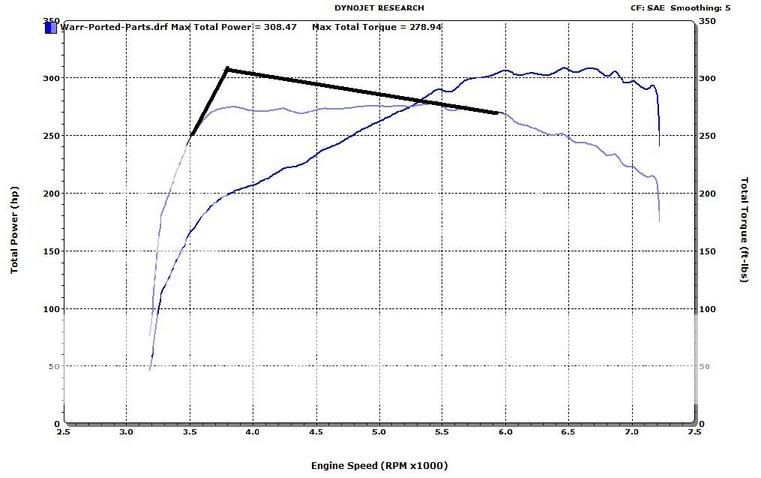
Here is a crude, extrapolated example, and this is still only if I was spiking right at a full 20psi instead of 18. If I could spike to 22-23, you might see that whole torque curve push up another 10-15 across the board...
Your torque and horsepower will always cross at 5250rpms.
Thread Starter
Evolved Member
iTrader: (6)
Joined: Jun 2004
Posts: 20,790
Likes: 2
From: Long Island, NY
Originally Posted by Ckjeepin
It's impossible to make more torque than horsepower after 5250rpm's
Your torque and horsepower will always cross at 5250rpms.
Your torque and horsepower will always cross at 5250rpms.

Originally Posted by TTP Engineering
Your flapper door remains open so you are always leaking boost into the exhaust. Your turbo has to spin at speeds to support say 26-27 psi to achieve your 19-20 since hypothetically you are letting out 6-8psi out the flapper door. Close the door with the WGA arm. At times even at the tightest setting, it is still not short enough so it has to be cut shorter.
-Paul
Originally Posted by Warrtalon
Um, that wasn't the point of the drawing, man. So I was off by a few centimeters or whatever. I wasn't even talking about that part of the graph anyway; I was focusing mainly on where the normal torque spike would be and what the resulting line would look like (obviously, it wouldn't be perfectly straight, and I know that it would intersect HP at 5252rpm).
Thread Starter
Evolved Member
iTrader: (6)
Joined: Jun 2004
Posts: 20,790
Likes: 2
From: Long Island, NY
Originally Posted by Ckjeepin
I know you probably know that, but for the sake of useless knowledge i figured i would let everyone else know.. Also you did say they would come back together at 5700rpms.


Originally Posted by PVD04
I'm not sure that this is correct. The only way the turbo would be spinning faster than necessary is with a leak on the intake side of the engine. In this case some of the energy from the exhaust gas is always allowed to bypass the turbine wheel, so it is being sent out the exhaust. The turbo is still only spinning at speeds required to support 19-20 psi. Once the problem is fixed (assuming it is the WGA preload), spoolup should happen slightly faster and boost should hold even better.
-Paul
-Paul
Keith

Evolving Member
Joined: Jul 2005
Posts: 274
Likes: 0
From: Davis, California
Any time a new actuator (or new exhaust, intercooler, etc) is installed, the wastegate arm should be adjusted until you get the desired wastegate pressure, though that isn't always the stock pressure.
It's a bit weird, to me anyway, that so few people seem to bother doing this when they instal the new part(s) in the first place.
It's a bit weird, to me anyway, that so few people seem to bother doing this when they instal the new part(s) in the first place.

First I have a question You posted a dyno graph of before and after. The before you posted is that the power your car was making when you ran your best times to date?
The increase in those graph are from the last time you were on the dyno to this time right? I know there are a lot of mods done since them but considering the boost levels the car has picked up a lot.
BTW, rather than messing with the pre-load try the heavy spring. I have used the Forged boost controller a few times and not been able to get over 19 psi on the light spring. That is my guess.
The preload. I usually pre-load it half the thickness of the pin you put it on.
David Buschur
www.buschurracing.com
You posted a dyno graph of before and after. The before you posted is that the power your car was making when you ran your best times to date?The increase in those graph are from the last time you were on the dyno to this time right? I know there are a lot of mods done since them but considering the boost levels the car has picked up a lot.
BTW, rather than messing with the pre-load try the heavy spring. I have used the Forged boost controller a few times and not been able to get over 19 psi on the light spring. That is my guess.
The preload. I usually pre-load it half the thickness of the pin you put it on.
David Buschur
www.buschurracing.com

Originally Posted by Warrtalon
Thanks for all the advice. It could be a pinched line, and it could be the pre-load. I believe it's the pre-load, since I still have over an inch of threads left that the turnbuckle could travel down (for KevO). I know it's a pain to get to and adjust, but I will try getting it turned down 3-4 rotations, then go test the boost again.