


View Poll Results: Which MBC install method did you use?


Voters: 140. You may not vote on this poll
Which MBC install method did you use?


I tried both ways.
Now I have it connected directly to the turbo nipple.
This way seems to get a more accurate reading. 1.6bar.
When I had it connected to the BOV, it would peak @ 1.7bar when my
car was tuned for around 22lbs or 1.6 bar.
Now I have it connected directly to the turbo nipple.
This way seems to get a more accurate reading. 1.6bar.
When I had it connected to the BOV, it would peak @ 1.7bar when my
car was tuned for around 22lbs or 1.6 bar.

Look, the MBC bleeds a good portion of the reference air off. This air is needed on top the BOV diaghram to hold the thing closed for maintaining boost on upwards.
Bleeding it off via MBC will just make the BOV hold less boost, but if you dont mind tapering WHP away - then by all means it's an easier way for the nonmechanical to fit a MBC.
Also, with MBC so high up the line from it to the WGA becomes excessively long which in turn decreases response - spike
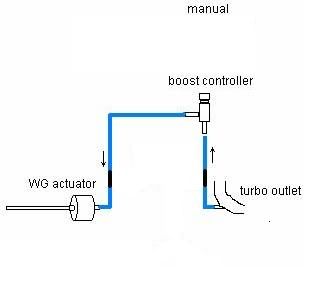
Inline from outlet nipple to WGA is by far the most effective route
Bleeding it off via MBC will just make the BOV hold less boost, but if you dont mind tapering WHP away - then by all means it's an easier way for the nonmechanical to fit a MBC.
Also, with MBC so high up the line from it to the WGA becomes excessively long which in turn decreases response - spike
Inline from outlet nipple to WGA is by far the most effective route

i thought hallman did , until i checked their website
http://www.hallmanboostcontroller.com/howto.html
http://www.hallmanboostcontroller.com/howto.html


Newbie
Joined: Dec 2006
Posts: 2
Likes: 0
From: Colorado Springs
Look, the MBC bleeds a good portion of the reference air off. This air is needed on top the BOV diaghram to hold the thing closed for maintaining boost on upwards.
Bleeding it off via MBC will just make the BOV hold less boost, but if you dont mind tapering WHP away - then by all means it's an easier way for the nonmechanical to fit a MBC.
Also, with MBC so high up the line from it to the WGA becomes excessively long which in turn decreases response - spike
Inline from outlet nipple to WGA is by far the most effective route
Bleeding it off via MBC will just make the BOV hold less boost, but if you dont mind tapering WHP away - then by all means it's an easier way for the nonmechanical to fit a MBC.
Also, with MBC so high up the line from it to the WGA becomes excessively long which in turn decreases response - spike
Inline from outlet nipple to WGA is by far the most effective route
I'm off the BOV line.. from reading this.. maybe that's why i'm spiking... i'll try the other way and see how it goes

Look, the MBC bleeds a good portion of the reference air off. This air is needed on top the BOV diaghram to hold the thing closed for maintaining boost on upwards.
Bleeding it off via MBC will just make the BOV hold less boost, but if you dont mind tapering WHP away - then by all means it's an easier way for the nonmechanical to fit a MBC.
Also, with MBC so high up the line from it to the WGA becomes excessively long which in turn decreases response - spike
Inline from outlet nipple to WGA is by far the most effective route
Bleeding it off via MBC will just make the BOV hold less boost, but if you dont mind tapering WHP away - then by all means it's an easier way for the nonmechanical to fit a MBC.
Also, with MBC so high up the line from it to the WGA becomes excessively long which in turn decreases response - spike
Inline from outlet nipple to WGA is by far the most effective route
T'ing off the BOV line has bugged the **** outta me for years, I don't understand why it's be so common to do this. Putting a probable boost leak on that line is almost as bad as tapping the FPR line for a boost gauge, yet another terrible place for a possible leak.
Even if there is no leak, the mbc still bleeds pressure out of the line resulting in the BOV to more than likely open while boosting. T'ing the MBC off the BOV is bad on all accounts. A bleeder type MBC (9/10 are this) are even worse in this situation because they are a vacuum leak when you let off, now we're getting into possible compressor surge.
Leave the BOV line alone!


Thread Starter
Evolved Member
iTrader: (38)
Joined: Nov 2006
Posts: 1,745
Likes: 10
From: New Hampshire, USA
More tips that I found from 2 years of MBC on Evo's with about 10 different configurations:
Plus, the manifold BOV source (being downstream TB) see's vacuum and the MBC and assoc lines become vacume between shifts and back to boost not to mention less spring preload from less psi, bla , bla , ramble BOV line sucks for MBC .

- Keep the line from MBC to WGA as short as you can but still be able to reach (for adjusting) to help avoid spikes.
- Use the thinnest ID tubing possible that you can slide over the nipples (outlet to MBC not as important).
- Try to use reinforced tubing to avoid punctures and mount away from heat.
- Ensure the bleed port isn't clogged and mount pointing down to avoid crap dropping in.
Plus, the manifold BOV source (being downstream TB) see's vacuum and the MBC and assoc lines become vacume between shifts and back to boost not to mention less spring preload from less psi, bla , bla , ramble BOV line sucks for MBC .
Thread Starter
Evolved Member
iTrader: (38)
Joined: Nov 2006
Posts: 1,745
Likes: 10
From: New Hampshire, USA
66% used Turbo Nipple
33% used BOV line
There seem to be a lot of technical explanations as to why the Turbo Nipple is the better choice, while the people that tapped BOV line simply say "Cause I was told to".
So... I think we can hand the win to Turbo Nipple.
33% used BOV line
There seem to be a lot of technical explanations as to why the Turbo Nipple is the better choice, while the people that tapped BOV line simply say "Cause I was told to".
So... I think we can hand the win to Turbo Nipple.

Both will work fine. I had to run off my BOV line because my BR LICP doesnt have a nipple. If I could I would run off the nipple as that boost source is right by the turbo outlet. If I had a leak in my LICP or FMIC or anywhere before the MBC I would not know now. I think that is a pretty quick way to sum up the technical explanation.
1. Hooking it up the compressor outlet nipple:
A. This way gives you less spikes but slower spool up.
B. It does not seem to give repeatable boost. It seems
to fluctuate more with the temperature.
C. Boost seems to be harder to control below 15 psi or
above 22 psi.
D. It is easier to hook up this way. No cutting any
boost lines. Plus the lines are kept shorter.
(Thus the less spikes).
2. Hooking it to the hose between the BOV and the intake:
A. This way seems to give slightly faster spool up than
the other way.
B. It gives more repeatable boost. It doesn't seem to
fluctuate as much with temperature differences.
C. The boost seems to be more controllable down to
stock turbo levels.
D. It is more work to hook up. You have to cut the hose
between the BOV and intake and tee it in. (Not
that this is hard, its just an extra step so I put it
in here)
Although I am having no issues from tapping to bov, I might switch to the turbo nipple to see if i can tell any differences

Where do you want to control boost pressure, at the turbo outlet or at the intake manifold? That should direct you on where to tap your boost reference. As the airflow (rpm) increases at wot, the pressure drop across your piping/intercooler also increases. You tap the turbo outlet, and you automatically will get boost taper that equals the pressure drop across your piping/intercooler which increases with rpm.
A manual boost controller doesn't "bleed" anything until desired boost is met. At which point, it controls the pressure in the manifold and in the vacuum line it's tapped into. So if you tap the BOV line, the BOV will still see the same pressure as the manifold is seeing, just like if it had it's own dedicated line.
A manual boost controller doesn't "bleed" anything until desired boost is met. At which point, it controls the pressure in the manifold and in the vacuum line it's tapped into. So if you tap the BOV line, the BOV will still see the same pressure as the manifold is seeing, just like if it had it's own dedicated line.