


Is it possible to Standardize Dyno Tests? Such as Starting RPM, AVG whp/wtq


Is it possible to Standardize Dyno Tests? Such as Starting RPM, AVG whp/wtq
I've noticed in several threads that questions concerning Peak whp and Peak wtq are used in comparisons of one dyno test to another. A PEAK number that is higher on the same car, same dyno may or may not be the best and most desireable tune. It seems that the AVERAGE power over the desired rpms is much more important. While this isn't any new revelation, it seems that we keep seeing these Peak numbers being used instead of the AVERAGE whp or AVERAGE wtq over the given rpm range. How difficult would it be for the Evo community to create our own set of standards for comparing a dyno test. An example would be to always and exactly start the run at 3000 rpms for 60lb and less turbos (just an example) and 3500 for 60+ turbos. By doing this, at least a BETTER comparison could be done when looking at various dyno charts. Such as % of increase between 3000 and 4000, or % of loss from crossover(5252) to 7000. This would help comparisons, even though the dynos will be completely different. I know for a FACT that starting the pulls early or late had an effect on the measured power from startup to 4000 rpms. After that, the chart appeared the same, regardless of start point, but it still would affect the 'area under the curve' or the 'AVERAGE horsepower/torque' on the pull.
By using Average numbers as opposed to PEAK numbers, the performance of the car in given rpm ranges would be more readily evaluated. I know that the Mustang has AVG as an option, just not too familiar with any of the others.
My above starting RPMS are only examples, but if we could get any kind of a standardized run (even if it's for only 1 final pull (in other words, the 'comparison pull', it would be helpful. There would be no difficulty to anyone involved, including the shop, since a standardized pull should be welcomed for comparisons. Any thoughts from the tuners or fellow EvoM'ers? Just a thought that we COULD have power over to help when comparing given parts, such as manifolds, cams, TB's, intakes, etc, since the % of gain or loss in the same rpm range is just as important at low rpm as it is at the higher rpm, and the AVERAGE whp/wtq is MORE important than a single Peak number.
By using Average numbers as opposed to PEAK numbers, the performance of the car in given rpm ranges would be more readily evaluated. I know that the Mustang has AVG as an option, just not too familiar with any of the others.
My above starting RPMS are only examples, but if we could get any kind of a standardized run (even if it's for only 1 final pull (in other words, the 'comparison pull', it would be helpful. There would be no difficulty to anyone involved, including the shop, since a standardized pull should be welcomed for comparisons. Any thoughts from the tuners or fellow EvoM'ers? Just a thought that we COULD have power over to help when comparing given parts, such as manifolds, cams, TB's, intakes, etc, since the % of gain or loss in the same rpm range is just as important at low rpm as it is at the higher rpm, and the AVERAGE whp/wtq is MORE important than a single Peak number.


Not that this helps but it's kind of on the same topic.
I'm getting an app written to analyze the area under the curve from two pulls on our Mustang dyno and spit out percentage gain at each RPM.
The reason for this is the same as what you are saying, people are too tunnel visioned on the peak numbers, which tell the smallest story about the power curves.
I'll post more details as I get it running well.
I'm getting an app written to analyze the area under the curve from two pulls on our Mustang dyno and spit out percentage gain at each RPM.
The reason for this is the same as what you are saying, people are too tunnel visioned on the peak numbers, which tell the smallest story about the power curves.
I'll post more details as I get it running well.
Wow, we must be on the same wave length. I just completed my percentage of gains on OKIX's car (or losses). I must have been calculating them while you were posting. Below is the HKS cams non-ported head, HKS with ported head and the JUN with ported head and the percentage of gain/loss at each rpm. I did both the wtq and the whp, but posting only the whp differences:
edited to add wtq numbers:

In summation, the JUN cams show gains with the ported head, where as the HKS 272's on this tune (also maxed out) show no gains and some losses below 5000, and reasonable gains above 5500.
Razorlab, great minds think alike.
edited to add wtq numbers:
In summation, the JUN cams show gains with the ported head, where as the HKS 272's on this tune (also maxed out) show no gains and some losses below 5000, and reasonable gains above 5500.
Razorlab, great minds think alike.
Last edited by 9sec9; Dec 31, 2007 at 02:13 PM.
The above post assumes that the 10.87 et run was equally as maxed as the dyno session was for the JUN's. I actually don't feel that the JUN's really were maxed in timing and AFR, as I've since found a few additional corrections to the tune that probably makes a slight difference at 4500 and 5500 rpms. Just thought this info would be interesting to review.

Thats really good info you can see where the gains were made easly.. I would like to do the same for my set up, did you write a program or just figure it out? I plan on going the same route with the jun setup but i still need to port my head and T.B..
Last edited by SuPeRNeT; Dec 31, 2007 at 01:27 PM.
These figures were completed by manually reviewing the dyno charts (graphs). A simple .xls file would do the same thing if you wanted to create one and plug in the whp/wtq at given rpms. This is why the combination of parts is very important to what the purpose of the engine/car is going to be. In this example, it would be easy to assume that a ported head with stock cams would not be a good combo. Even the HKS 272's on a ported head would not be good if the engine was being used for low to 5500 rpms (like coming out of corners, etc). On a stock head with the HKS272's, we made significant low end power as well as good topend power. The JUNS made good power gains down low through midrange and very good gains above 5500. In other words, they made good use of the ported head.
Trending Topics

Yeah, really all you need to do is determine the gains, rather than the peaks...
Yes 250 whp Dynojet is different than 250 Mustang... but, 50 whp gain is basically exactly the same on both. So really all people need to do is stop being cheap-asses and pay for baseline dynos I.E. I dynoed at 207 whp on a mustang, after tune, exhaust, drop-in, I dynoed at 272 on the very same dyno... So unless I don't understand dynos nearly as much as I think I do... If I dynoed 250 baseline on a Dynojet I would dyno 315 "now." But, I could definitely be wrong, so no one believe me until someone says "+1"
Yes 250 whp Dynojet is different than 250 Mustang... but, 50 whp gain is basically exactly the same on both. So really all people need to do is stop being cheap-asses and pay for baseline dynos
I.E. I dynoed at 207 whp on a mustang, after tune, exhaust, drop-in, I dynoed at 272 on the very same dyno... So unless I don't understand dynos nearly as much as I think I do... If I dynoed 250 baseline on a Dynojet I would dyno 315 "now." But, I could definitely be wrong, so no one believe me until someone says "+1"
Yeah, really all you need to do is determine the gains, rather than the peaks...
Yes 250 whp Dynojet is different than 250 Mustang... but, 50 whp gain is basically exactly the same on both. So really all people need to do is stop being cheap-asses and pay for baseline dynos I.E. I dynoed at 207 whp on a mustang, after tune, exhaust, drop-in, I dynoed at 272 on the very same dyno... So unless I don't understand dynos nearly as much as I think I do... If I dynoed 250 baseline on a Dynojet I would dyno 315 "now." But, I could definitely be wrong, so no one believe me until someone says "+1"
Yes 250 whp Dynojet is different than 250 Mustang... but, 50 whp gain is basically exactly the same on both. So really all people need to do is stop being cheap-asses and pay for baseline dynos
I.E. I dynoed at 207 whp on a mustang, after tune, exhaust, drop-in, I dynoed at 272 on the very same dyno... So unless I don't understand dynos nearly as much as I think I do... If I dynoed 250 baseline on a Dynojet I would dyno 315 "now." But, I could definitely be wrong, so no one believe me until someone says "+1"
Just take a .csv file from the pull (I assume the dyno pc can create this) and open it in Excel spreadsheet. Your percentages would be automatically calculated for you. I just don't happen to have Excel on this desktop, nor on my 'flashing/logging' pc. Then I was too lazy to copy out the logs/loads to a flash drive and open it on my 'programming laptop', so the old No.2 pencil and notepad had to work.
Just take a .csv file from the pull (I assume the dyno pc can create this) and open it in Excel spreadsheet. Your percentages would be automatically calculated for you. I just don't happen to have Excel on this desktop, nor on my 'flashing/logging' pc. Then I was too lazy to copy out the logs/loads to a flash drive and open it on my 'programming laptop', so the old No.2 pencil and notepad had to work.

I was just curious to see my avg. hp from 4k to 7100 and I got 362.12 hp not too bad by an means on e70..
We have sence then added a lot mor timing up top so im not sure were i am now.
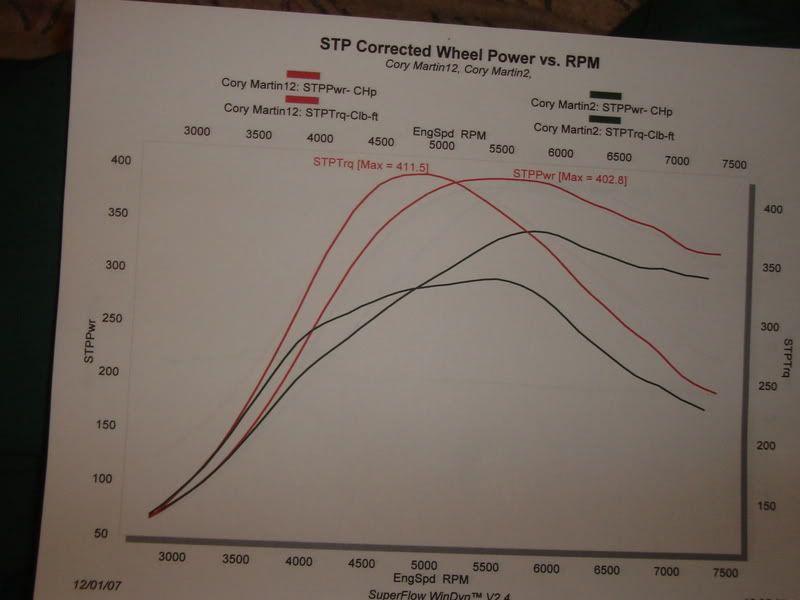
We have sence then added a lot more timing up top so im not sure were i am now.
We have sence then added a lot mor timing up top so im not sure were i am now.
We have sence then added a lot more timing up top so im not sure were i am now.
Nice SuPeRNet. The average numbers will be a better way to determine performance than just a peak number. If the starting rpm is held as a standard, then the average numbers and power improvements can be compared from dyno to dyno. There will always be the 'number difference', but the percentage of gain from rpm to rpm can be compared.