


What's important and what's not for making power...




Even maintaining exactly stock geometry, a built bottom end can make more power. When I finally get around to building my motor (everything) I will dyno before and after on the same setup (externally anyway) and see if there was any gain. I am gonna build my motor how I did my BBC...Pro Stock or go home 

this is also incorrect.
building a bottom end CAN make power. different piston dome shapes, ceramic piston coatings, different compression ratios, different stroke lengths, different cylinder bore, anti friction coatings, knife edged crank, lighter pistons, lighter rods, will add reduce parasitic losses/make for a more efficient burn/in effect make more power. if your going to the trouble to build a motor at least some of these steps will be taken, even if the gains are minimal.
building a bottom end CAN make power. different piston dome shapes, ceramic piston coatings, different compression ratios, different stroke lengths, different cylinder bore, anti friction coatings, knife edged crank, lighter pistons, lighter rods, will add reduce parasitic losses/make for a more efficient burn/in effect make more power. if your going to the trouble to build a motor at least some of these steps will be taken, even if the gains are minimal.
EDIT: before someone brings this up the Groden Aluminium rods are stupid light. Dont k now if they are heavier then stock or not butg all forged alloy rods are by alot.
Last edited by whitey4d; Feb 15, 2008 at 03:39 PM.

i can see that this thread could easily have been prompted by the "500whps stock block club" thread, and it' is a good addendum to it. it is easy for someone to get the wrong idea when they see a post about a stock block making 500+whp, moreover multiple ones. what is often left unsaid is that many of the the stock blocks making that much power were often:
a) expected to blow, and the owner was k=just trying to see how far they could take it before it did
and/or
b) dynoed at this tune just to reach this number, then tuned down to a safer level
additionally, a stock block making 500whp consistently is not the same as one doing so reliably for a long time.
threads like this are good for putting things back into perspective, especially when you have a hundred people on here who are all too eager to reach a certain power number.
a) expected to blow, and the owner was k=just trying to see how far they could take it before it did
and/or
b) dynoed at this tune just to reach this number, then tuned down to a safer level
additionally, a stock block making 500whp consistently is not the same as one doing so reliably for a long time.
threads like this are good for putting things back into perspective, especially when you have a hundred people on here who are all too eager to reach a certain power number.
This was PRECISELY the point. Thanks for the post.
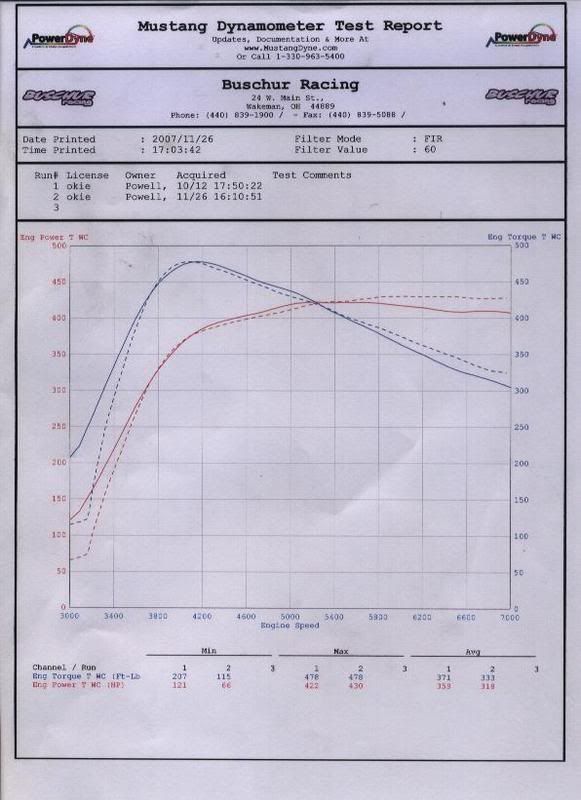
One more final comment then I'll get out, I've said my 2 cents. If simply building the bottom end with top quality parts would make more power, then why did we only pick up 15-18 whp WITH a built bottom end using forged rods, pistons and the full stage 3 short block from Buschur Racing AND on top of that a Stage 3 head and lighter valves? The head alone was the only reason we made the additional 15-18 horsepower. The build in and of it's self did not make the additional power. All dimensions were left stock, e.g. bore, stroke and compression. ONLY the head was changed to increase power. The engine build just gave us more reliability. Again, thanks hokiruu for helping make the point.

This was PRECISELY the point. Thanks for the post.
One more final comment then I'll get out, I've said my 2 cents. If simply building the bottom end with top quality parts would make more power, then why did we only pick up 15-18 whp WITH a built bottom end using forged rods, pistons and the full stage 3 short block from Buschur Racing AND on top of that a Stage 3 head and lighter valves? The head alone was the only reason we made the additional 15-18 horsepower. The build in and of it's self did not make the additional power. All dimensions were left stock, e.g. bore, stroke and compression. ONLY the head was changed to increase power. The engine build just gave us more reliability. Again, thanks hokiruu for helping make the point.
One more final comment then I'll get out, I've said my 2 cents. If simply building the bottom end with top quality parts would make more power, then why did we only pick up 15-18 whp WITH a built bottom end using forged rods, pistons and the full stage 3 short block from Buschur Racing AND on top of that a Stage 3 head and lighter valves? The head alone was the only reason we made the additional 15-18 horsepower. The build in and of it's self did not make the additional power. All dimensions were left stock, e.g. bore, stroke and compression. ONLY the head was changed to increase power. The engine build just gave us more reliability. Again, thanks hokiruu for helping make the point.

If simply building the bottom end with top quality parts would make more power, then why did we only pick up 15-18 whp WITH a built bottom end using forged rods, pistons and the full stage 3 short block from Buschur Racing AND on top of that a Stage 3 head and lighter valves?
It might not account for much, but parasitic loss because of piston skirt design versus a low drag design (full skirt v Mahle for instance), low drag rings with gas ported piston instead of extra wide rings all add up to less drag. Rods and pistons in and of themselves (stock design with aftermarket materials) wouldnt make any difference to be sure. Then there are all the high tech coatings that can be applied to the top and sides of the piston (or already are in the case of the Mahles)
The Head is where 98% of the power is, but to say that there isnt any in the bottom end is silly.
The Head is where 98% of the power is, but to say that there isnt any in the bottom end is silly.


This was PRECISELY the point. Thanks for the post.
One more final comment then I'll get out, I've said my 2 cents. If simply building the bottom end with top quality parts would make more power, then why did we only pick up 15-18 whp WITH a built bottom end using forged rods, pistons and the full stage 3 short block from Buschur Racing AND on top of that a Stage 3 head and lighter valves? The head alone was the only reason we made the additional 15-18 horsepower. The build in and of it's self did not make the additional power. All dimensions were left stock, e.g. bore, stroke and compression. ONLY the head was changed to increase power. The engine build just gave us more reliability. Again, thanks hokiruu for helping make the point.
One more final comment then I'll get out, I've said my 2 cents. If simply building the bottom end with top quality parts would make more power, then why did we only pick up 15-18 whp WITH a built bottom end using forged rods, pistons and the full stage 3 short block from Buschur Racing AND on top of that a Stage 3 head and lighter valves? The head alone was the only reason we made the additional 15-18 horsepower. The build in and of it's self did not make the additional power. All dimensions were left stock, e.g. bore, stroke and compression. ONLY the head was changed to increase power. The engine build just gave us more reliability. Again, thanks hokiruu for helping make the point.
Last edited by 9sec9; Feb 15, 2008 at 04:47 PM.

9sec9 you are totally right with this thread. It is great to see someone come out and finally say it. The next common misinterpretation is linear and hard limits on "how much power can i make on the stock turbo", "how much HP will i get with this setup", "how can i get to xxxhp", "how much boost can the stock turbo run". There are so many variables there is no way to accurately predict anything in this game without variation.

Evolved Member
Joined: Aug 2006
Posts: 1,427
Likes: 4
From: Sag-Nasty, MI
Example, someone on a budget that allows them to do a mod here and there, wants to go fast this summer.
He could save up all his $$ for a year or two or more, and do it all at once, and have a built motor and a fast car. Problem, he's been bitten by the speed bug and wants to go faster now....
So you don't have the money to go built motor yet, but you could go with a smaller turbo and supporting mods, right? sure... that's a nice waste of 1700 bucks if you already know it won't be fast enough in 6 months... speed bug again.
So what's happening is people are getting the big turbo kits, sacrificing some drive ability, and just buying what they need to get it to work... so later, when the funds are there to actually get internals, coil on plug, and other things.. they already have the big turbo waiting to turn up the boost and make more power.
It's all about horsepower to dollar. you get the car and put a TB exhaust on it... good gains... MBC, great! Cams, excellent... those things you can really feel the difference. Now the next time you've got a few grand to play with... what's the biggest bang for the buck.... well, I can give you a hint, it's not building the engine or sending your trans in to Shep.
It's difficult to do these cars one mod at a time, if you're the type that isn't sitting on a gold mine and really wants to feel an improvement every time they shell out another thousand bucks... it is a very difficult thing to spend the money to build an engine and drop it in to get.. pretty much no gain compared to the $$ it costs.
If there is a way to "get away" with something, guaranteed there will be someone there trying to do it. It doesn't mean it's a smart thing to do, but it will be done. And it might blow up. Might not though.
He could save up all his $$ for a year or two or more, and do it all at once, and have a built motor and a fast car. Problem, he's been bitten by the speed bug and wants to go faster now....
So you don't have the money to go built motor yet, but you could go with a smaller turbo and supporting mods, right? sure... that's a nice waste of 1700 bucks if you already know it won't be fast enough in 6 months... speed bug again.
So what's happening is people are getting the big turbo kits, sacrificing some drive ability, and just buying what they need to get it to work... so later, when the funds are there to actually get internals, coil on plug, and other things.. they already have the big turbo waiting to turn up the boost and make more power.
It's all about horsepower to dollar. you get the car and put a TB exhaust on it... good gains... MBC, great! Cams, excellent... those things you can really feel the difference. Now the next time you've got a few grand to play with... what's the biggest bang for the buck.... well, I can give you a hint, it's not building the engine or sending your trans in to Shep.
It's difficult to do these cars one mod at a time, if you're the type that isn't sitting on a gold mine and really wants to feel an improvement every time they shell out another thousand bucks... it is a very difficult thing to spend the money to build an engine and drop it in to get.. pretty much no gain compared to the $$ it costs.
If there is a way to "get away" with something, guaranteed there will be someone there trying to do it. It doesn't mean it's a smart thing to do, but it will be done. And it might blow up. Might not though.

With an extra 180 ft/lbs of torque, just one count of preignition can be enough to break moving parts.
Here is some info I gathered not through exp, just from reading. Should be accurate to the point of memory, most you probably know most of it though:
Preignition is caused by CHTs, and pinging from CHT's and EGTs. Colder plugs combat CHT's but not EGT's and charge cooling helps both. High boost on small turbos at high rpm makes exhaust backpressure causing internal egr at valve overlap promoting preignition. Alcohol has reversable antiknock behavior following TEL, my guess MMT too (the orange stuff). Tuning = minimal timing for best torque, AFR should be - cough, scuse me. Peak and average cyl pressure doesn't change much from boost when compared to knocking. Being octane limited either results in being slow or being forged and ARP fastenered. You are much better off having a drunk evo drive you rather than the opposite.
In that dyno comparison above I would guess the reason the head makes more with same psi is from increased pumping efficiency, duh?
Here is some info I gathered not through exp, just from reading. Should be accurate to the point of memory, most you probably know most of it though:
Preignition is caused by CHTs, and pinging from CHT's and EGTs. Colder plugs combat CHT's but not EGT's and charge cooling helps both. High boost on small turbos at high rpm makes exhaust backpressure causing internal egr at valve overlap promoting preignition. Alcohol has reversable antiknock behavior following TEL, my guess MMT too (the orange stuff). Tuning = minimal timing for best torque, AFR should be - cough, scuse me. Peak and average cyl pressure doesn't change much from boost when compared to knocking. Being octane limited either results in being slow or being forged and ARP fastenered. You are much better off having a drunk evo drive you rather than the opposite.
In that dyno comparison above I would guess the reason the head makes more with same psi is from increased pumping efficiency, duh?
Last edited by C6C6CH3vo; Feb 15, 2008 at 10:49 PM.

Account Disabled
Joined: Feb 2008
Posts: 67
Likes: 0
From: In a house
Those threads let people know what the limits are on the stock bottom end. It's valuable information.
You have plenty of money to have 2 fully built cars - good for you, many people don't. I would upgrade my block in a second if i had money for it, until then i will be looking at those threads to determine what a stock block can handle.
You have plenty of money to have 2 fully built cars - good for you, many people don't. I would upgrade my block in a second if i had money for it, until then i will be looking at those threads to determine what a stock block can handle.

Evolved Member
Joined: Aug 2006
Posts: 1,427
Likes: 4
From: Sag-Nasty, MI
The worst thing to do would be throw a big turbo on a stock block and see how fast it spools in 5th at WOT, lots of fatigue there
(ok, maybe not the absolute worst, 7k launch would be worse
 )
) 
The benefits of MIVEC for egr, water/meth for EGT and CHT. Both before and after dyno runs represent both and the ability to take those into account. The pumping efficiency through head work has always been the goal when doing head work. The purpose of showing this particular dyno sheet was to support the theory that even though the engine was 'built', it would not have shown much if any whp increase without the head work. Maybe 3-4 at most. V8's can show more increase by virtue of parsitic losses being reduced more due to 8 pistons and rods as opposed to 4. Align boring, piston/wall clearance, bearing clearances, etc all contribute to minimal gains. Not sure what's done now, but when we built short blocks on our race cars, we measured the effort required to 'turn the assembly' over by hand, without heads installed. If it was more than 1.4 lbs, it came apart and was re-checked.


Ive read of people dropping in rods and pistons with the motor still in the car( or maybe im tripping?), not sure how the rings would break in properly like that but how much is that?