


AMS to now offer the FP HTA series Turbos



Thread Starter
Former Sponsor
iTrader: (42)
Joined: Oct 2003
Posts: 6,132
Likes: 3
From: West Chicago, IL
soo a intake is 100-200.....thats still 800 diff over other kits of the same thing..
ETS comes with downpipe and intake, buscher is downpipe for sure ( not so sure on the intake though )
so again, I'm NOT trying to be a d1ck, I just don't see a 1k diff to see AMS welded on the manifold. granted there kits are top notch, but so are ETS and Buscher as far as I'm concerned
ETS comes with downpipe and intake, buscher is downpipe for sure ( not so sure on the intake though )
so again, I'm NOT trying to be a d1ck, I just don't see a 1k diff to see AMS welded on the manifold. granted there kits are top notch, but so are ETS and Buscher as far as I'm concerned
https://www.evolutionm.net/forums/sh...d.php?t=310298
Check that out and you will see why our kits cost more, quite simply...they cost a lot more to make and for good reason.
Eric
Last edited by AutoMotoSports; Mar 7, 2008 at 02:50 PM.
Thread Starter
Former Sponsor
iTrader: (42)
Joined: Oct 2003
Posts: 6,132
Likes: 3
From: West Chicago, IL
I made it easy on you 
Here is that post
Here is that post
Due to some recent discussions here are some points of our turbo kit that make it the best kit on the market and why it costs more to manufacture.
1. Manifold. Some of you might notice that some other turbo kits have larger diameter runners than our kit. Bigger is better right? In this case wrong. If you go top big on the diameter of the runners then all you are doing is losing exhaust energy and increasing turbo lag. This is because if the exhaust gas comes out of the head port and into a larger cross section area it slows down and the pressure changes, and as it meets back in the turbine it has to speed up and the pressure changes again (Bernoulli principle). The more the speed and pressure change the more energy is lost, giving our turbine less potential. Again these are things that we have tested in the past and why we use custom mandrel bend tubing to our specifications rather then much cheaper cast weld-els which are available in very limited sizes.
Our Manifold has forged transition pieces that take the oval port of the head and transition it to the round runners. This smooth transition is better for flow. We've also tested a lot of variations of our turbo kit back in 2003. It took us over 6 months of testing out kit to finalize our design. We've tried different collectors, bend angles, ect. and what we came up with fit the best in the car and performed. The angle of our merge collector is what it is because it doesn't hurt flow and allows for better fitment of the runners.


2. O2 Housing As you can see this is a very complex part that is expensive to manufacture. You have a turbine housing that now you custom machine and port, a more complex flange to make, and a proper wastegate dump tube with a double slip fit joint and return that is further downstream as to not disrupt post-turbine gas flow. The header, turbine housing, wastegate piping, and o2 housing all heat up at different rates and grow differently, as the car goes through thermal cycles this needs to be addressed because it can cause a failure. Our design allows for this and can take years of punishment and thousands of road racing miles (like our Time Attack car). Just look at burnsstainless site and see what they say about double slip fit. Their stuff is used on many pro race teams and it's very expensive! If you do see any leaks it's because when the pipes are dead cold they sometimes allow some leakage and as soon as it heats up the joint expands to form a tight seal, that's how they work. http://www.burnsstainless.com/MergeC...ollectors.html It takes roughly 5-6 hours to make one of our o2 housing, it's very labor intensive.


All of our flanges are surface ground flat, this ensures no leaks on the manifold or O2 hsg. Upon inspection, even after 1 year of 10+ events, testing, dyno, ect our kit on our time attack was sealed tight and mating surfaces were clean.
As for the rest of the kit.
Downpipe The downpipe incorporates a flex section, why you ask? Well the 4G63 in the EVO is a transverse mount, meaning the crankshaft is perpendicular to the direction of the vehicles motion. If you've ever seen an evo on a dyno you'll notice how much the engine & trans (they are mounted together) rock back and forth under accel/decel. The factory OEM turbo setup used a ball & socket type swivel with a doughnut gasket on the o2 to downpipe transition. The downpipe is bolted up with some spring loaded fasteners to allow for movement between the engine and the exhaust system. The factory uses a heavy duty cast manifold and small turbo and it still uses this flex system and a support bracket! If there is no provision for this movement your turbo kit and exhaust system will want to rock back and forth together, putting a lot of stress on those part which will eventually lead to some sort of failure.
Check out these photos


All the feed and return lines are high quality and high temperature material. Oil feed line is a s.s. braided teflon line. The oil return line is an Aeroquip industrial hose (not just rubber) that is multilayer and braided for strength and heat resistance.

Water lines

The water feed and return lines are 3ply braided silicone lines that will not burst and hold up to the most extreme applications (rally and road race)
Turbo Support Bracket The importance of a turbo kit support bracket cannot be stressed enough! we've put over 3000 miles of road racing our time attack car and have had no issues with any cracks or leaks. Our kit even outlasted a Garrett GT35R turbo, which failed a few events ago after two years of abuse. If you look at the FACTORY turbo setup you'll notice they also include a support bracket!

The proof is here!
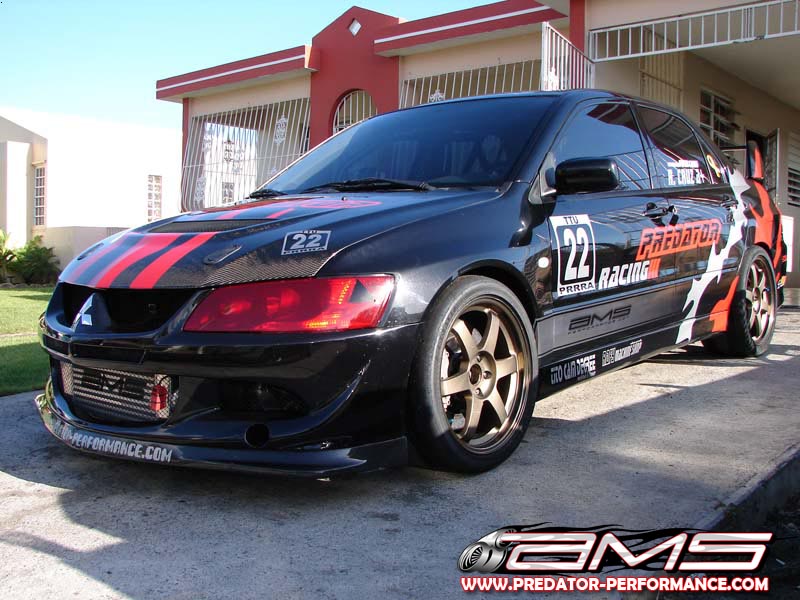
These are just some of the examples of race cars that run our turbo kits & engines. A rally or road race car is the ultimate testament to product durability, if it can survive hours and hours of abuse and hundreds if not thousands of miles of race stress, it has proven itself for a lifetime of road and drag use. Drag racing in particular does not reflect on product durability, it pales in comparison to even daily street use. It may take a year of street driving to reveal any issues with durability, but on a road race or rally car, it may take only 30 minutes of heavy abuse to find issues. Ask any racer and I'm sure you've heard the quote, "hey it works fine on the street?"
Hill climb car from Europe with our turbo kit and engine

Predator Performance road race car with our turbo kit
Roger Feghali's winning Rally car with our turbo kit and engine

Our Time Attack car with over 3000 miles of road racing on it's odometer!

If you have any questions regarding our kit please feel free to ask me!
Regards,
1. Manifold. Some of you might notice that some other turbo kits have larger diameter runners than our kit. Bigger is better right? In this case wrong. If you go top big on the diameter of the runners then all you are doing is losing exhaust energy and increasing turbo lag. This is because if the exhaust gas comes out of the head port and into a larger cross section area it slows down and the pressure changes, and as it meets back in the turbine it has to speed up and the pressure changes again (Bernoulli principle). The more the speed and pressure change the more energy is lost, giving our turbine less potential. Again these are things that we have tested in the past and why we use custom mandrel bend tubing to our specifications rather then much cheaper cast weld-els which are available in very limited sizes.
Our Manifold has forged transition pieces that take the oval port of the head and transition it to the round runners. This smooth transition is better for flow. We've also tested a lot of variations of our turbo kit back in 2003. It took us over 6 months of testing out kit to finalize our design. We've tried different collectors, bend angles, ect. and what we came up with fit the best in the car and performed. The angle of our merge collector is what it is because it doesn't hurt flow and allows for better fitment of the runners.
2. O2 Housing As you can see this is a very complex part that is expensive to manufacture. You have a turbine housing that now you custom machine and port, a more complex flange to make, and a proper wastegate dump tube with a double slip fit joint and return that is further downstream as to not disrupt post-turbine gas flow. The header, turbine housing, wastegate piping, and o2 housing all heat up at different rates and grow differently, as the car goes through thermal cycles this needs to be addressed because it can cause a failure. Our design allows for this and can take years of punishment and thousands of road racing miles (like our Time Attack car). Just look at burnsstainless site and see what they say about double slip fit. Their stuff is used on many pro race teams and it's very expensive! If you do see any leaks it's because when the pipes are dead cold they sometimes allow some leakage and as soon as it heats up the joint expands to form a tight seal, that's how they work. http://www.burnsstainless.com/MergeC...ollectors.html It takes roughly 5-6 hours to make one of our o2 housing, it's very labor intensive.
All of our flanges are surface ground flat, this ensures no leaks on the manifold or O2 hsg. Upon inspection, even after 1 year of 10+ events, testing, dyno, ect our kit on our time attack was sealed tight and mating surfaces were clean.
As for the rest of the kit.
Downpipe The downpipe incorporates a flex section, why you ask? Well the 4G63 in the EVO is a transverse mount, meaning the crankshaft is perpendicular to the direction of the vehicles motion. If you've ever seen an evo on a dyno you'll notice how much the engine & trans (they are mounted together) rock back and forth under accel/decel. The factory OEM turbo setup used a ball & socket type swivel with a doughnut gasket on the o2 to downpipe transition. The downpipe is bolted up with some spring loaded fasteners to allow for movement between the engine and the exhaust system. The factory uses a heavy duty cast manifold and small turbo and it still uses this flex system and a support bracket! If there is no provision for this movement your turbo kit and exhaust system will want to rock back and forth together, putting a lot of stress on those part which will eventually lead to some sort of failure.
Check out these photos
All the feed and return lines are high quality and high temperature material. Oil feed line is a s.s. braided teflon line. The oil return line is an Aeroquip industrial hose (not just rubber) that is multilayer and braided for strength and heat resistance.
Water lines
The water feed and return lines are 3ply braided silicone lines that will not burst and hold up to the most extreme applications (rally and road race)
Turbo Support Bracket The importance of a turbo kit support bracket cannot be stressed enough! we've put over 3000 miles of road racing our time attack car and have had no issues with any cracks or leaks. Our kit even outlasted a Garrett GT35R turbo, which failed a few events ago after two years of abuse. If you look at the FACTORY turbo setup you'll notice they also include a support bracket!
The proof is here!
These are just some of the examples of race cars that run our turbo kits & engines. A rally or road race car is the ultimate testament to product durability, if it can survive hours and hours of abuse and hundreds if not thousands of miles of race stress, it has proven itself for a lifetime of road and drag use. Drag racing in particular does not reflect on product durability, it pales in comparison to even daily street use. It may take a year of street driving to reveal any issues with durability, but on a road race or rally car, it may take only 30 minutes of heavy abuse to find issues. Ask any racer and I'm sure you've heard the quote, "hey it works fine on the street?"
Hill climb car from Europe with our turbo kit and engine
Predator Performance road race car with our turbo kit
Roger Feghali's winning Rally car with our turbo kit and engine
Our Time Attack car with over 3000 miles of road racing on it's odometer!
If you have any questions regarding our kit please feel free to ask me!
Regards,


2. O2 Housing As you can see this is a very complex part that is expensive to manufacture. You have a turbine housing that now you custom machine and port, a more complex flange to make, and a proper wastegate dump tube with a double slip fit joint and return that is further downstream as to not disrupt post-turbine gas flow. The header, turbine housing, wastegate piping, and o2 housing all heat up at different rates and grow differently, as the car goes through thermal cycles this needs to be addressed because it can cause a failure. Our design allows for this and can take years of punishment and thousands of road racing miles (like our Time Attack car). Just look at burnsstainless site and see what they say about double slip fit. Their stuff is used on many pro race teams and it's very expensive! If you do see any leaks it's because when the pipes are dead cold they sometimes allow some leakage and as soon as it heats up the joint expands to form a tight seal, that's how they work. http://www.burnsstainless.com/MergeC...ollectors.html It takes roughly 5-6 hours to make one of our o2 housing, it's very labor intensive.
Last edited by turboDan; Mar 7, 2008 at 09:12 PM.

I understand where your coming from but I had both AMS and Buschur 35r and Ams turbo kits are way better quality. The welds play a big a factor in these turbo kits especially the o2 housing and the flex on the downpipe. I mean if you want something from the top of line fabricators order yourself an Ams turbo kit and you will see where im coming from.
evo 8 u.. if you are really breaking it down, need to realize that AMS uses the Tial 38mm wastegate(usually $225ish) while buschur uses the Tial 44mm(usually $350-370ish)
The reason I think they are slightly more experience is the fact that they are in Chicago, and Buschur is out in the middle of nowhere... When I went to buschur to get some things done, I thought their shop might be out in the middle of a barn. Anyhow even though Buschur's facility is top notch, you have to figure real estate taxes and just the property itself is a big.. BIG difference.
Not to mention they sell plenty of items at the price they currently are.... So why would you lower it?
The reason I think they are slightly more experience is the fact that they are in Chicago, and Buschur is out in the middle of nowhere... When I went to buschur to get some things done, I thought their shop might be out in the middle of a barn. Anyhow even though Buschur's facility is top notch, you have to figure real estate taxes and just the property itself is a big.. BIG difference.
Not to mention they sell plenty of items at the price they currently are.... So why would you lower it?


AMS,
I currently run your 50 Trim kit which I got from a group buy a long time ago.
Will the 5 bolt .63 a/r back end still work on my existing 02 housing from the 50 trim kit?
I currently run your 50 Trim kit which I got from a group buy a long time ago.
Will the 5 bolt .63 a/r back end still work on my existing 02 housing from the 50 trim kit?

Newbie
Joined: Aug 2007
Posts: 66
Likes: 0
From: Pakistan
I understand where your coming from but I had both AMS and Buschur 35r and Ams turbo kits are way better quality. The welds play a big a factor in these turbo kits especially the o2 housing and the flex on the downpipe. I mean if you want something from the top of line fabricators order yourself an Ams turbo kit and you will see where im coming from.
Did you dynoed your car on both kits? If so, I'd appreciate if u put dyno charts here, provided if engine setup was same in both cases.
I'm just curious to know which one had better spooling in street & drag racing, offered more power, overall better performance & better power curve

How do I obtain one of these new style o2 housings? I have your 35r "kit" and for some reason my o2 housing does NOT have that slip fit and does constantly crack, 2 times within 1000 miles.I have since had it tig welded and recoated and have not put it back on yet.Maybe that is why you now use that slip fit joint? Is the o2 housing covered under that "limited lifetime warranty" or is it just the header?
How do I obtain one of these new style o2 housings? I have your 35r "kit" and for some reason my o2 housing does NOT have that slip fit and does constantly crack, 2 times within 1000 miles.I have since had it tig welded and recoated and have not put it back on yet.Maybe that is why you now use that slip fit joint? Is the o2 housing covered under that "limited lifetime warranty" or is it just the header?
What I find funny is that AMS started this thread and continued to post in this thread,right up until the time I questioned them about the "quality" of their o2 housing that was in the "kit" I purchased from them and the fact that it does NOT have the slip joint fitting and that it DOES crack and how I go about obtaining a new one with the Slip Joint and if it is "lifetime" warranty and they have since NOT posted in this thread..... Way to stand behind your product's AMS. ......I know if Dave Buschur started this thread and a question like I posted over a week ago was asked he would have responded within a few hours,not just "blown it off"...
Oh well,they must be too busy counting their money to care about customers concerns......
......I know if Dave Buschur started this thread and a question like I posted over a week ago was asked he would have responded within a few hours,not just "blown it off"...Oh well,they must be too busy counting their money to care about customers concerns......

What I find funny is that AMS started this thread and continued to post in this thread,right up until the time I questioned them about the "quality" of their o2 housing that was in the "kit" I purchased from them and the fact that it does NOT have the slip joint fitting and that it DOES crack and how I go about obtaining a new one with the Slip Joint and if it is "lifetime" warranty and they have since NOT posted in this thread..... Way to stand behind your product's AMS. ......I know if Dave Buschur started this thread and a question like I posted over a week ago was asked he would have responded within a few hours,not just "blown it off"...
Oh well,they must be too busy counting their money to care about customers concerns......
......I know if Dave Buschur started this thread and a question like I posted over a week ago was asked he would have responded within a few hours,not just "blown it off"...Oh well,they must be too busy counting their money to care about customers concerns......
