


Boost leak test and trange results...


+1 i had a post on this a few months back. my car does the same thing. air comes out of the valve cover when i boost leak test. never got a answer. i suspect something with the turbo because it never did it with the stock turbo.

Thread Starter
Evolving Member
Joined: Aug 2006
Posts: 499
Likes: 1
From: I'm Canadian living and working in Dubai/Kuwait/Bahrain
There are 2 lines connected to the wastegate...
1 to the boost controller solenoid (vacuum)
1 to the vacuum/boost line
but then again this is on the hot side guys...
i think the culprit is the oil feed line for the turbo but how the heck does that leak only one way because wouldent you think the oil pressure would make the oil flood into the cold side when idling.... no oil!! clean as a whistle...
ok removing the feed line would pinpoint but right now its hard for me to do that job as its a big and messy job if need be i will do it but i would like to avoid that especially if its not the problem..
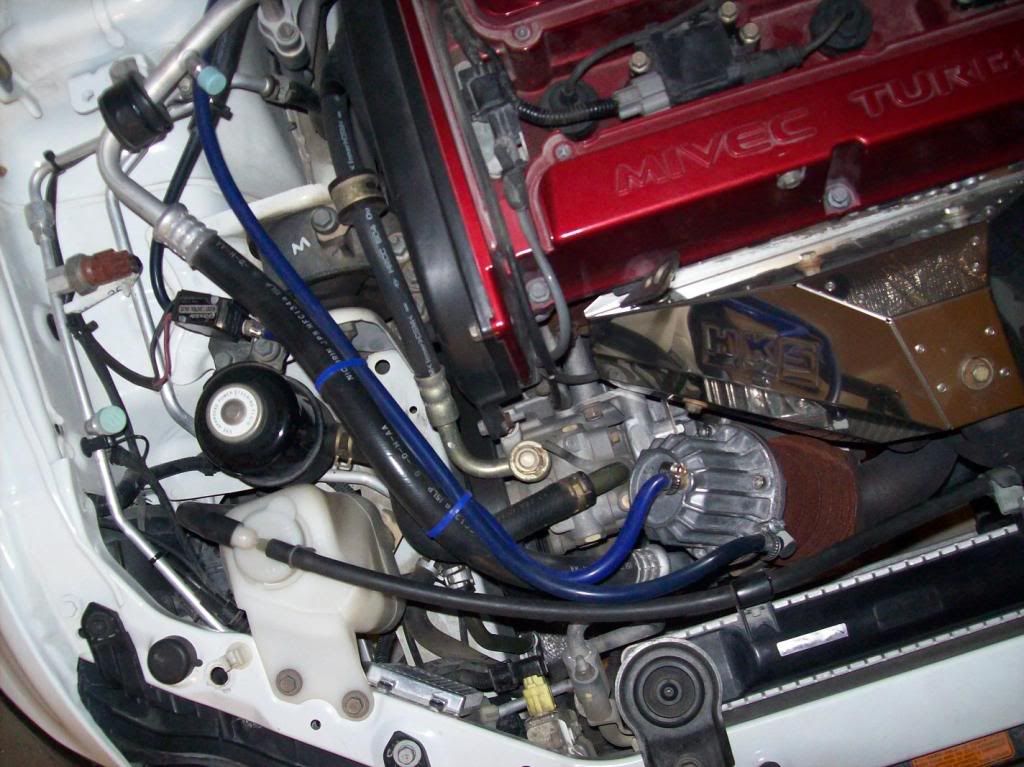
1 to the boost controller solenoid (vacuum)
1 to the vacuum/boost line
but then again this is on the hot side guys...
i think the culprit is the oil feed line for the turbo but how the heck does that leak only one way because wouldent you think the oil pressure would make the oil flood into the cold side when idling.... no oil!! clean as a whistle...
ok removing the feed line would pinpoint but right now its hard for me to do that job as its a big and messy job if need be i will do it but i would like to avoid that especially if its not the problem..
Thread Starter
Evolving Member
Joined: Aug 2006
Posts: 499
Likes: 1
From: I'm Canadian living and working in Dubai/Kuwait/Bahrain
YES exactly like me stock turbo did not do it... this setup its the first time to boost leak test and this is what i'm getting...

The OP in theory should be able to completely seal the system he is testing, as he is NOT connected to the intake manifold.

Evolved Member
Joined: Oct 2002
Posts: 2,788
Likes: 1
What don't you understand about that?
Evolved Member
Joined: Oct 2002
Posts: 2,788
Likes: 1
It's normal to have some pressure vent at the valve cover ONLY IF you do a normal boost leak test, in which you leave the throttle body connected, and pressurize the entire engine. Some of the valves are open and pressure will leak slowly past the rings into the crankcase - and vent.
The OP in theory should be able to completely seal the system he is testing, as he is NOT connected to the intake manifold.
The OP in theory should be able to completely seal the system he is testing, as he is NOT connected to the intake manifold.
Thread Starter
Evolving Member
Joined: Aug 2006
Posts: 499
Likes: 1
From: I'm Canadian living and working in Dubai/Kuwait/Bahrain
It's normal to have some pressure vent at the valve cover ONLY IF you do a normal boost leak test, in which you leave the throttle body connected, and pressurize the entire engine. Some of the valves are open and pressure will leak slowly past the rings into the crankcase - and vent.
The OP in theory should be able to completely seal the system he is testing, as he is NOT connected to the intake manifold.
The OP in theory should be able to completely seal the system he is testing, as he is NOT connected to the intake manifold.
perhaps this turbo has a one way valve system...
lets break it down.... doing a compression test in this case is compressing air before the blades where in normal running condition the compression will happen after the blades....
is it possible that the design is to allow the aspirated low pressure air before the compression stage into the system and with the boost test i'm actually creating a pressurized state before the compression stage?
sounds like astronomy but read it a few times to get my point...
Thread Starter
Evolving Member
Joined: Aug 2006
Posts: 499
Likes: 1
From: I'm Canadian living and working in Dubai/Kuwait/Bahrain

ok so here we are, with what said earlier.. there is a cone inside the intake supported by three screws to centralize it and possibly there is a one way valve incorporated in there or something...
apparently the design is to allow the air to flow more smoothly and doubt it has anything to do with my issue but might as well show a clearer picture of the situation i am facing
Last edited by dxbtune; May 1, 2009 at 02:08 PM.
yes slipped my mind there absolutely right...
perhaps this turbo has a one way valve system...
lets break it down.... doing a compression test in this case is compressing air before the blades where in normal running condition the compression will happen after the blades....
is it possible that the design is to allow the aspirated low pressure air before the compression stage into the system and with the boost test i'm actually creating a pressurized state before the compression stage?
sounds like astronomy but read it a few times to get my point...
perhaps this turbo has a one way valve system...
lets break it down.... doing a compression test in this case is compressing air before the blades where in normal running condition the compression will happen after the blades....
is it possible that the design is to allow the aspirated low pressure air before the compression stage into the system and with the boost test i'm actually creating a pressurized state before the compression stage?
sounds like astronomy but read it a few times to get my point...
 Are you talking about an anti-surge compressor housing? If so, it just allows over-boost to equalize back to the low pressure area in front of the turbo inlet:
That would not change anything about your boost leak test.

Thread Starter
Evolving Member
Joined: Aug 2006
Posts: 499
Likes: 1
From: I'm Canadian living and working in Dubai/Kuwait/Bahrain

now back to the strange situation im facing....


Has any one thought simple...?
Any one ever felt the air that comes out of these power pumps that run on electricity vs. the ones that are in a big air tank. It looks the a little travel unit... I am no expert, and am not claiming to be, just read through the post, visualized, inspected, and have a theory...
That little air pump probably gets real hot. I would have to say that hot air rises. One, could a valve be open, and as the air goes through the blower side of the turbo, could it be warm enough to rise through the exhaust, or through the oil line, to bubble any where that is up. 2nd thing, its pressurized, which makes it move or travel that much faster, fill every ounce of open space, even if it is the minutest of cracks. Doesnt matter which end of the mattress the pump blows air, it all pressurizes the same. Oil may be thick, but oxygen or compressed air still rises through it. And if you think about a valve that only moves one way in circulating system, could this be a design flaw by Mitsu, and they actually reversed the valve so it opens up stream, instead of down stream...I would doubt this one.
Then I read this:
I would imagine that even with the ic pipe off, that it could still be something in this area. Just because the UICP is open, he still has it sealed, if you think about it, the butterfly on the other side to the intake, is sealed as well. A seal is a seal, either way, air still travels the same way, and I would imagine that you answered the question with this idea. Good job dude. So I second your theory, and would bet by doing a TDC, or whatever closes the valves the most, should help test this theory. Then if no leaky leaky, you have your anser.
Just my 2 cents here.
Any one ever felt the air that comes out of these power pumps that run on electricity vs. the ones that are in a big air tank. It looks the a little travel unit... I am no expert, and am not claiming to be, just read through the post, visualized, inspected, and have a theory...
That little air pump probably gets real hot. I would have to say that hot air rises. One, could a valve be open, and as the air goes through the blower side of the turbo, could it be warm enough to rise through the exhaust, or through the oil line, to bubble any where that is up. 2nd thing, its pressurized, which makes it move or travel that much faster, fill every ounce of open space, even if it is the minutest of cracks. Doesnt matter which end of the mattress the pump blows air, it all pressurizes the same. Oil may be thick, but oxygen or compressed air still rises through it. And if you think about a valve that only moves one way in circulating system, could this be a design flaw by Mitsu, and they actually reversed the valve so it opens up stream, instead of down stream...I would doubt this one.
Then I read this:
It's normal to have some pressure vent at the valve cover ONLY IF you do a normal boost leak test, in which you leave the throttle body connected, and pressurize the entire engine. Some of the valves are open and pressure will leak slowly past the rings into the crankcase - and vent.
The OP in theory should be able to completely seal the system he is testing, as he is NOT connected to the intake manifold.
The OP in theory should be able to completely seal the system he is testing, as he is NOT connected to the intake manifold.
Just my 2 cents here.