


Custom Crank Trigger Wheel questions


 Custom Crank Trigger Wheel questions
I'm in the process of making up a custom crank trigger wheel for when i rebuild the engine.
I'm running a Link G4 Xtreme ecu.
I know Buschur Racing does a 12 tooth version of this.
I'm looking to make one that has 23 teeth (24 minus 1 for location, approx 60BTDC), 15degrees apart.
Each tooth is 3mm wide. (very small)
My question is, will the stock pickup work ok with this? do i need to run a larger tooth like the Buschur racing item?
I'm planning on testing it next week at work (with power supply, Oscilloscope and Power drill) but if anyone can point me in the right direction that would be a help!!
I'll post a pic up 2mrw of exactly what i mean, i have a autocad drawing at work.
Cheers, Mike
I'm running a Link G4 Xtreme ecu.
I know Buschur Racing does a 12 tooth version of this.
I'm looking to make one that has 23 teeth (24 minus 1 for location, approx 60BTDC), 15degrees apart.
Each tooth is 3mm wide. (very small)
My question is, will the stock pickup work ok with this? do i need to run a larger tooth like the Buschur racing item?
I'm planning on testing it next week at work (with power supply, Oscilloscope and Power drill) but if anyone can point me in the right direction that would be a help!!
I'll post a pic up 2mrw of exactly what i mean, i have a autocad drawing at work.
Cheers, Mike

I did a bunch of looking into the sensor some time ago and from what I remember, it's a pretty sensitive part. It is capable of picking up pretty small teeth. It's been a while, but it seems like anything greater then the width of the metal tab in the sensor would likely be big enough to get a reliable signal from.
However, is there any particular reason you want to go 24 teeth instead of 12? I know the 24 is pretty common for cam triggers but a 12 tooth crank gives the same resolution. If you aren't doing something like misfire detection or pretty sophisticated knock detection, is there any major benefit to going up to 24 teeth on the crank? Most aftermarket ECUs just seem to ignore anything more then the number of cylinders you have with simple digital logic.
However, is there any particular reason you want to go 24 teeth instead of 12? I know the 24 is pretty common for cam triggers but a 12 tooth crank gives the same resolution. If you aren't doing something like misfire detection or pretty sophisticated knock detection, is there any major benefit to going up to 24 teeth on the crank? Most aftermarket ECUs just seem to ignore anything more then the number of cylinders you have with simple digital logic.
My tuner requested it, so i'm going with his suggestion 
It's what he is running on his car, and he said it made a large difference in the ignition accuracy and tuning to the limit.
The Link does have good knock detection, with individual cylinder ignition monitoring/retard etc.
i guess the oscilloscope will show all next week!
Thanks for your input
It's what he is running on his car, and he said it made a large difference in the ignition accuracy and tuning to the limit.
The Link does have good knock detection, with individual cylinder ignition monitoring/retard etc.
i guess the oscilloscope will show all next week!
Thanks for your input
Cool, it would be interesting to have somebody from Link explain why your tuner may have seen improvements from going to the 24 tooth over the 12.
I know a couple big name ECUs do NOTHING with the additional signals, they essentially just ignore them and on a 24 tooth plate on a 4 cylinder, only 1 in 12 teeth actually even gets looked at in the processor.
I can see the potential benefits though if all 24 teeth are used to run the car. Things like engine speed filtering and ignition attack rate could be more precise and have more lag free response.
I know a couple big name ECUs do NOTHING with the additional signals, they essentially just ignore them and on a 24 tooth plate on a 4 cylinder, only 1 in 12 teeth actually even gets looked at in the processor.
I can see the potential benefits though if all 24 teeth are used to run the car. Things like engine speed filtering and ignition attack rate could be more precise and have more lag free response.
Ok i just finished talking with Carl.
He said the reason for using 24 teeth is for detecting change of engine speed at a higher resolution. It's not just for triggering.
His setup on his S14 is a 24 tooth, but his plate is 3mm thick. Mine is only 1mm thick.
We might look at going 12 tooth, with equal metal to air gap. Just like the Buschur Racing item.
But we'll lob off one tooth once we can work out the best position to do so. (so the ecu knows where to start "counting")
That way it's doesn't rely on the Cam angle sensor for crank position.
He said the reason for using 24 teeth is for detecting change of engine speed at a higher resolution. It's not just for triggering.
His setup on his S14 is a 24 tooth, but his plate is 3mm thick. Mine is only 1mm thick.
We might look at going 12 tooth, with equal metal to air gap. Just like the Buschur Racing item.
But we'll lob off one tooth once we can work out the best position to do so. (so the ecu knows where to start "counting")
That way it's doesn't rely on the Cam angle sensor for crank position.
Trending Topics
yes of course mate, it's a really really powerful ecu. Similar to Motec but cheaper. (same/similar to ViPec V88).
http://www.linkecu.com/products/engi...ecus/g4-xtreme
Here is my autocad pic of the wheel
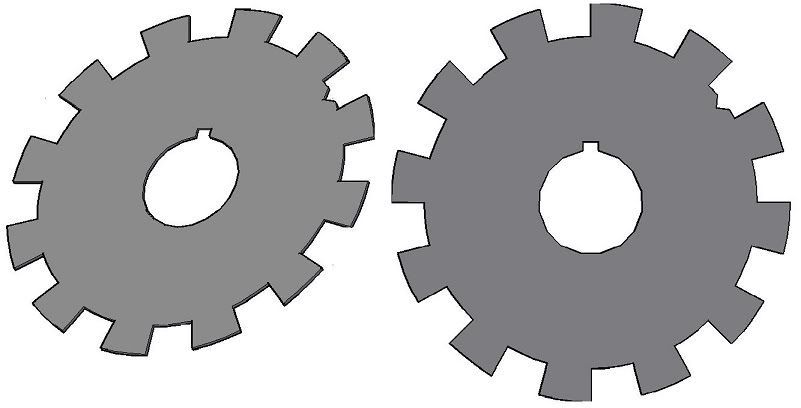
i did some testing with the Oscilloscope and the stock sensor.
I'm not sure if it was my setting on the scope or not, but it wasn't picking up small teeth moving through it at high speed.
So i've chosen the 12 tooth design, and gone for 1.2mm thickness (standard 1.0mm).
pretty sure the 0.2mm (~8thou) wont put off the cambelt pulley off too much.
http://www.linkecu.com/products/engi...ecus/g4-xtreme
Here is my autocad pic of the wheel
i did some testing with the Oscilloscope and the stock sensor.
I'm not sure if it was my setting on the scope or not, but it wasn't picking up small teeth moving through it at high speed.
So i've chosen the 12 tooth design, and gone for 1.2mm thickness (standard 1.0mm).
pretty sure the 0.2mm (~8thou) wont put off the cambelt pulley off too much.


Hi all
You might have a prob with the plate being 1.2mm as for when you depress the clutch and the crank moves it may hit the sensor they are very delicate and will leave you on the side of road very easily
The clearance is already very limited and most times if you check a sensor on a stock setup you will see signs of touching already it will get worse with a thicker one so be careful, also the edge of the plate may chew on the timing belt as the oil pump gear guides the timing belt towards the trigger wheel and now the crank pulley being spaced out
try a offset on the balance shaft pulley for the added clearance if your gonna go that route.
I did something very similar with my setup 3mm trigger wheel machined the balance shaft pulley and used a different pickup sensor works fine
You might have a prob with the plate being 1.2mm as for when you depress the clutch and the crank moves it may hit the sensor they are very delicate and will leave you on the side of road very easily
The clearance is already very limited and most times if you check a sensor on a stock setup you will see signs of touching already it will get worse with a thicker one so be careful, also the edge of the plate may chew on the timing belt as the oil pump gear guides the timing belt towards the trigger wheel and now the crank pulley being spaced out
try a offset on the balance shaft pulley for the added clearance if your gonna go that route.
I did something very similar with my setup 3mm trigger wheel machined the balance shaft pulley and used a different pickup sensor works fine
thanks for your input.
i've already milled down the balance shaft drive gear, so it's just a spacer now. i can mill off 0.2mm to keep things all even.
we'll check all the tolerances once it's on the engine stand.
if i have any problems with this setup, i might go to a different pickup too.
is your new pickup a hall effect sensor? or a voltage inducing sensor?
Cheers, Mike
i've already milled down the balance shaft drive gear, so it's just a spacer now. i can mill off 0.2mm to keep things all even.
we'll check all the tolerances once it's on the engine stand.
if i have any problems with this setup, i might go to a different pickup too.
is your new pickup a hall effect sensor? or a voltage inducing sensor?
Cheers, Mike


Thread
Thread Starter
Forum
Replies
Last Post
Blue91lx
For Sale/WTB - Engine / Drivetrain / Power
2
May 9, 2012 11:15 AM
