


whining noise while driving


whining noise while driving
Guys my evo began making a wierd whining noise while driving. Im not sure if its a tranny or the tcase? i looked under the car last night and i have some oil/fluid drippng. Smells like tranny fluid. Im not drivimg my car until i get it to the shop and fix it.
The thing is the tranny shifts fine no problem but the noise is there leading me to believe its the tcase...
Does this mean the tcase is all done for or can it be its low on fluid and is making that noise?
let me kno guys
The thing is the tranny shifts fine no problem but the noise is there leading me to believe its the tcase...
Does this mean the tcase is all done for or can it be its low on fluid and is making that noise?
let me kno guys

Its hard to tell from what you've described.
I would change the fluid in the transfer case and transmission (that way you can also check to see how much is actually in each) at that time you can also inspect for large holes lol.
Then I would take the car out and try to identify when the whining happens. certain speeds, rpms, only at part throttle etc. We can better identify the issue that way. It could be a lot of things.
I would suspect the transfer case however. TRE does an a top notch transfer case rebuild service. www.teamrip.com
I would change the fluid in the transfer case and transmission (that way you can also check to see how much is actually in each) at that time you can also inspect for large holes lol.
Then I would take the car out and try to identify when the whining happens. certain speeds, rpms, only at part throttle etc. We can better identify the issue that way. It could be a lot of things.
I would suspect the transfer case however. TRE does an a top notch transfer case rebuild service. www.teamrip.com


Guys my evo began making a wierd whining noise while driving. Im not sure if its a tranny or the tcase? i looked under the car last night and i have some oil/fluid drippng. Smells like tranny fluid. Im not drivimg my car until i get it to the shop and fix it.
The thing is the tranny shifts fine no problem but the noise is there leading me to believe its the tcase...
Does this mean the tcase is all done for or can it be its low on fluid and is making that noise?
let me kno guys
The thing is the tranny shifts fine no problem but the noise is there leading me to believe its the tcase...
Does this mean the tcase is all done for or can it be its low on fluid and is making that noise?
let me kno guys

It's hard to tell what you're talking about. There are various different types of whining the Evo drivetrain can produce and some of them are normal.
You can youtube videos of transfer case whining. Whining at slow speeds is normal. Sometimes decel noise can be normal, but if it's excessive, it could be a bad input shaft, and sometimes throw-out bearing make a coffee grinder sound. Slight whining on the highway is ok.
My Evo has a heinous noise on decel, but I can tell you it's not the t-case, it's the input shaft bearing. The T-case will typically get louder and louder, as well as higher pitched the faster you go. If's it's gear specific, it's transmission related.
Bad t-case:
http://www.youtube.com/watch?v=TXbisxnAW-s
Remember, not ALL whines are the death whine.
You can youtube videos of transfer case whining. Whining at slow speeds is normal. Sometimes decel noise can be normal, but if it's excessive, it could be a bad input shaft, and sometimes throw-out bearing make a coffee grinder sound. Slight whining on the highway is ok.
My Evo has a heinous noise on decel, but I can tell you it's not the t-case, it's the input shaft bearing. The T-case will typically get louder and louder, as well as higher pitched the faster you go. If's it's gear specific, it's transmission related.
Bad t-case:
http://www.youtube.com/watch?v=TXbisxnAW-s
Remember, not ALL whines are the death whine.

Trending Topics
It's hard to tell what you're talking about. There are various different types of whining the Evo drivetrain can produce and some of them are normal.
You can youtube videos of transfer case whining. Whining at slow speeds is normal. Sometimes decel noise can be normal, but if it's excessive, it could be a bad input shaft, and sometimes throw-out bearing make a coffee grinder sound. Slight whining on the highway is ok.
My Evo has a heinous noise on decel, but I can tell you it's not the t-case, it's the input shaft bearing. The T-case will typically get louder and louder, as well as higher pitched the faster you go. If's it's gear specific, it's transmission related.
Bad t-case:
http://www.youtube.com/watch?v=TXbisxnAW-s
Remember, not ALL whines are the death whine.
You can youtube videos of transfer case whining. Whining at slow speeds is normal. Sometimes decel noise can be normal, but if it's excessive, it could be a bad input shaft, and sometimes throw-out bearing make a coffee grinder sound. Slight whining on the highway is ok.
My Evo has a heinous noise on decel, but I can tell you it's not the t-case, it's the input shaft bearing. The T-case will typically get louder and louder, as well as higher pitched the faster you go. If's it's gear specific, it's transmission related.
Bad t-case:
http://www.youtube.com/watch?v=TXbisxnAW-s
Remember, not ALL whines are the death whine.
Thats exactly what it sounds like. Can it be because its low on fluid its making that noise or is is done for sure?

I wanted to comment on this and to get your guys opinion. I know improper fluid level or improper fluid type seems to be what everybody says is the cause of the infamous death whine but I think that’s only part of the problem. I believe one of the main culprits is the design of the ring and pinion itself that leads to the failures of these transfer cases. Correct me if I’m wrong but it seems the ring and pinion on the Evo’s TC has a reverse cut design. This seems odd to me that Mitsubishi would design it this way because that would mean that the weaker "coast" side of the ring gear is pushing on the pinion gear. I’m guessing Mitsubishi designed it this way in order to get fluid up to the pinion gear because of its high pinion design but there are better ways to do this for a high pinion differential. Oil slingers are what first come to mind. Not reverse cutting the ring & pinion but I don’t know fore sure why Mitsubishi did it this way. You’ll get a better understanding of what I’m saying if you look at the pics below.

If I have the rotation of the center differential correct then, as you can see, the coast side of the ring gear is pushing on the pinion gear.
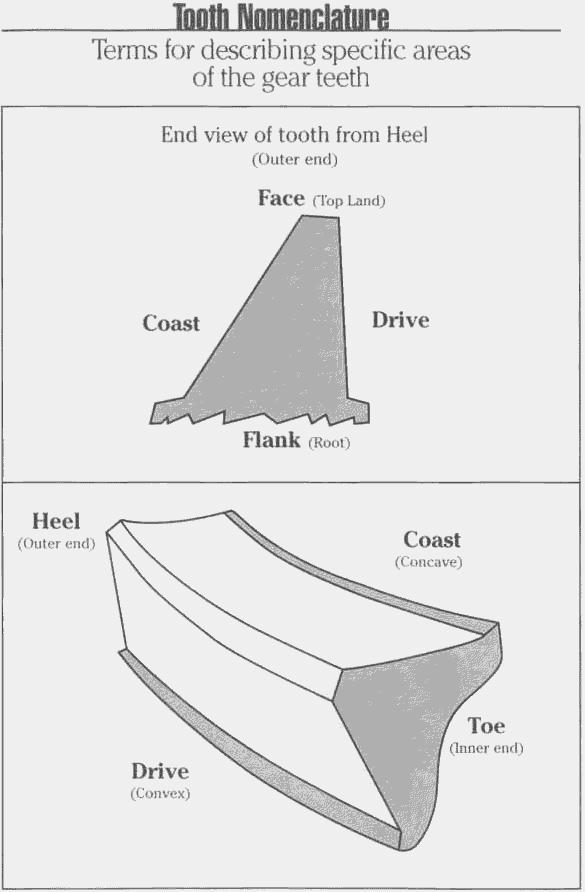
In 4WD vehicles (in order to keep cost down) manufactures would use a rear differential in the front (flipped around) for the front drive system. However, all ring and pinion gears are cut in such a way that they are inherently stronger when pushing the vehicle in the forward direction and weaker when driving in reverse. That means that a standard cut (rearend style) gear, when used in the front, must push on the weaker side of the gear to move the vehicle in a forward direction. This wasn’t a major problem in a stock 4WD vehicle because the rear is doing most of the work anyways but when you start pushing the limits of your 4WD vehicle that’s when having a rear differential in the front becomes a problem. That’s where the reverse cut gear set comes in. The idea behind reverse cut is to strengthen the operation of the gear when it is used for a front axle application. In the Evo’s transfer case the reverse cut ring gear is working opposite of this. I know there is an upgraded ring & pinion available in the aftermarket but what I believe what needs to be done is to have a standard cut ring a pinion gear set made with some type of oil slinger system to feed fluid to the high pinion gear. I don’t know. What do you guys think? Am I way off on this?
David
If I have the rotation of the center differential correct then, as you can see, the coast side of the ring gear is pushing on the pinion gear.
In 4WD vehicles (in order to keep cost down) manufactures would use a rear differential in the front (flipped around) for the front drive system. However, all ring and pinion gears are cut in such a way that they are inherently stronger when pushing the vehicle in the forward direction and weaker when driving in reverse. That means that a standard cut (rearend style) gear, when used in the front, must push on the weaker side of the gear to move the vehicle in a forward direction. This wasn’t a major problem in a stock 4WD vehicle because the rear is doing most of the work anyways but when you start pushing the limits of your 4WD vehicle that’s when having a rear differential in the front becomes a problem. That’s where the reverse cut gear set comes in. The idea behind reverse cut is to strengthen the operation of the gear when it is used for a front axle application. In the Evo’s transfer case the reverse cut ring gear is working opposite of this. I know there is an upgraded ring & pinion available in the aftermarket but what I believe what needs to be done is to have a standard cut ring a pinion gear set made with some type of oil slinger system to feed fluid to the high pinion gear. I don’t know. What do you guys think? Am I way off on this?
David
Last edited by MechanicDave; Aug 5, 2011 at 06:23 PM.

Newbie
Joined: Jan 2011
Posts: 2
Likes: 0
From: San Jose
I took apart my old transfer case that had the infamous death whine to see if what you are saying is true and sure enough. You are right. Just like in your description, the coast side of the ring gear “is” pushing on the pinion gear. That’s crazy! Why did Mitsubishi do that?.. That’s a shame because the center diff in the evo looks pretty decent. The eclipse center diff is tiny..
I’m an avid off-roader (84 cj7) and I know first hand how crappy a differential is when running on the coast side.
This makes complete sense to me as to why the evo transfer case is so prone to going bad. I think you hit the nail right on the head there David.. I truly believe now that this is the main cause of the failure in these transfer cases. With a standard cut ring gear set I believe these transfer cases would hold up to a lot more power. Now the question is how much would it cost to have a company redesign the ring & pinion to a standard cut. I'm surprised nobody has chimed in on this. Any guru on the board that could share some insight on this???
That’s a shame because the center diff in the evo looks pretty decent. The eclipse center diff is tiny.. I’m an avid off-roader (84 cj7) and I know first hand how crappy a differential is when running on the coast side.
This makes complete sense to me as to why the evo transfer case is so prone to going bad. I think you hit the nail right on the head there David..
I truly believe now that this is the main cause of the failure in these transfer cases. With a standard cut ring gear set I believe these transfer cases would hold up to a lot more power. Now the question is how much would it cost to have a company redesign the ring & pinion to a standard cut. I'm surprised nobody has chimed in on this. Any guru on the board that could share some insight on this???
Last edited by MR2JZ; Jan 5, 2011 at 06:17 PM.
some of the earlier Evo transfer case rings were heat treated while hanging from a hook... this caused oval drive rings... and part of the bad wrap the Evo's got for eating T/C's.
The transfer case is also high slung... not low slung. meaning the pinion will attempt to bury itself in the ring, rather than try to pull away from it.
The transfer case is also high slung... not low slung. meaning the pinion will attempt to bury itself in the ring, rather than try to pull away from it.
Newbie
Joined: Jan 2011
Posts: 2
Likes: 0
From: San Jose
Yeah. In the off-road seen we call it a high pinion diff when the pinion gear is above the center line of the differential and low pinion when it’s below the centerline.
I'm no mechanical engineer by any stretch of the imagination but I have extensive experience with Jeep, Ford, and Toyota differentials. Being high slung isn’t why the pinion will attempt to bury itself in the ring, rather than try to pull away from it. It’s the reverse (or “right-hand” as far as how the gear teeth curve) cut that causes the pinion to want to bury itself in the ring. It all has to do with thrust force and the direction in which the gears rotate.
In a typical differential the pinion drives the ring gear. In the evo transfer case it’s the other way around. The ring gear drives the pinion. It’s because of this and the combination of the reverse cut ring & pinion that the pinion will attempt to bury itself in the ring gear. If it had a standard (or left-hand) cut ring & pinion then the thrust direction would be the other way and the drive side of the ring gear would now be pushing on the pinion gear. Its common knowledge in the off-road seen that when driving on the coast side of a gear, the ring and pinion is about 25% weaker than when running on the drive side.
Like I said before... I'm no mechanical engineer by any stretch of the imagination but from my experience and research in the matter I believe that MechanicDave is correct in his observation. Imho…
