


WRC Evo Engine have soo much torque?


Thread Starter
Evolving Member
Joined: Feb 2003
Posts: 218
Likes: 0
From: Denver CO
 WRC Evo Engine have soo much torque?
I was wandering if anybody can explain to me why WRC engines wich are 2.0 l 4 cylinders and 299Hp, make soo much torque. Last I checked it was around 525 ft/lb. How can they possibly achieve this? Can anybody explain? Can we mod our engine that way too?

Evolved Member
iTrader: (20)
Joined: Mar 2003
Posts: 4,941
Likes: 0
From: Danville/Blackhawk, California
Intake restrictors. They limit ultimate airflow which is dictates ultimate horsepower. But until that airflow ceiling is reached, the car is capable of making gobs of torque. Unrestricted, I suspect the WRC cars could make closer to the hp numbers that one would expect given the amount of torque they are making. Of course, a lot has to do with component maching (turbos, injectors, intercoolers, cams, etc,.) which are probably optimized for their restricted conditions.
Cheers.
Shiv
Cheers.
Shiv
Thread Starter
Evolving Member
Joined: Feb 2003
Posts: 218
Likes: 0
From: Denver CO
Thanks for the reply Shiv. I knew about the restrictor. So what you are saying is that these engine are probably 500HP plus engines without the restrictors.
So is machining parts with tighter tollerance the only way to pick up some good low end torque? Except for increasing the displacement?
How about their turbo? Wouldn't it have to spool at very low rpms?
PS. Too bad I can't make it to the Vishnu day anymore. You will have fun especially up in the hills with Paul. Enjoy your trip. Hopefully I'll get to meet you sometimes next year.
So is machining parts with tighter tollerance the only way to pick up some good low end torque? Except for increasing the displacement?
How about their turbo? Wouldn't it have to spool at very low rpms?
PS. Too bad I can't make it to the Vishnu day anymore. You will have fun especially up in the hills with Paul. Enjoy your trip. Hopefully I'll get to meet you sometimes next year.

Evolved Member
Joined: May 2003
Posts: 2,815
Likes: 24
From: Davidson, NC
Tight tolerances don't make good torque. What he is saying is that with a restrictor you can only flow so much air regardless of what rpm the engine is turning but, if you keep the turbo turning it's max rpm regardless of engine speed what would be say 19 pounds of boost @ 8000rpm is more like 38 psi @4000 rpm. Which will give you gobs of torque and low hp numbers because they are at very low rpm's. P.S. these #'s are just for illustration.
Thread Starter
Evolving Member
Joined: Feb 2003
Posts: 218
Likes: 0
From: Denver CO
I guess I fail to understand the major differences between the EVO 8 engine and the WRC say EVO 7 or 8 engine. Since I have no idea what's in that engine. On the surface they seem quite similar. 2.0 L 4 cylinder similar horsepower. I just wonder if there is anyway to achieve similar low torque figures from our engine?
Does the turbo then spinn at the same speed at all RPM's on those cars? I'm confused. How is this achieved?
Does the turbo then spinn at the same speed at all RPM's on those cars? I'm confused. How is this achieved?


Evolving Member
Joined: Dec 2001
Posts: 301
Likes: 0
From: Pittsburgh PA
Originally posted by Crazy4Cars
You meant the ALS system=Anti Lag.
You meant the ALS system=Anti Lag.

Trending Topics

Evolved Member
Joined: Dec 2003
Posts: 1,074
Likes: 0
From: UK
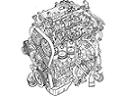
The components that are used in a WRC/Group A engine will be similar to any other race engine. The bottom end will be all steel, fully balanced (critical to race engines), and in normalcy strong. The pistons will be super light, but surprisingly quite a high compression (probably 9:1), this helps with the drivability and the huge torque that they produce. The head will be fully machined to maximize air flow. The cams will have huge lift and duration to maximize the air flow in AND out the engine. The valves will be bigger than standard but lighter for the same reasons as above. The turbos normally have small turbines and large compressors to maximize the boost potential and to obtain boost at low RMPs. The exhausts will be matched to the head and the turbo inlet to reduce restrictions, and will also be of equal length. ETC. ETC. ETC.
The most critical thing is the controller (ie ECU). This will be 3D and have numerous maps for each thing (fuel, timing, boost, diffs etc.). This is also normaly the controller for anti-lag.
Anti-lag systems are a crude way of keeping the turbo spinning when there is inefficient exhaust gas/pressure to do so. This normally means that on overrun you set the ECU to cut sparks not fuel, thus having a plenty of fuel and air still running through the engine. As this mixture hits the red hot exhaust turbine it explodes (hopefully with the exhaust vales closed or closing). This gives you the pressure needed to spin the turbo. More complex systems are available including one that pumps fuel and air straight onto the turbo!
The one thing that you can guaranty with any anti-lag system is that it will shorten (dramatically) the life of the turbo.
The most critical thing is the controller (ie ECU). This will be 3D and have numerous maps for each thing (fuel, timing, boost, diffs etc.). This is also normaly the controller for anti-lag.
Anti-lag systems are a crude way of keeping the turbo spinning when there is inefficient exhaust gas/pressure to do so. This normally means that on overrun you set the ECU to cut sparks not fuel, thus having a plenty of fuel and air still running through the engine. As this mixture hits the red hot exhaust turbine it explodes (hopefully with the exhaust vales closed or closing). This gives you the pressure needed to spin the turbo. More complex systems are available including one that pumps fuel and air straight onto the turbo!
The one thing that you can guaranty with any anti-lag system is that it will shorten (dramatically) the life of the turbo.

Newbie
Joined: Oct 2003
Posts: 71
Likes: 0
From: baltimore
since Hp = torque * rpm / 5252
That means they are making 500ft/lbs at only 3151.2 rpm.
That torque curve must drop like a rock after peak torque if they are only pulling 300hp!
I never knew they made that much torque:OMG:
aaron
That means they are making 500ft/lbs at only 3151.2 rpm.
That torque curve must drop like a rock after peak torque if they are only pulling 300hp!
I never knew they made that much torque:OMG:
aaron


Evolved Member
Joined: Dec 2003
Posts: 1,074
Likes: 0
From: UK
Couple all that torque to a six speed ‘box that’s capable of 1st to 6th in less than a second (or quicker than you can go up the sequential box), and a drive train that more trick than you can imagine (all three diffs completely active), and you can see why they will hit 60mph in around 3 seconds!!!!

Registered User
Joined: May 2002
Posts: 508
Likes: 0
From: Texas...panhandle...ugh
Alright, I don't understand all this anti-lag magic and I need someone to explain it. How do you get an air/fuel mix to hit the turbo and why isn't anyone doing this in our community? Also, it seems that all this low-end torque is really what makes a car quick as hell and that's what I want more than top end speed. Never did understand why noone talks about the clutched supercharger in conjunction with the turbo. Anyone know about that setup? Basically, I really don't understand how the WRC can make that kind of torque at low RPMs and we can't. We should be able to copy that...at least to some extent! Splain! Splain Lucy!
Originally posted by chuntington101
Couple all that torque to a six speed ‘box that’s capable of 1st to 6th in less than a second (or quicker than you can go up the sequential box), and a drive train that more trick than you can imagine (all three diffs completely active), and you can see why they will hit 60mph in around 3 seconds!!!!
Couple all that torque to a six speed ‘box that’s capable of 1st to 6th in less than a second (or quicker than you can go up the sequential box), and a drive train that more trick than you can imagine (all three diffs completely active), and you can see why they will hit 60mph in around 3 seconds!!!!

Newbie
Joined: Oct 2003
Posts: 71
Likes: 0
From: baltimore
"Bang-Bang" anti lag works by retarding the timing and dumping extra fuel at high TPS, and low boost pressure points of the map.
The retard of timing creates allot of extra EGT heat.
Send a ton of un-burnt fuel threw the engine with those high EGT's & you get an explosion in the exhaust manifold. The pressure from the explosion spools the turbo and wham 500ft/lbs at 3100rpm.
Just about any standalone ECU worth it's salt has an anti lag option.
"bang bang" Antilag is VERY HARD on turbine wheels. Plan on exploding a few a season.
There are some other popular anti lag set up out there. One that uses bypass air dumped in the manifold, others that use butterfly valves. Some use a combination of all three.
aaron
The retard of timing creates allot of extra EGT heat.
Send a ton of un-burnt fuel threw the engine with those high EGT's & you get an explosion in the exhaust manifold. The pressure from the explosion spools the turbo and wham 500ft/lbs at 3100rpm.
Just about any standalone ECU worth it's salt has an anti lag option.
"bang bang" Antilag is VERY HARD on turbine wheels. Plan on exploding a few a season.
There are some other popular anti lag set up out there. One that uses bypass air dumped in the manifold, others that use butterfly valves. Some use a combination of all three.
aaron