


HFC Cat cell count information - A little exhaust flow calculation


 )
)


You are ignoring boundary layer effects which are significant. The less surface area esposed to airflow, the better for pressure drop.
I can say this, I went 91.5mph in the 1/8 with my mil.spec cat on, and 92mph with it off. I am running the speed density patch and I noticed no observable change in AFR or boost. The mil.spec cat works very well on my car which is in the 350WHP range.
I have no idea if it works as well as other HFC for cleaning up the exhaust but it works well enough that it kills the terrible smell of a cat-less 4G63.
I can say this, I went 91.5mph in the 1/8 with my mil.spec cat on, and 92mph with it off. I am running the speed density patch and I noticed no observable change in AFR or boost. The mil.spec cat works very well on my car which is in the 350WHP range.
I have no idea if it works as well as other HFC for cleaning up the exhaust but it works well enough that it kills the terrible smell of a cat-less 4G63.
Yes, this is just a very quick calculation, boundary layer effect is what cell count affect, but this is not really what I meant to talk about; I didn't compare or calculate flow vs cell count.
I just wanted illustrate the importance to have a 3 inch cat, which negate some of the effect of a high cell count cat.
The milspec cost a lot , isn't 100% sure to pass smog and smell a little. I didn't start with that for these reasons.
I just wanted illustrate the importance to have a 3 inch cat, which negate some of the effect of a high cell count cat.
The milspec cost a lot , isn't 100% sure to pass smog and smell a little. I didn't start with that for these reasons.
Last edited by domyz; Apr 13, 2011 at 09:46 PM.
$150 for something that kills the smell and keeps the power seems reasonable?
I don't run my car all that rich, but it definitely kills the smell in the car. It might still smell horrible from behind, but it doesn't get that horrible cloud of **** smell engulfing the car as you pull up to a stop light.
I don't run my car all that rich, but it definitely kills the smell in the car. It might still smell horrible from behind, but it doesn't get that horrible cloud of **** smell engulfing the car as you pull up to a stop light.
You are ignoring boundary layer effects which are significant. The less surface area esposed to airflow, the better for pressure drop.
I can say this, I went 91.5mph in the 1/8 with my mil.spec cat on, and 92mph with it off. I am running the speed density patch and I noticed no observable change in AFR or boost. The mil.spec cat works very well on my car which is in the 350WHP range.
I have no idea if it works as well as other HFC for cleaning up the exhaust but it works well enough that it kills the terrible smell of a cat-less 4G63.
I can say this, I went 91.5mph in the 1/8 with my mil.spec cat on, and 92mph with it off. I am running the speed density patch and I noticed no observable change in AFR or boost. The mil.spec cat works very well on my car which is in the 350WHP range.
I have no idea if it works as well as other HFC for cleaning up the exhaust but it works well enough that it kills the terrible smell of a cat-less 4G63.
$150 for something that kills the smell and keeps the power seems reasonable?
I don't run my car all that rich, but it definitely kills the smell in the car. It might still smell horrible from behind, but it doesn't get that horrible cloud of **** smell engulfing the car as you pull up to a stop light.
I don't run my car all that rich, but it definitely kills the smell in the car. It might still smell horrible from behind, but it doesn't get that horrible cloud of **** smell engulfing the car as you pull up to a stop light.
It's all about finding where you are between a test pipe and 5 cat converters in a row. All the opinions are okay.
Trending Topics
Yes, this is just a very quick calculation, boundary layer effect is what cell count affect, but this is not really what I meant to talk about; I didn't compare or calculate flow vs cell count.
I just wanted illustrate the importance to have a 3 inch cat, which negate some of the effect of a high cell count cat.
The milspec cost a lot , isn't 100% sure to pass smog and smell a little. I didn't start with that for these reasons.
I just wanted illustrate the importance to have a 3 inch cat, which negate some of the effect of a high cell count cat.
The milspec cost a lot , isn't 100% sure to pass smog and smell a little. I didn't start with that for these reasons.


Most of the other metal cats I have seen have Chinese made cores. Our cats also have high-quality PGM coatings. I'm not sure how you quantify or qualify "smell a little" with our cats. Do you have direct experience with them? My smell-o-meter detects no noticeable smell from my MIL.SPEC cat. Then again, maybe my nose wasn't properly calibrated.

People have passed smog using our cats. Of course, we make no claims regarding smog...it's dependent on so many things: tune, cams, etc. If you are really that concerned about smog, we can source 200 cell cats that are EPA approved in 49 states.
Also, here is a little flow data chart for you. It's off a SuperFLow 600, and we maxed out the machine way before we hit 28* of water

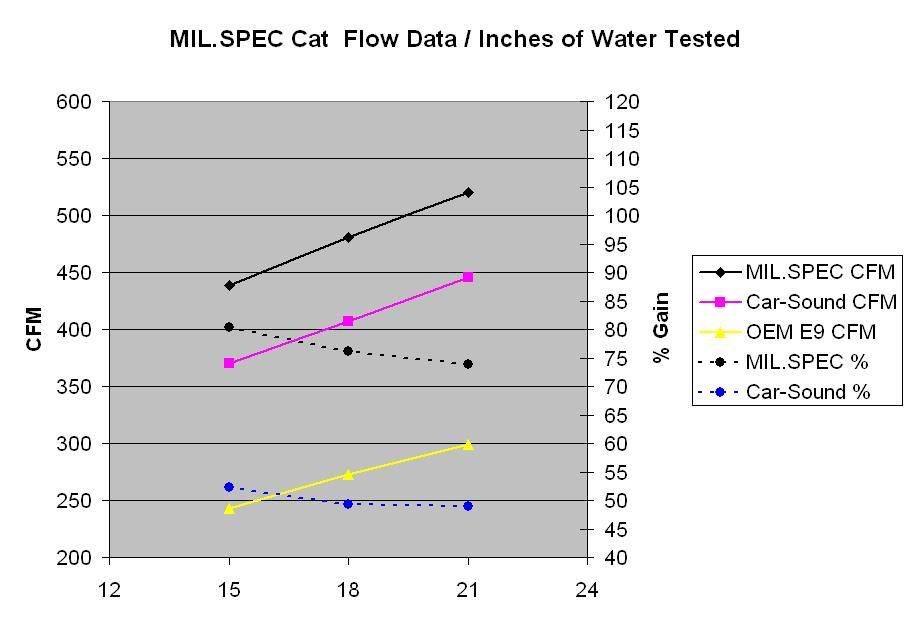
Last edited by Erik@MIL.SPEC; Apr 15, 2011 at 11:49 PM.

HJS is TÜV approved, has Group N FIA homologation and is just about the only cat used by rally cars throughout Europe, and apart from that, will pass emissions to, at least for a year anyway. Hence - the price.
Yes. I wasn't knocking HJS. The OP was complaining about the price of our cats, and I was trying to illustrate that our cats aren't expensive if you're looking for a quality cat. HJS makes a top-quality product...which is supported by their price point.

Thread
Thread Starter
Forum
Replies
Last Post
