


View Poll Results: Best compressor wheel choice for GT30 turbine?


Voters: 47. You may not vote on this poll
Best compressor wheel choice for GT30 turbine?


Thread Starter
Newbie

Joined: Dec 2006
Posts: 76
Likes: 0
From: na
Turbine housing choice is a given (i.e. not an option), as stated in my initial post. Its the standard externally wastegated HKS3037 housing, with a T2 inlet, 0.87A/R, and 4-bolt GT 3" outlet. Very nice piece, and bolts right on to any stock-location SR20 bottom-mount manifold. All that's left is for me to pick out a nice CHRA for it 
GTX3076 isn't an option as far as I'm concerned...
GTX3076 isn't an option as far as I'm concerned...
Last edited by hydra; Nov 14, 2011 at 05:25 AM.



I would do the following-
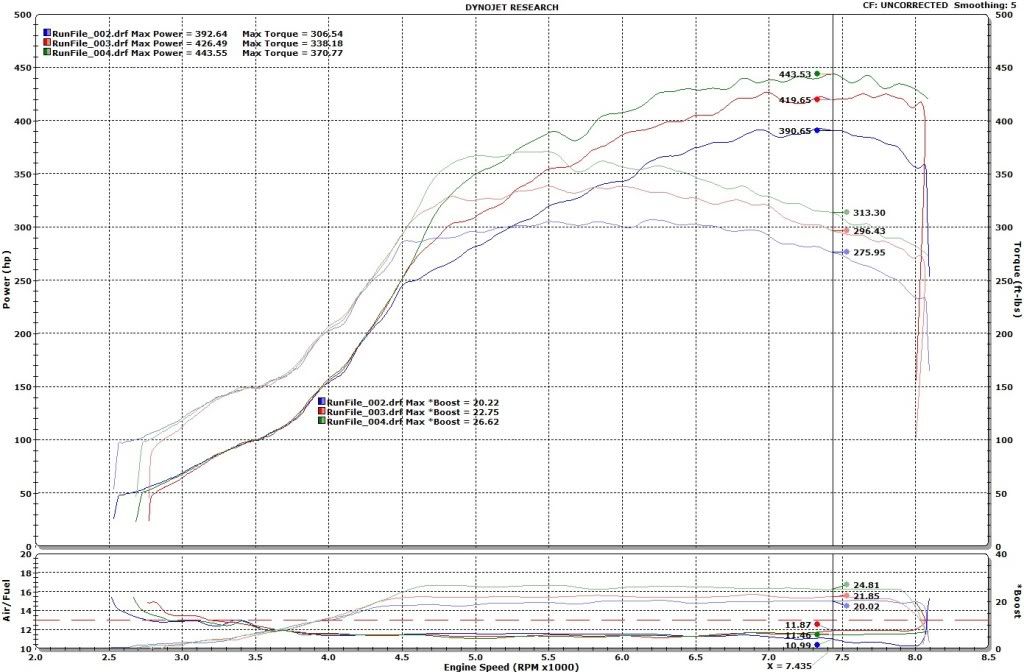
Dump the T25 HKS housing as it will actually hurt spool being that choked (based on a good at the time HKS3037 on both a 2.0L and 2.4 with HKS272 cams, Evo VIII).
Grab the HTA3076 even if you are at 23psi and no more.
Here is a 2.0L Evo VIII with S1s (268/268 11mm/10,5mm) and an ETS HTA3076 kit at "low boost" specifically run #3-
Dump the T25 HKS housing as it will actually hurt spool being that choked (based on a good at the time HKS3037 on both a 2.0L and 2.4 with HKS272 cams, Evo VIII).
Grab the HTA3076 even if you are at 23psi and no more.
Here is a 2.0L Evo VIII with S1s (268/268 11mm/10,5mm) and an ETS HTA3076 kit at "low boost" specifically run #3-


Turbine housing choice is a given (i.e. not an option), as stated in my initial post. Its the standard externally wastegated HKS3037 housing, with a T2 inlet, 0.87A/R, and 4-bolt GT 3" outlet. Very nice piece, and bolts right on to any stock-location SR20 bottom-mount manifold. All that's left is for me to pick out a nice CHRA for it
GTX3076 isn't an option as far as I'm concerned...
GTX3076 isn't an option as far as I'm concerned...
Last edited by Geoff Raicer; Nov 17, 2011 at 12:51 PM.

i agree gtx3076 isnt a viable option. since your requirement is to re-use the existing HKS turbine housing - are you 100% certain that you have a 60.0mm turbine wheel? I thought the T2 inlet hks turbos used a 56.5mm turbine wheel... these people dont realize your setup, a lot of the compressors they are suggesting are a bit too much for this hotside.


The GTX3076R should be a viable option since it uses the GT30 turbine wheel. You can have cut a range of compressor housings such as T04B, T04E, T04S, standard ported shroud and probably others.
Last edited by 240Z TwinTurbo; Nov 17, 2011 at 03:48 PM.

Evolving Member

Joined: Jun 2004
Posts: 371
Likes: 0
From: Australia
Another option is a 52T GT3037S/GT3076R which you should be able to get through Garrett Japan .
Heres something I remember reading a long time ago , I know its a FrWD Sentra SER but its also an SR20 .
http://www.motoiq.com/magazine_artic...o-se-r-ii.aspx
Cheers A .
Heres something I remember reading a long time ago , I know its a FrWD Sentra SER but its also an SR20 .
http://www.motoiq.com/magazine_artic...o-se-r-ii.aspx
Cheers A .
Thread Starter
Newbie
Joined: Dec 2006
Posts: 76
Likes: 0
From: na
FWIW I was able to confirm that 0.87A/R = 12cm^2 from HKS themselves!
http://www.hks-power.co.jp/db/produc...LN=EN&N_ID=502
Feeling pretty pleased with myself for figuring it out on my own
http://www.hks-power.co.jp/db/produc...LN=EN&N_ID=502
Feeling pretty pleased with myself for figuring it out on my own
im biased, i dont like any of the options  if it has to be a singlescroll turbo for an SR20 id suggest a t25 flanged EFR
...but for the sake of keeping it on-topic hta3073R or gtx3071R would be my vote if i had to pick. id still rather see a twinscroll housing/manifold be used on either of those 60mm turbines
if it has to be a singlescroll turbo for an SR20 id suggest a t25 flanged EFR ...but for the sake of keeping it on-topic hta3073R or gtx3071R would be my vote if i had to pick. id still rather see a twinscroll housing/manifold be used on either of those 60mm turbines
Thread Starter
Newbie
Joined: Dec 2006
Posts: 76
Likes: 0
From: na
I ended up going with a 3073HTA FWIW. I had a 7670 EFR on order if you remember but ended up cancelling because I got tired of waiting, plus in my opinion, BW still have some more development to do on these... I'm a big believer in twin-scroll setups, but ended up going this route due to having the right (wrong? lol) parts lying around... Plus the 1k-1.5k $$ savings can be put to good use elsewhere on the car
Like I said in my initial post, ANY of the billet wheeled GT30R CHRAs I listed will have less overall rotational inertia than the EFR7670 even with its Ti-Al turbine wheel. Granted its good for more overall flow, but maxing out the 7670 was never my intention. The 7163 T25 seems like an interesting choice, but it hasn't been released yet. Btw why is it that the GTX wheels have so much better looking compressor maps than their equivalent EFR wheels?
Like I said in my initial post, ANY of the billet wheeled GT30R CHRAs I listed will have less overall rotational inertia than the EFR7670 even with its Ti-Al turbine wheel. Granted its good for more overall flow, but maxing out the 7670 was never my intention. The 7163 T25 seems like an interesting choice, but it hasn't been released yet. Btw why is it that the GTX wheels have so much better looking compressor maps than their equivalent EFR wheels?
Last edited by hydra; Nov 22, 2011 at 02:47 PM.

It wouldn't surprise me due to the 10mm difference in size, but it seems like a guess to me? The TiAl material is less than HALF the density as inconel and most of the material is probably in the hub area where it will have a minimal impact on rotational inertia.
Thread Starter
Newbie
Joined: Dec 2006
Posts: 76
Likes: 0
From: na
HTA and EFR both have 7+7 bladed compressors and 10 bladed turbines,
assuming design similitude:
I = shape factor x mass x radius^2
m = shape factor x density x radius^3
in short, I = constant x density x radius^5
in practice, blade thickness is proportional to between the square root and cube root of radius (depending on whether ultimate strength or stiffness is the design constraint, taking the most conservative scenario:
I = constant x density x radius^4.333
density of inconel = 8.2
density of Ti-AL = 4.0
The HTA3076 0.82A/R SS and 7670 EFR 0.83 SS have comparable compressor flow rates and turbine flow rates, with the former having a slightly higher flowing hotside, and the latter a slightly better flowing coldside so its fair to compare both directly.
I did the math and the HTA3076 actually has a slightly lower (on the order of 5-10% I forgot) rotational inertia than the EFR. So we conclude that if the EFR has better spoolup and transient response characteristics, it has to be due to its lower compressor/turbine diameter ratio and thus wheel speed mismatch, and its superback turbine wheel which I would imagine increases turbine efficiency during spoolup, as well as rotational inertia (which was not factored into the above calculations)
assuming design similitude:
I = shape factor x mass x radius^2
m = shape factor x density x radius^3
in short, I = constant x density x radius^5
in practice, blade thickness is proportional to between the square root and cube root of radius (depending on whether ultimate strength or stiffness is the design constraint, taking the most conservative scenario:
I = constant x density x radius^4.333
density of inconel = 8.2
density of Ti-AL = 4.0
The HTA3076 0.82A/R SS and 7670 EFR 0.83 SS have comparable compressor flow rates and turbine flow rates, with the former having a slightly higher flowing hotside, and the latter a slightly better flowing coldside so its fair to compare both directly.
I did the math and the HTA3076 actually has a slightly lower (on the order of 5-10% I forgot) rotational inertia than the EFR. So we conclude that if the EFR has better spoolup and transient response characteristics, it has to be due to its lower compressor/turbine diameter ratio and thus wheel speed mismatch, and its superback turbine wheel which I would imagine increases turbine efficiency during spoolup, as well as rotational inertia (which was not factored into the above calculations)
I like your train of thought, but it's still an educated guess. I have made roughly the same hypothesis though, so don't take it as me saying you are wrong.
The one caveat though, more modern turbine design can have a pretty good boost in efficiency, particularly at low pressure ratios (spool up). Even if the EFR wheel did have slightly higher inertia, if it were able to grab 5%-10% more energy from the exhaust due to higher efficiency, it could easily out spool the lighter GT30 wheel. Also, the higher inertia of the EFR also comes with the advantage of more blade surface area for a given airflow mass, which definitely helps with spool up.
Either way, it's probably splitting hairs. The twinscroll setup does claim ~25% gain in spool up efficiency though, which is signifigant and would easily make up for any higher amount of inertia.
The one caveat though, more modern turbine design can have a pretty good boost in efficiency, particularly at low pressure ratios (spool up). Even if the EFR wheel did have slightly higher inertia, if it were able to grab 5%-10% more energy from the exhaust due to higher efficiency, it could easily out spool the lighter GT30 wheel. Also, the higher inertia of the EFR also comes with the advantage of more blade surface area for a given airflow mass, which definitely helps with spool up.
Either way, it's probably splitting hairs. The twinscroll setup does claim ~25% gain in spool up efficiency though, which is signifigant and would easily make up for any higher amount of inertia.