


buschur racing dyno evo..


Evolved Member
Joined: Oct 2002
Posts: 1,062
Likes: 0
From: Los Angeles, CA
Originally posted by Señor Info
I don't understand why you folks believe in the % loss factor. Let's try a little thought experiment.
Suppose some FWD car with an engine crank-rated at 250 lb-ft of torque at 3600 rpm is measured to produce 225 lb-ft of torque at 3600 rpm on a chassis dyno. That's a loss of 25 lb-ft or 10%, attributable to the drivetrain. Now pull that engine out and swap in its place one which produces 750 lb-ft of torque at the crank at 3600 rpm. Do you now expect the drivtrain to somehow absorb 75 lb-ft of torque (10% of of 750)? Why would it suddenly absorb tripple the amount of torque as before when nothing about the drivetrain has changed?
I don't understand why you folks believe in the % loss factor. Let's try a little thought experiment.
Suppose some FWD car with an engine crank-rated at 250 lb-ft of torque at 3600 rpm is measured to produce 225 lb-ft of torque at 3600 rpm on a chassis dyno. That's a loss of 25 lb-ft or 10%, attributable to the drivetrain. Now pull that engine out and swap in its place one which produces 750 lb-ft of torque at the crank at 3600 rpm. Do you now expect the drivtrain to somehow absorb 75 lb-ft of torque (10% of of 750)? Why would it suddenly absorb tripple the amount of torque as before when nothing about the drivetrain has changed?
There's no way the drivetrain loss is only 15%. Just like the previous Evos, it's going to be around 24%, like others have said. Besides the impact of the weight of driven parts in the AWD system, there's no way you can avoid power losses in a drivetrain with a set number of gear meshes. Each time one gear transmits motion to another gear in the gearbox or in a differential, power is lost due to the efficiency of that gear type. An efficiency of 90-95% for a single spur gear or helical gear stage is excellent, and won't be improved upon.
Find a book or website about geartrain design to learn more.
Find a book or website about geartrain design to learn more.

Evolved Member
Joined: Jan 2003
Posts: 1,121
Likes: 1
http://www.sdsefi.com/techdyno.htm
http://www.pumaracing.co.uk/power3.htm
http://www.pumaracing.co.uk/coastdwn.htm
Funny, here is one by Shiv:
http://www.miatapower.net/w3archive/.../msg00054.html
"For cars that Paulsen deals with on a day to day basis (ones that generate 200-400hp
at the wheels), he uses a drivetrain loss of 12-15%. For lower output cars
(100-200hp), he favors a 15-20% loss. More disgustingly powerful cars (over 400hp),
he would use 10% or less as the loss. He developed this recipe from years of
comparing chassis and engine dyno results of the same powerplant."
Do some searches. You will find varying answers. But the end result is that the only way to know for sure is to dyno the engine on an engine dyno, then dyno the same engine in the car and subtract the two.
http://www.pumaracing.co.uk/power3.htm
http://www.pumaracing.co.uk/coastdwn.htm
Funny, here is one by Shiv:
http://www.miatapower.net/w3archive/.../msg00054.html
"For cars that Paulsen deals with on a day to day basis (ones that generate 200-400hp
at the wheels), he uses a drivetrain loss of 12-15%. For lower output cars
(100-200hp), he favors a 15-20% loss. More disgustingly powerful cars (over 400hp),
he would use 10% or less as the loss. He developed this recipe from years of
comparing chassis and engine dyno results of the same powerplant."
Do some searches. You will find varying answers. But the end result is that the only way to know for sure is to dyno the engine on an engine dyno, then dyno the same engine in the car and subtract the two.

Evolved Member
iTrader: (20)
Joined: Mar 2003
Posts: 4,941
Likes: 0
From: Danville/Blackhawk, California
From the SDS website:
It seems as if his conclusions were based off his experience with Dynojets which exhibit such noisey behavior. I'd suggest he try other types of dynos before saying they aren't good measuring devices. Used properly, a good load bearing dyno is just as useful and accurate as a good engine dyno. It's just that one measures horsepower at the wheels and the other at the flywheel. Trying to use a chassis dyno to estimate flywheel horsepower (or visa versa) is a flawed notion, to say the least.
Shiv
Looking at the jagged, sawtooth "curve" that most chassis dynos produce is amusing. The torque and hp curves really don't look like this. This is a result of poor software or mechanical measurement in the first place. Torque does not go up down, up down 2-4 ft./lbs. over 50-100 rpm as any real engine dyno will prove. Chassis dynos are essentially tuning aids, not true hp measurement devices.
Shiv

Originally posted by Sweft
One is AWD the other is FWD?
Damn, even I knew that.
Logically, I do not see how a front wheel DYNO would give a less accurate rating of CRANK horse power than a 4 wheel dyno. I even thing it might give a more ACCURATE reading since it does not have to pass through the different differentials and drive train loss can be accounted for.
One is AWD the other is FWD?
Damn, even I knew that.
Logically, I do not see how a front wheel DYNO would give a less accurate rating of CRANK horse power than a 4 wheel dyno. I even thing it might give a more ACCURATE reading since it does not have to pass through the different differentials and drive train loss can be accounted for.
Your right converted Evo FWD number could be more accurate if knew what the losses where. It is just the application of a different conversion factor.
I have no doubt that shiv would have found the same thing if he had a dynojet just that the absolute numbers would have been different.


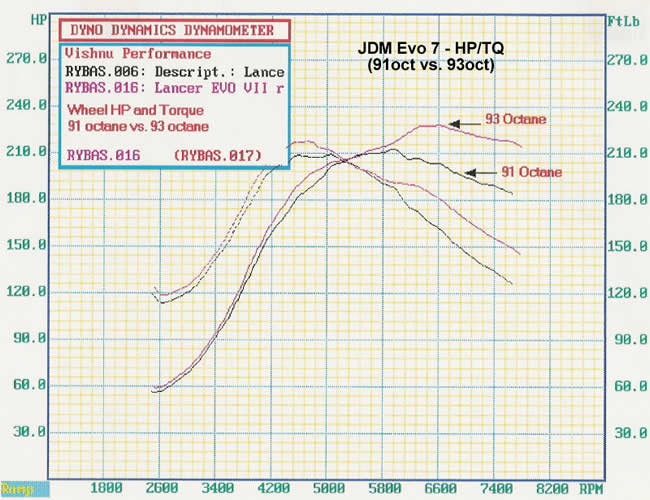
There's no way the US Evo is as powerful as the JDM Evo in stock form, based on dyno comparisons. Shiv dynoed a JDM Evo on 91 octane, pinging badly, and it was much higher than the US Evo dyno numbers at the 93 octane mixture.
This is the JDM Evo dyno:
Mark
This is the JDM Evo dyno:
Mark
Originally posted by MalibuJack
Comparing horsepower #'s really is like comparing ***** size.. The biggest number in the world is useless if you can't get it up..
Comparing horsepower #'s really is like comparing ***** size.. The biggest number in the world is useless if you can't get it up..
Last edited by erikgj; Mar 24, 2003 at 09:09 AM.
A friend of mine has driven a USDM Evo and a EVO 7 and they're that not close. The USDM was on a 50:50 mix of 104 and 91 CBG. Power delivery was very different as well.
So I don't buy that argument.
Erik
So I don't buy that argument.
Erik

Newbie
Joined: Mar 2003
Posts: 86
Likes: 0
From: NYC Kid!
New news from Pruven performance. The car dynoed almost 300 to the wheels. It just wint 12.5
check out the site
http://www.pruvenperformance.com
check out the site
http://www.pruvenperformance.com

Thread
Thread Starter
Forum
Replies
Last Post
fenixz
Evo X Engine Management / Tuning Forums
6
Oct 1, 2014 02:36 PM
Fourdoor
09+ Ralliart Engine/Turbo/Drivetrain
53
Nov 15, 2009 07:06 PM
Fourdoor
09+ Ralliart Engine/Turbo/Drivetrain
8
Nov 14, 2009 03:47 PM
SilvRA
04-06 Ralliart Engine/Drivetrain
7
Aug 3, 2005 09:24 AM
