


Which HID 6000? or 4300?


Originally Posted by donmeca2020
you my friend think you have an answer for everything, your answers are bull****. so because the kelvin is a higher and a brighter color its ricer, and idiots will buy it? thats the dumbest thing i've heard. id expect a rediclous comment like this from some one from clubrsx because thats all the nonsense they would talk. but bro that doesnt answer the question. i stick to what i say. your answer to the lower K 4300 kit is better visually and what not is moronic. you show me an actual article from a good source that states that and then i'll take back what i said. until then its not a "true fact" to me.
Look at it this way:
Every HID bulb has the same power input; it just depends on how it's used.
High frequency light takes more energy to produce than lower frequency light. Higher color temps shift the peak frequency output towards higher frequencies. Purple light is a higher frequency than blue, blue is higher than green, green higher than yellow, etc.
However, around 4300 K the peak frequency output is more flat and broad so the light is more white but the peak maybe around yellow or sometimes a slight green (I've had a greenish tinge before on an HID kit). They appear to be more white than anything.
When the temps get higher towards 10,000 K the peak frequency output is "peakier" and the peak color is expressed more heavily. 10,000 K looks pretty freaking purple.
Also, as you move towards the higher frequencies we are also moving toward the edge of what is considered visible light. More of the light being produced is now turning up in the invisible part of the light spectrum.
So back the first statement: Every HID bulb has the same power input; it just depends on how it's used.
So if you start off with the same power input for two different bulbs, one is 4300 K and the other 10,000 K, we will see that the lower temp uses it's power to make more photons at lower frequencies as lower frequencies require less power to produce each photon. The higher temp is using its energy to make less higher frequency photons as high frequency light is more energetic. Plus, as the high color temp puts the peak output closer to the edge of the visible spectrum, we see even less illumination.
Here is a visual, check it:
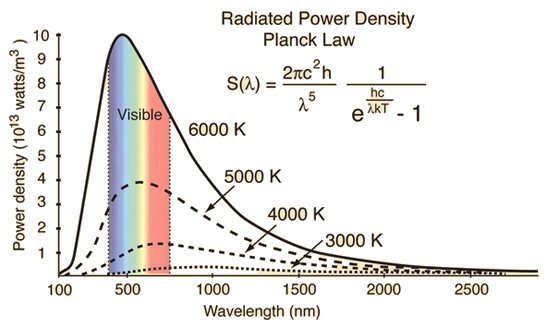
Oh, and in the visual above, since we have the same input power, we have to scale each temperature line so that the area under each of the curves are equal. If we did that, we can see that 4300 K has more area in the visible light spectrum than the higher temps.
The reason why higher temps might be more expensive is either:
The temps in the bulb have to be hotter to produce the higher frequency light and require something different and a little more expensive to do that.
Or, it's marketing BS, to lead people to think more temp is brighter, better, etc. and make a quick buck or two.
The reason why higher temps might be more expensive is either:
The temps in the bulb have to be hotter to produce the higher frequency light and require something different and a little more expensive to do that.
Or, it's marketing BS, to lead people to think more temp is brighter, better, etc. and make a quick buck or two.


The higher the Kelvin rating the dimmer the light is because you lose lumens, 4300K which comes on about 99.99% of OEM HID kits is considered to be the best useable light. Just because a BMW's HID look blue, Benz looks purple, and Acura's looks white does not mean much because they all are the same bulb (relatively) and the key differences are in the projector and the headlamp.
Going above 4300K, you will achieve almost the exact same amounts of use from any kit from 4300K-5500K, the differences from the amount of light seen on the road are not enough for you to really distinguish between their ratings. As you go higher many people agree that 6000K are the best looking and offer great visibility (best selling kits at our site and many people say that the 6000K is the rice cut off).
The higher rated kits are harder to produce for most companies which is why they are more expensive, once colors start to become so important there is a great margin of error since each bulb is made individually (since many people purchase 6000K+ for color reasons)
Personal experience, i was loyal to 8000K for 2 years and then I got new headlamps and got 6000K and loved them and I just got new headlamps again and bought 5300K and well they look nice but personally I was most happy with the 6000K, they looked amazing in the city and when driving on dark roads I had no use for high beams since these were soo amazing!
-Allan
www.UltraBrightLights.com
Going above 4300K, you will achieve almost the exact same amounts of use from any kit from 4300K-5500K, the differences from the amount of light seen on the road are not enough for you to really distinguish between their ratings. As you go higher many people agree that 6000K are the best looking and offer great visibility (best selling kits at our site and many people say that the 6000K is the rice cut off).
The higher rated kits are harder to produce for most companies which is why they are more expensive, once colors start to become so important there is a great margin of error since each bulb is made individually (since many people purchase 6000K+ for color reasons)
Personal experience, i was loyal to 8000K for 2 years and then I got new headlamps and got 6000K and loved them and I just got new headlamps again and bought 5300K and well they look nice but personally I was most happy with the 6000K, they looked amazing in the city and when driving on dark roads I had no use for high beams since these were soo amazing!
-Allan
www.UltraBrightLights.com

Originally Posted by SRT-TO-EVO
Thank you Evogasm for the beautiful diagram. Someone just got owned with that one. And thank you GPtourer for noticing the ignorance.


Thread
Thread Starter
Forum
Replies
Last Post
tsitalon1
Evo X General
23
Dec 3, 2010 10:58 AM
HID Evolution
Evo 'For Sale' Electronics / Lighting / Audio
10
Dec 1, 2008 05:50 PM
HID Evolution
Lancer Ralliart Vendor Classifieds
2
Apr 5, 2008 01:00 AM
