


The Basics of Advanced Suspension


Thread Starter
Evolved Member
iTrader: (5)
Joined: Oct 2006
Posts: 3,805
Likes: 2
From: Sacramento, CA
The Basics of Advanced Suspension
The topics I'm gonna cover here are really advanced for modding but useful for the guys that want to know what in god's name those suspension parts really do. Oh and information was blatantly stolen from many good websites FYI.. please don't imagine I'm somehow a suspension god I just read and can summarize 
Tonight's Topics:
1) Front Roll Center
2) Bump Steer
Front Roll Center:
The roll center is a calculated point derived from lines drawn through the suspension points and the center of the tire contact patch. This point determines the location of the center about which the car rolls to the side. With suspension movement this roll center changes positions.
The roll center location on a stock car with stock location suspension points can only be moved by raising or lowering the chassis. This vertical suspension movement will also change camber and caster gain.
To put that into perspective here your car has a set center of gravity, CG, which hardly changes as you raise or lower the car. If the car has a high CG lowering the car increases the distance between the CG and the front roll center and actually increases body roll. In this odd scenario you could actually raise the car and decrease body roll.

Some usefull information about roll center:
The front roll center should always be lower than the rear roll center. If the front roll center is too low in relation to the rear roll center it will most likely cause a push. On the other hand, if the rear roll center is too high in relation to the front roll center it will tend to stray towards a loose condition. Wheelbase is also an important factor effecting roll centers, the shorter the wheelbase the more critical the front and rear roll center relationship becomes. Your roll centers on a high banked paved track should be lower so the camber change curve is less, and a little higher for a flat or mildly banked track.
Bump Steer Definition:
Bump Steer is when your wheels steer themselves without input from the steering wheel. The undesirable steering is caused by bumps in the track interacting with improper length or angle of your suspension and steering linkages.
How Much Bump Steer?
Ideally you should run as little bump steer as possible. Most of the tracks we see today are old and bumpy. Bump steer on these rough surfaces causes the car to be unpredictable. Some bump out can make the car more stable on corner entry. Bump in is almost always undesirable.
How to fix Bump Steer:
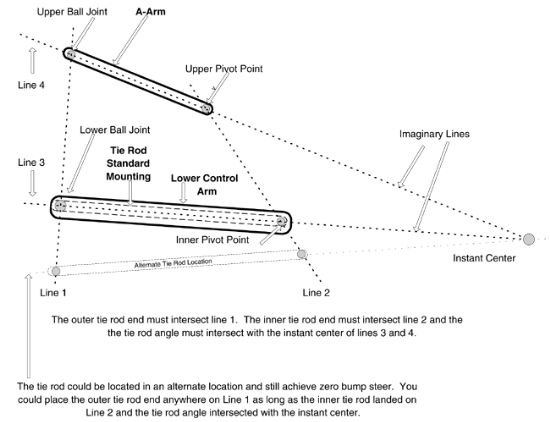
In order to accomplish zero bump the tie rod must fall between an imaginary line that runs from the upper ball joint through the lower ball joint and an imaginary line that runs through the upper a-arm pivot and the lower control arm pivot. In addition, the centerline of the tie rod must intersect with the instant center created by the upper a-arm and the lower control arm (See diagram below).
Sounds complicated? Really it is very simple. To achieve zero bump the front end must be designed correctly. The tie rod must travel on the same arc as the suspension when the car goes through travel. Simply matching lengths and arcs to prevent any unwanted steering of the front tires.
To exaggerate, if the tie rod were only 10" long and the suspension were 20" long then when the suspension traveled the tie rod angle would shorten much quicker than the suspension arc. In this scenario the tie rod would shorten much quicker through travel than the suspension and the car would toe in drastically over bumps. The shorter arc of the tie rod would pull on the spindle and toe it in through travel.
Tonight's Topics:
1) Front Roll Center
2) Bump Steer
Front Roll Center:
The roll center is a calculated point derived from lines drawn through the suspension points and the center of the tire contact patch. This point determines the location of the center about which the car rolls to the side. With suspension movement this roll center changes positions.
The roll center location on a stock car with stock location suspension points can only be moved by raising or lowering the chassis. This vertical suspension movement will also change camber and caster gain.
To put that into perspective here your car has a set center of gravity, CG, which hardly changes as you raise or lower the car. If the car has a high CG lowering the car increases the distance between the CG and the front roll center and actually increases body roll. In this odd scenario you could actually raise the car and decrease body roll.
Some usefull information about roll center:
The front roll center should always be lower than the rear roll center. If the front roll center is too low in relation to the rear roll center it will most likely cause a push. On the other hand, if the rear roll center is too high in relation to the front roll center it will tend to stray towards a loose condition. Wheelbase is also an important factor effecting roll centers, the shorter the wheelbase the more critical the front and rear roll center relationship becomes. Your roll centers on a high banked paved track should be lower so the camber change curve is less, and a little higher for a flat or mildly banked track.
Bump Steer Definition:
Bump Steer is when your wheels steer themselves without input from the steering wheel. The undesirable steering is caused by bumps in the track interacting with improper length or angle of your suspension and steering linkages.
How Much Bump Steer?
Ideally you should run as little bump steer as possible. Most of the tracks we see today are old and bumpy. Bump steer on these rough surfaces causes the car to be unpredictable. Some bump out can make the car more stable on corner entry. Bump in is almost always undesirable.
How to fix Bump Steer:
In order to accomplish zero bump the tie rod must fall between an imaginary line that runs from the upper ball joint through the lower ball joint and an imaginary line that runs through the upper a-arm pivot and the lower control arm pivot. In addition, the centerline of the tie rod must intersect with the instant center created by the upper a-arm and the lower control arm (See diagram below).
Sounds complicated? Really it is very simple. To achieve zero bump the front end must be designed correctly. The tie rod must travel on the same arc as the suspension when the car goes through travel. Simply matching lengths and arcs to prevent any unwanted steering of the front tires.
To exaggerate, if the tie rod were only 10" long and the suspension were 20" long then when the suspension traveled the tie rod angle would shorten much quicker than the suspension arc. In this scenario the tie rod would shorten much quicker through travel than the suspension and the car would toe in drastically over bumps. The shorter arc of the tie rod would pull on the spindle and toe it in through travel.
Last edited by RoadSpike; Mar 7, 2008 at 08:34 PM.



Be careful with roll centers. They can tell you a lot, but in the end it's just an imaginary point. This is a pretty good article:
http://zzyzxmotorsports.com/library/...nd-reality.pdf
http://zzyzxmotorsports.com/library/...nd-reality.pdf

Evolved Member
Joined: Oct 2005
Posts: 642
Likes: 1
From: IL, USA
Those pictures speak a thousand words. I've had them saved to my hard drive for some time now. But keep in mind that the first diagram is for a mac-strut suspension (our fronts) and the rear is for a double a-arm suspension (not us). Bump steer comes about a little more differently in a mac-strut setup.
Last edited by Noob4life; Mar 7, 2008 at 09:40 PM.
Thread Starter
Evolved Member
iTrader: (5)
Joined: Oct 2006
Posts: 3,805
Likes: 2
From: Sacramento, CA
Those pictures speak a thousand words. I've had them saved to my hard drive for some time now. But keep in mind that the first diagram is for a mac-strut suspension (our fronts) and the rear is for a double a-arm suspension (not us). Bump steer comes about a little more differently in a mac-strut setup.


Thread
Thread Starter
Forum
Replies
Last Post
Speed Element
Evo Tires / Wheels / Brakes / Suspension
51
Nov 11, 2020 03:54 AM
Nast_Nas
Outlander Sport
19
Sep 24, 2019 03:34 PM
Spaceman
For Sale - Suspension / Brakes / Handling
0
Jul 18, 2016 06:18 PM
Touge Factory
EvoX 'For Sale' Suspension / Brakes / Handling
26
Apr 1, 2011 10:46 AM
David Buschur
Evo Tires / Wheels / Brakes / Suspension
18
Feb 28, 2008 04:37 PM
