


Ignition Timing: Upper/Lower bound


Ignition Timing: Upper/Lower bound
With some help from some key people after finding out that the Evo 10 MR would not run lower than a certain ignition timing at WOT in key areas, we have found a very handy table for the MR.
Even more handy for people that only have access to 91 oct.
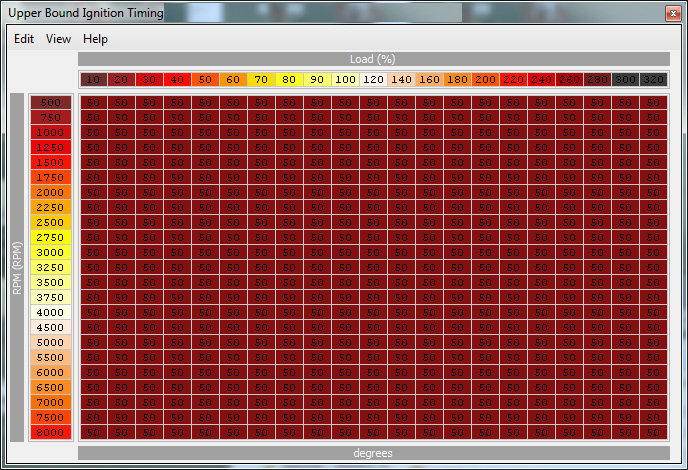
The Upper Bound Ignition Timing table for both GSR and MR look like this:
The Lower Bound Ignition Timing table for the GSR is on top, MR on bottom:
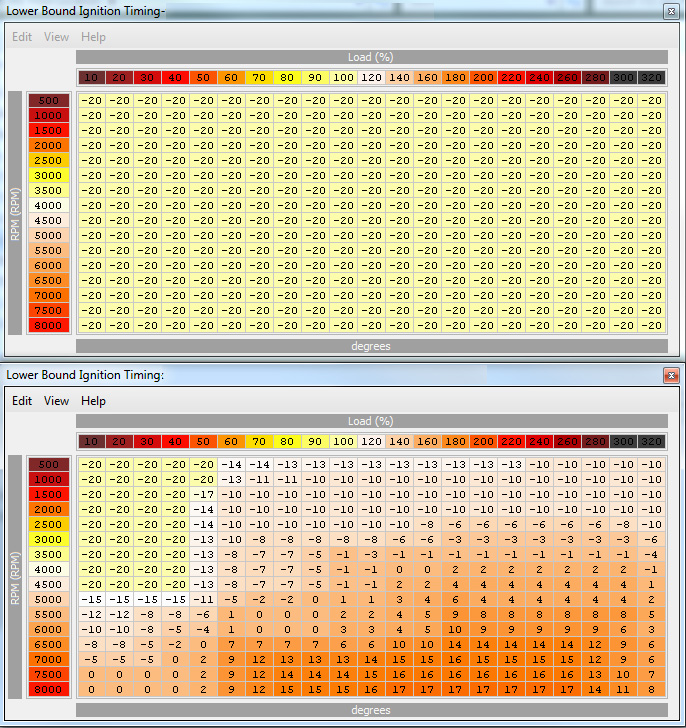
As you can see, very handy table to have with the MR as 14-17* from 6500 to 8000 can be a bit much on 91 with a larger turbo.
Upper / Lower bound XML for 2010 USDM Evo 10 MR - Rom ID 55580005: (thanks to Tephra for finding these)
Even more handy for people that only have access to 91 oct.
The Upper Bound Ignition Timing table for both GSR and MR look like this:
The Lower Bound Ignition Timing table for the GSR is on top, MR on bottom:
As you can see, very handy table to have with the MR as 14-17* from 6500 to 8000 can be a bit much on 91 with a larger turbo.
Code:
<scaling name="Min timing" units="degrees" toexpr="x-20" frexpr="x+20" format="%.0f" min="-61" max="61" inc="1" storagetype="int8" endian="big"/>

<table name="Lower Bound Ignition Timing" category="Timing" address="50793" type="3D" level="2" swapxy="true" scaling="Min timing">
		<table name="Load" address="61348" type="X Axis" elements="21" scaling="Load"/>
		<table name="RPM" address="612fc" type="Y Axis" elements="16" scaling="RPM"/>
	</table>

	<table name="Upper Bound Ignition Timing" category="Timing" address="6078d" type="3D" level="2" swapxy="true" scaling="Timing">
		<table name="Load" address="60f78" type="X Axis" elements="22" scaling="Load"/>
		<table name="RPM" address="60f42" type="Y Axis" elements="23" scaling="RPM"/>
	</table>
Code:
<scaling name="Min timing" units="degrees" toexpr="x-20" frexpr="x+20" format="%.0f" min="-61" max="61" inc="1" storagetype="int8" endian="big"/>

<table name="Lower Bound Ignition Timing" category="Timing" address="507a5" type="3D" level="2" swapxy="true" scaling="Min timing">
		<table name="Load" address="615a0" type="X Axis" elements="21" scaling="Load"/>
		<table name="RPM" address="61554" type="Y Axis" elements="16" scaling="RPM"/>
	</table>

	<table name="Upper Bound Ignition Timing" category="Timing" address="608e8" type="3D" level="2" swapxy="true" scaling="Timing">
		<table name="Load" address="611a6" type="X Axis" elements="22" scaling="Load"/>
		<table name="RPM" address="61172" type="Y Axis" elements="23" scaling="RPM"/>
	</table>
Last edited by GST Motorsports; Feb 11, 2010 at 10:38 AM.

 Great find guys! Thanks for the update Bryan. So much potential in the SST, its great to see that us MR guys aren't being put on the back burner. Love my car now that you adjusted some small things. Keep the good news coming!


Evolved Member
Joined: Apr 2009
Posts: 536
Likes: 0
From: US
Nice find! Any idea why the MR lower bound is not the same as the GSR's? Seems kind of odd they would force the MR to run a pretty significant amount of minimum timing. Is it because of the SST and holding boost between shifts?


Trending Topics

So did some more testing with these this week.
Turns out the "Lower Bound Ignition Timing table" is also used on the MR's between shifts. This is one of the missing pieces to help with boost overshooting between SST shifts.
Log the MR during shifts and see what load and rpm the car hits between shifts and tweak the Lower Bound Ignition Timing table as needed. Less retard will cause less boost overshooting between shifts. Of course becareful you don't use too much timing in this table as this table also bounds the lower timing limit. Meaning the car will NOT go under what is in that table at WOT, even if you have a lower ignition timing number in your main ignition timing map.
Reducing the -20 (less retard) in the cruise regions also helps "soften" the cruise shifting. It won't change the shift speed but it will make the shifts feel less abrupt. I ended up trying out -5 to -7 in that region and it really made the shifts more civilized.
Hope this helps some MR owners.
- Bryan
Turns out the "Lower Bound Ignition Timing table" is also used on the MR's between shifts. This is one of the missing pieces to help with boost overshooting between SST shifts.
Log the MR during shifts and see what load and rpm the car hits between shifts and tweak the Lower Bound Ignition Timing table as needed. Less retard will cause less boost overshooting between shifts. Of course becareful you don't use too much timing in this table as this table also bounds the lower timing limit. Meaning the car will NOT go under what is in that table at WOT, even if you have a lower ignition timing number in your main ignition timing map.
Reducing the -20 (less retard) in the cruise regions also helps "soften" the cruise shifting. It won't change the shift speed but it will make the shifts feel less abrupt. I ended up trying out -5 to -7 in that region and it really made the shifts more civilized.
Hope this helps some MR owners.
- Bryan
Last edited by GST Motorsports; Jan 30, 2010 at 08:20 PM.

Wow that is a really interesting find! I can't imagine forcing the car to run 14-17* timing as high as 260 load on a larger turbo up top. That "might" be just barely ok for 93 octane but there is no way 91 octane will be happy about that at 25+ psi of boost. Awesome work! 
Tephra, the table you posted is interesting as well. Seems that 45* timing as about as much as you want to run at the cruise loads which makes sense in my findings, 43-44* seems to be optimal there but I guess it could vary by car and mods.
The area that concerns me is the 3000 RPM and lower region at higher loads. If someone tunes for max spool on the stock turbo on say E85, their timing is going to be clamped quite heavily until they reach 3250 if those maps are in play. I think I'll load these tables just to verify what mine are set for although they are likely +50* and -20* for the standard GSR maps.
The area that concerns me is the 3000 RPM and lower region at higher loads. If someone tunes for max spool on the stock turbo on say E85, their timing is going to be clamped quite heavily until they reach 3250 if those maps are in play. I think I'll load these tables just to verify what mine are set for although they are likely +50* and -20* for the standard GSR maps.

This is a very odd set of maps to me and would like to give some input if you guys don't mind, for discussion obviously.
It would seem to me that allowing the car to reach any timing that the tuner didn't want it to reach put the car in a very dangerous situation.
Some tell me why you wouldn't just be better off setting the upper and lower bound limits to the same settings you use on your high/low octane ignition maps? That sure seems to be the best idea in my book, especially at higher loads.
It would seem to me that allowing the car to reach any timing that the tuner didn't want it to reach put the car in a very dangerous situation.
Some tell me why you wouldn't just be better off setting the upper and lower bound limits to the same settings you use on your high/low octane ignition maps? That sure seems to be the best idea in my book, especially at higher loads.


I would think setting it up to run a lower timing could be helpful just incase there is knock present so it allows the ECU to trim it out. If you set it to the same value as you tuned for it might not be able to pull it back out in case of a knock event.
Thoughts??
Mitch
Thoughts??
Mitch