


Cusco 1.5 RS Rear Diff Review


Cusco 1.5 RS Rear Diff Review
Car: Evo X GSR
Diff: Cusco RS 1.5way Rear for cars with AYC
Fluid: Amsoil SVG 75w140 (cusco recommends their 80w140, but amsoil is fine)
I got this installed recently but didn't get a chance to give my cusco rear diff a real workout until last Sunday's auto-x.
The first big difference I noticed was behavior through sweepers. The throttle oversteer was controllable and you could move the rear end out much more easily. What this meant for me was that I could get on the gas earlier and stay on it through the entire turn.
On tight turns it made the car much more nimble when you kept in the power band. Just using some good throttle modulation went a long way in getting the car around, keeping speed, and positioning for the exit and next element. Normally I would suffer from a little too much understeer on exit and have to go slower in the entry and mid to position the car where I wanted it.
For extremely tight turns I also saw improvement. Although you still have wait a bit more than you'd like, as is the nature of some turns, it was easier to get out of it. I could start applying a little more throttle early on and the rear end would step out. It just required faster unwinding of the wheel with the throttle application to make sure I kept the car in the direction I wanted and under control.
For those wondering about daily driving, it does make it a bit better as it decreases mid-turn and exit understeer with throttle application. You do need to not be an *** hat though and try to hammer the accelerator with the wheel cranked as you will get your car's *** out very quickly.
The only down side is that it'll sound like your car is broken. Even with a proper break-in of figure-eights, circles, and a fluid change it's still clunks a bit. Most of the sound goes away when the fluid is hot, but it'll always be there. And if you do a 3-pt turn, just expect to hear the clunking and catching of the plates.
Diff: Cusco RS 1.5way Rear for cars with AYC
Fluid: Amsoil SVG 75w140 (cusco recommends their 80w140, but amsoil is fine)
I got this installed recently but didn't get a chance to give my cusco rear diff a real workout until last Sunday's auto-x.
The first big difference I noticed was behavior through sweepers. The throttle oversteer was controllable and you could move the rear end out much more easily. What this meant for me was that I could get on the gas earlier and stay on it through the entire turn.
On tight turns it made the car much more nimble when you kept in the power band. Just using some good throttle modulation went a long way in getting the car around, keeping speed, and positioning for the exit and next element. Normally I would suffer from a little too much understeer on exit and have to go slower in the entry and mid to position the car where I wanted it.
For extremely tight turns I also saw improvement. Although you still have wait a bit more than you'd like, as is the nature of some turns, it was easier to get out of it. I could start applying a little more throttle early on and the rear end would step out. It just required faster unwinding of the wheel with the throttle application to make sure I kept the car in the direction I wanted and under control.
For those wondering about daily driving, it does make it a bit better as it decreases mid-turn and exit understeer with throttle application. You do need to not be an *** hat though and try to hammer the accelerator with the wheel cranked as you will get your car's *** out very quickly.
The only down side is that it'll sound like your car is broken. Even with a proper break-in of figure-eights, circles, and a fluid change it's still clunks a bit. Most of the sound goes away when the fluid is hot, but it'll always be there. And if you do a 3-pt turn, just expect to hear the clunking and catching of the plates.

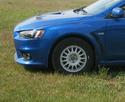
When this came up in another thread, I asked about the theory behind this (but got no answer). The part that confuses me is why it seems to work so well to have two devices that are "trying" to do different things. The AYC is trying to make the outside rear turn faster than the inside rear; the 1.5-way is try to make both rears turn the same speed. Why does this work? Is something between the two better than either extreme? Did Mitsu go too far when they "upgraded" from the original AYC to the super AYC? If anyone knows the theory behind the 1.5-way + AYC combination, I would love to hear it. Thanks.


Maybe the answer to my question can be found in the difference between the RS and MZ, then. My understanding is that the RS uses relatively soft coil springs for the preload, while the MZ is a cone-type. So the RS will lock much less hard at first, which would make it less incompatible with what the AYC is trying to do, at least at part throttle. But when you're at WOT, does the RS ever lock as hard as the MZ? If it does, then I'm still wondering about the Cusco fighting the AYC under these conditions. The only way for me to make sense of all this is to assume that an RS can never lock as hard as an MZ.
Trending Topics
The only difference between the MZ and RS is that the MZ has the cones at the end and the RS uses springs in the middle. I think the cones MIGHT block the connection between the AYC and the rear diff gears.
Mr. Move, it's a direct bolt in. You just need to get some new side bearings to make the job easier.
Mr. Move, it's a direct bolt in. You just need to get some new side bearings to make the job easier.
Correct me if I'm wrong, but I don't see how the internals to the diff could prevent the AYC from working. The AYC takes the input to the diff and connects it to the right output after either gearing it up or down. The only place where the AYC interacts with the diff is by using it to turn the left output at the opposite difference in speed from the right output. It does this by - in effect - assuming that the diff is open, so that any increase (or decrease) in the speed of the right output must be matched by a decrease (or increase) in the speed of the left output. And that is why I keep wondering how a locking diff can be used.
I mean the physical connection itself. One of the half-shafts actually passes through both the AYC and the rear diff. So you'd probably need a different half-shaft if the cone plates were symmetrical.
As for HOW it does it, I'm not fully sure. From it's behavior the AYC seems to act more like an additional locking mechanism to reduce understeer given throttle position, steering angle, and I'm sure a myriad of other variables. So having a stronger rear diff would seem to make the AYC work less since the job of reducing understeer was already being taken care of.
From a physical standpoint, a single shaft piece passes through both the AYC mechanism and the rear differential. If I remember correctly during install, the left axle half shaft popped out of the diff and was left connected to the car. The right axle part came off clean with a shaft piece still in the AYC and diff. The AYC is also only found on the right side of the whole assembly. That seems to support the idea that all the AYC does in the end is support the diff to make it a stronger locking device.
As for HOW it does it, I'm not fully sure. From it's behavior the AYC seems to act more like an additional locking mechanism to reduce understeer given throttle position, steering angle, and I'm sure a myriad of other variables. So having a stronger rear diff would seem to make the AYC work less since the job of reducing understeer was already being taken care of.
From a physical standpoint, a single shaft piece passes through both the AYC mechanism and the rear differential. If I remember correctly during install, the left axle half shaft popped out of the diff and was left connected to the car. The right axle part came off clean with a shaft piece still in the AYC and diff. The AYC is also only found on the right side of the whole assembly. That seems to support the idea that all the AYC does in the end is support the diff to make it a stronger locking device.
Yes, the right axle goes through the AYC and into the diff, but I don't think that it goes any further and I don't think that the left axle goes any deeper than the diff, itself. My understanding of how an AYC works is that it operates entirely on the right output and lets the diff transfer the converse effect to the left output. My understanding is that the AYC has two "extra" inputs (besides the right axle) to use: one that is geared to turn faster than the diff's carrier and one that is geared to turn slower. To produce yaw to the left, for example, the AYC links the faster-turning "extra" input to the right axle and then lets the diff force the left axle to slow down.


Here's the small writeup I did on the install.
https://www.evolutionm.net/forums/ev...f-install.html
https://www.evolutionm.net/forums/ev...f-install.html

Thread
Thread Starter
Forum
Replies
Last Post
kyoo
Evo Engine / Turbo / Drivetrain
1244
Jul 27, 2022 01:02 PM
son of krypton
Vendor Service / Parts / Tuning Review
41
Jul 27, 2022 11:35 AM
Thoe99
Evo Engine / Turbo / Drivetrain
378
Jul 30, 2018 05:56 PM
rawkus
Evo Tires / Wheels / Brakes / Suspension
26
Oct 5, 2009 09:07 AM
