
What's the point of CNC porting and cam upgrading for the cylinder head?
Subscribe
Lightsaber
Evolved Member
close


May 5, 2026
- Join DateJul 2013
- LocationVancouver, BC
- Posts:805
-
iTrader Positive Feedback0
-
iTrader Feedback Score(0)
-
Likes:183
-
Liked:110 Times in 92 Posts
I understand that for a naturally aspirated engine, CNC-porting the head and having aggressive camshafts is a great way to have more horsepower by freeing up the airflow, but for a turbocharged engine like our 4B11T's, isn't the power, in its essence, limited by the turbocharger itself? For example, here is a compressor map of the BorgWarner 7163-F(v):
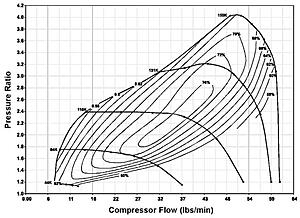
While it's factory underrated as 550 bhp, you do see that for the volume of stoichiometric mixture it can pump, this turbo cannot make much more than 600 whp. Let's say, in a hypothetical bench-racing scenario, we build a very strong short block and max out the turbo. Then what's the point of further improving the 4B11T's cylinder heads with CNC-porting and aftermarket cams? Does it increase mid-range output? Does it help the turbo spool up faster? Or does it really achieve absolutely nothing?

While it's factory underrated as 550 bhp, you do see that for the volume of stoichiometric mixture it can pump, this turbo cannot make much more than 600 whp. Let's say, in a hypothetical bench-racing scenario, we build a very strong short block and max out the turbo. Then what's the point of further improving the 4B11T's cylinder heads with CNC-porting and aftermarket cams? Does it increase mid-range output? Does it help the turbo spool up faster? Or does it really achieve absolutely nothing?

LetsGetThisDone
EvoM Guru
close
Yesterday
- Join DateOct 2013
- LocationLas Vegas
- Posts:15,973
-
iTrader Positive Feedback100
-
iTrader Feedback Score(1)
-
Likes:162
-
Liked:1,629 Times in 1,392 Posts
The head will gain good power under the curve. Cams will also gain area under the curve. Both parts increase engine airflow, allowing the engine to make more power at lower boost levels. It's all about increasing airflow. Just like putting a bigger turbo on the car..
Lightsaber
Evolved Member
close
May 5, 2026
- Join DateJul 2013
- LocationVancouver, BC
- Posts:805
-
iTrader Positive Feedback0
-
iTrader Feedback Score(0)
-
Likes:183
-
Liked:110 Times in 92 Posts
Quote:
Now that makes perfect sense! I envision it kindly of like pairing the same turbo with a 2.0L engine and a 2.5L engine. They will make the same peak horsepower, but the 2.5L engine will have better output in the mid-range and when the wastegate is half-open (like partial throttle)!Originally Posted by letsgetthisdone
The head will gain good power under the curve. Cams will also gain area under the curve. Both parts increase engine airflow, allowing the engine to make more power at lower boost levels. It's all about increasing airflow. Just like putting a bigger turbo on the car..


Newbie
Something is wrong if the WG is open at part throttle, isn't it? The DV, I can visualize that happening, maybe.... but not the WG.
LetsGetThisDone
EvoM Guru
close
Yesterday
- Join DateOct 2013
- LocationLas Vegas
- Posts:15,973
-
iTrader Positive Feedback100
-
iTrader Feedback Score(1)
-
Likes:162
-
Liked:1,629 Times in 1,392 Posts
It opens if you hit the load (boost) threshold for it to open.
Also, throttle doesn't dictate how far it opens your WGDC setting in the tune, or the where the MBC is set dictates how far it opens. On a lot of stock turbo cars, especially on E85, the wastegate is pretty much closed to extract as much boost as possible.
Also, throttle doesn't dictate how far it opens your WGDC setting in the tune, or the where the MBC is set dictates how far it opens. On a lot of stock turbo cars, especially on E85, the wastegate is pretty much closed to extract as much boost as possible.
Newbie
Sure, theoretically. But, as a practical matter, it would help to know at what PSI, it, the WG, that is, is actually opening, at least from my perspective. And is the OP talking about fully open, or cracking pressure?
I am curious to know both: At what PSI the flapper valve is cracking up off its seat and also what peak boost(full open travel) is. If it is going full open at part throttle then probably insufficient spring pressure(preload) is an issue.
Both load threshold and WGDC only come into play above WG spring pressure level. So, if OP has no preload above the wimpy factory setting coupled with a fatigued actuator spring and you combine that with an uncrushed DV he is going to have boost issues......independently of WGDC and load threshold.
I am curious to know both: At what PSI the flapper valve is cracking up off its seat and also what peak boost(full open travel) is. If it is going full open at part throttle then probably insufficient spring pressure(preload) is an issue.
Both load threshold and WGDC only come into play above WG spring pressure level. So, if OP has no preload above the wimpy factory setting coupled with a fatigued actuator spring and you combine that with an uncrushed DV he is going to have boost issues......independently of WGDC and load threshold.
LetsGetThisDone
EvoM Guru
close
Yesterday
- Join DateOct 2013
- LocationLas Vegas
- Posts:15,973
-
iTrader Positive Feedback100
-
iTrader Feedback Score(1)
-
Likes:162
-
Liked:1,629 Times in 1,392 Posts
Quote:
I am curious to know both: At what PSI the flapper valve is cracking up off its seat and also what peak boost(full open travel) is. If it is going full open at part throttle then probably insufficient spring pressure(preload) is an issue.
Both load threshold and WGDC only come into play above WG spring pressure level. So, if OP has no preload above the wimpy factory setting coupled with a fatigued actuator spring and you combine that with an uncrushed DV he is going to have boost issues......independently of WGDC and load threshold.
You made that 100 times more complicated than it needs to be.Originally Posted by Sligo
Sure, theoretically. But, as a practical matter, it would help to know at what PSI, it, the WG, that is, is actually opening, at least from my perspective. And is the OP talking about fully open, or cracking pressure?I am curious to know both: At what PSI the flapper valve is cracking up off its seat and also what peak boost(full open travel) is. If it is going full open at part throttle then probably insufficient spring pressure(preload) is an issue.
Both load threshold and WGDC only come into play above WG spring pressure level. So, if OP has no preload above the wimpy factory setting coupled with a fatigued actuator spring and you combine that with an uncrushed DV he is going to have boost issues......independently of WGDC and load threshold.
Lightsaber
Evolved Member
close
May 5, 2026
- Join DateJul 2013
- LocationVancouver, BC
- Posts:805
-
iTrader Positive Feedback0
-
iTrader Feedback Score(0)
-
Likes:183
-
Liked:110 Times in 92 Posts
Quote:
Also, throttle doesn't dictate how far it opens your WGDC setting in the tune, or the where the MBC is set dictates how far it opens. On a lot of stock turbo cars, especially on E85, the wastegate is pretty much closed to extract as much boost as possible.
I think this statement hits the nail on the head.Originally Posted by letsgetthisdone
It opens if you hit the load (boost) threshold for it to open.Also, throttle doesn't dictate how far it opens your WGDC setting in the tune, or the where the MBC is set dictates how far it opens. On a lot of stock turbo cars, especially on E85, the wastegate is pretty much closed to extract as much boost as possible.
