


Gus' EvoIX MR Tuning Story


Gus' EvoIX MR Tuning Story
Generous Donors of Project Evo Tuning
Donation will go toward
Donate Here!
Now accepting datalogging sessions with (near CT area):
I drive a 2006 Evo IX MR and it has remained in stock form ever since the day I bought the car last August. Because I'm heavily involved with the local autocross events here in Connecticut and competes in A-Stock class, plus I run at my own rallycross event in AWD Street class, there's not much I can do on the car to stay "legal."


With the majority of Evo owners getting the "5 and 1" package from Mitsubishi with warranty issues, I wanted to stay away from any visible modification (i.e. exhaust system, boost controller, etc) as much as possible. So far it's paid off; the local dealership helped me get rid of suspension popping sound I was having under heavy braking.
The allure of tweaking the ECU to gain horsepower is becoming so popular, and it seems like anybody with a laptop can become a tuning guru. It is now my turn to get good at it.
Sharing my Tuning Story
I've been asked by my friends to keep track of everything I'm doing in detail since it may be useful for people at the same level, so I'm going to do my best to record everything on my own blog (in the sig). Keep in mind I'm only an amateur at this so take everything with a "grain of salt."
I already have 4 blogs written and posted, so I'm going to post it here and write some observations as I go. Hopefully as I progress people will find this as a helpful reference.
If you have any questions at all, please feel free to PM me or email me at psgevo@projectsologear.com
Here Goes!
`Gus
- madmax199 - $50
Donation will go toward
- EvoScan - $25
- WideBand O2 - $250
- E-Boost Gauge - Still searching for compatible one
Donate Here!
Now accepting datalogging sessions with (near CT area):
- Stock 03-07 STI
- Stock VIII & IX MR
- Anybody's request
I drive a 2006 Evo IX MR and it has remained in stock form ever since the day I bought the car last August. Because I'm heavily involved with the local autocross events here in Connecticut and competes in A-Stock class, plus I run at my own rallycross event in AWD Street class, there's not much I can do on the car to stay "legal."
With the majority of Evo owners getting the "5 and 1" package from Mitsubishi with warranty issues, I wanted to stay away from any visible modification (i.e. exhaust system, boost controller, etc) as much as possible. So far it's paid off; the local dealership helped me get rid of suspension popping sound I was having under heavy braking.
The allure of tweaking the ECU to gain horsepower is becoming so popular, and it seems like anybody with a laptop can become a tuning guru. It is now my turn to get good at it.
Sharing my Tuning Story
I've been asked by my friends to keep track of everything I'm doing in detail since it may be useful for people at the same level, so I'm going to do my best to record everything on my own blog (in the sig). Keep in mind I'm only an amateur at this so take everything with a "grain of salt."
I already have 4 blogs written and posted, so I'm going to post it here and write some observations as I go. Hopefully as I progress people will find this as a helpful reference.
If you have any questions at all, please feel free to PM me or email me at psgevo@projectsologear.com
Here Goes!
`Gus
Last edited by PSG Evo; Jan 8, 2008 at 01:12 AM.
Project Evo Tuning (The Beginning)
Project Evo Tuning (The Beginning) - Written 5 days ago
Blog:
~~~~~~~~~~~~~~~~~~~~~~~~~~~~~~~~~~
Cars now-a-day comes with such technologically advanced engine management system, it is amazing how much you can do with it. Fuel trim, timing, boost, and much much more can be adjusted at a click of a button.
The allure of tweaking the ecu to gain horsepower is becoming so popular, and it seems like anybody with a laptop can become a tuning guru. It is now my turn to get good at it.
I want to start off my project by testing out the myth that by leaning out the rich factory a/f settings and adjusting the active intake valve timing (MIVEC system on the Evo 9), one can gain around 30 hp at the crank. Just to put that in perspective, a stock Evolution 9 MR usually dyno's at 230hp on a roller dyno. My target is 260hp.
I already have the OBD2 cable in possession which I purchased from (http://www.tactrix.com/) and it is now time to find out what else I need.
~~~~~~~~~~~~~~~~~~~~~~~~~~~~~~~~~~
Comments:
I noticed that I forgot to say changing the boost mapping will also help with hitting the target goal of 260hp.
Am I going to achieve that goal without any physical bolt-on modifications? Honestly I think it's going to be very hard. If it is at all possible, that would mean many things.
1) Factory tune is very very conservative (timing, boost, fuel mixture)
2) Factory tune is not optimized
3) My Evo is unusual (not likely)
`Gus
Blog:
~~~~~~~~~~~~~~~~~~~~~~~~~~~~~~~~~~
Cars now-a-day comes with such technologically advanced engine management system, it is amazing how much you can do with it. Fuel trim, timing, boost, and much much more can be adjusted at a click of a button.
The allure of tweaking the ecu to gain horsepower is becoming so popular, and it seems like anybody with a laptop can become a tuning guru. It is now my turn to get good at it.
I want to start off my project by testing out the myth that by leaning out the rich factory a/f settings and adjusting the active intake valve timing (MIVEC system on the Evo 9), one can gain around 30 hp at the crank. Just to put that in perspective, a stock Evolution 9 MR usually dyno's at 230hp on a roller dyno. My target is 260hp.
I already have the OBD2 cable in possession which I purchased from (http://www.tactrix.com/) and it is now time to find out what else I need.
~~~~~~~~~~~~~~~~~~~~~~~~~~~~~~~~~~
Comments:
I noticed that I forgot to say changing the boost mapping will also help with hitting the target goal of 260hp.
Am I going to achieve that goal without any physical bolt-on modifications? Honestly I think it's going to be very hard. If it is at all possible, that would mean many things.
1) Factory tune is very very conservative (timing, boost, fuel mixture)
2) Factory tune is not optimized
3) My Evo is unusual (not likely)
`Gus
Project Evo Tuning (needed software)
Project Evo Tuning (needed software) - Written 5 days ago
Blog:
~~~~~~~~~~~~~~~~~~~~~~~~~~~~~~~~~~
So I began looking around online for software, and for my purpose I need two things right now:
1) Datalogging Software and,
2) ECU reflashing software
The good news is, there are free software out there that is readily available for downloading. There are also ones you can pay. Since I'm doing this for fun, I'm going to test out the free software first.
For Datalogging, I went with the Mitsulogger which can be downloaded from http://www.aktivematrix.com/ Malibu Jack who's the owner of the forum founded this software and provides regular updates to his software. Go to the download section and get it. The version I went for was V 1.5 Alpha.
For ECU reflashing, I went with ECUFlash that can be downloaded from http://www.openecu.org I downloaded the latest version 13.4 .
Now onward to playing around with it and making it work.
~~~~~~~~~~~~~~~~~~~~~~~~~~~~~~~~~~
Comments:
Nothing that beginners don't know here. I didn't include references to EvoScan but many Evo owners find it very useful, especially with useful applications that others have written for it. I may sooner or later try it out. For the price, it's very affordable.
`Gus
Blog:
~~~~~~~~~~~~~~~~~~~~~~~~~~~~~~~~~~
So I began looking around online for software, and for my purpose I need two things right now:
1) Datalogging Software and,
2) ECU reflashing software
The good news is, there are free software out there that is readily available for downloading. There are also ones you can pay. Since I'm doing this for fun, I'm going to test out the free software first.
For Datalogging, I went with the Mitsulogger which can be downloaded from http://www.aktivematrix.com/ Malibu Jack who's the owner of the forum founded this software and provides regular updates to his software. Go to the download section and get it. The version I went for was V 1.5 Alpha.
For ECU reflashing, I went with ECUFlash that can be downloaded from http://www.openecu.org I downloaded the latest version 13.4 .
Now onward to playing around with it and making it work.
~~~~~~~~~~~~~~~~~~~~~~~~~~~~~~~~~~
Comments:
Nothing that beginners don't know here. I didn't include references to EvoScan but many Evo owners find it very useful, especially with useful applications that others have written for it. I may sooner or later try it out. For the price, it's very affordable.
`Gus
Last edited by PSG Evo; Nov 21, 2007 at 10:52 AM.
Project Evo Tuning (first attempt with ECUFlash + a little snag)
Project Evo Tuning (first attempt with ECUFlash + a little snag) - Written 4 days ago
Blog:
~~~~~~~~~~~~~~~~~~~~~~~~~~~~~~~~~~
Wow, believe it or not, installing ECUFlash and making it work takes A LOT of effort. In fact if you search around in the OpenECU forum (where you will find most of your answers), you will find that majority of the posts are written by people who are having issues with the computer communicating with the car ECU.
One thing I discovered is the OBD2 cable that I have requires a driver to be installed before use. The good thing is ECUFlash software has the driver built into the program, so as long as you install the ECUFlash program correctly, the cable should work. Here's the steps that I took which worked for me:
1) Download OpenECU
2) Plug the OBD2 Cable to the car (both the OBD2 port and the flash port)
3) Plug the OBD2 Cable to the computer
At this point, it's going to prompt you to choose a driver. I ignored the prompt
4) Run the OpenECU exe file to begin install
5) Go through the steps, and when it's about 90% complete with install, it's going to open another window which will install the cable driver for you.
6) Finish install
You should be all done now.
I was successful in pulling the data from the ECU on the initial try! YES! The first thing I did was read the immobilization code and write it down somewhere safe. Since all cars have different immobilization code, you can imagine the horror stories of how people cannot start their car after using a map from another car. Remember, once you lose the code, you will never get it back. Time to flat bed your car to the dealership where they will void your warranty for messing around with the ECU!

One problem I did run into occured when I tried to save the ROM. Somehow I kept getting the error message below:I found out that it has to do with my OS so I'm going to reimage my computer and try again.
To be continued...
~~~~~~~~~~~~~~~~~~~~~~~~~~~~~~~~~~
Comments:
Immobilization Code - VERY IMPORTANT! Write it down as soon as you download your ECU data. You do not want to lose this information because the only way (that I know of) to get it is through your friendly Mitsubishi dealership. If they find out that the ECU has been tempered with, guess what goes right out of the window? Warranty for Powertrain!
Cable Driver - Countless amount of people have issues with getting this to work. At worst, the computer/laptop doesn't recognize the cable and you will not be able to use any datalogging and reflashing software at all. I don't have a good answer for everyone, and it will be case-by-case troubleshooting. If all else fails, try uninstalling ECUFlash and then installing it again.
Problem with foreign Window XP OS - I have read multiple posts about foreign versions of XP not being able to save maps. Since I got my laptop from my uncle overseas, the laptop had the Asian version installed. Since I can pull and write (not save), I'll probably ask Kyle @ BishopMotorsports to keep a copy of my data on his laptop and then start playing around with the parameters. At the very worst I can reflash the car back to stock map.
YES I wrote my immobilization code down already. Have you?
`Gus
Blog:
~~~~~~~~~~~~~~~~~~~~~~~~~~~~~~~~~~
Wow, believe it or not, installing ECUFlash and making it work takes A LOT of effort. In fact if you search around in the OpenECU forum (where you will find most of your answers), you will find that majority of the posts are written by people who are having issues with the computer communicating with the car ECU.
One thing I discovered is the OBD2 cable that I have requires a driver to be installed before use. The good thing is ECUFlash software has the driver built into the program, so as long as you install the ECUFlash program correctly, the cable should work. Here's the steps that I took which worked for me:
1) Download OpenECU
2) Plug the OBD2 Cable to the car (both the OBD2 port and the flash port)
3) Plug the OBD2 Cable to the computer
At this point, it's going to prompt you to choose a driver. I ignored the prompt
4) Run the OpenECU exe file to begin install
5) Go through the steps, and when it's about 90% complete with install, it's going to open another window which will install the cable driver for you.
6) Finish install
You should be all done now.
I was successful in pulling the data from the ECU on the initial try! YES! The first thing I did was read the immobilization code and write it down somewhere safe. Since all cars have different immobilization code, you can imagine the horror stories of how people cannot start their car after using a map from another car. Remember, once you lose the code, you will never get it back. Time to flat bed your car to the dealership where they will void your warranty for messing around with the ECU!
One problem I did run into occured when I tried to save the ROM. Somehow I kept getting the error message below:I found out that it has to do with my OS so I'm going to reimage my computer and try again.
To be continued...
~~~~~~~~~~~~~~~~~~~~~~~~~~~~~~~~~~
Comments:
Immobilization Code - VERY IMPORTANT! Write it down as soon as you download your ECU data. You do not want to lose this information because the only way (that I know of) to get it is through your friendly Mitsubishi dealership. If they find out that the ECU has been tempered with, guess what goes right out of the window? Warranty for Powertrain!
Cable Driver - Countless amount of people have issues with getting this to work. At worst, the computer/laptop doesn't recognize the cable and you will not be able to use any datalogging and reflashing software at all. I don't have a good answer for everyone, and it will be case-by-case troubleshooting. If all else fails, try uninstalling ECUFlash and then installing it again.
Problem with foreign Window XP OS - I have read multiple posts about foreign versions of XP not being able to save maps. Since I got my laptop from my uncle overseas, the laptop had the Asian version installed. Since I can pull and write (not save), I'll probably ask Kyle @ BishopMotorsports to keep a copy of my data on his laptop and then start playing around with the parameters. At the very worst I can reflash the car back to stock map.
YES I wrote my immobilization code down already. Have you?
`Gus
Last edited by PSG Evo; Nov 21, 2007 at 11:00 AM.
Project Evo Tuning (Got Mitsulogger Working + 4th Gear Pull Data)
Project Evo Tuning (Got Mitsulogger Working + 4th Gear Pull Data) - Written Yesterday
Blog:
~~~~~~~~~~~~~~~~~~~~~~~~~~~~~~~~~~

I got Mitsulogger to work over the weekend. Awesome! It was a piece of cake and everything worked very well. The driver for the tactrix cable was already installed when I installed the OPENECU software, so the only thing I had to do was connect the cable from the car to the computer, start the program, and click "Start Logging."
The software had to make an "initialize" attempt to connect with the car CPU, and after a good 5 seconds, it creates a new log file and begun the logging of data.
I kept as many variable as I know "on" as I logged, but I've been told that the program will log slower with more values being tracked. I had the RPM, Speed, Load Value, AirFlow, Knock, and Timing Advance turned on. I might have left a few other things on just for kicks, and I went out for a drive.
Apparently in the MR, the advantage of the gear ratio really comes out in its 4th gear. Having heard that when comparing two similarly modified BPU Evo's (exhaust, intake pipes, boost controller, tune), a MR has been known to pull away from a GSR in 4th, I wanted to capture a 4th gear pull as my first significant log.
The night was around 40~50F and I did a 2500rpm to redline pull with 100% throttle committed. Here's the result from the pull:
Load Value vs. NarrowBand O2 Sensor

With the limited knowledge that I have, I have been told that the load value has a lot to do with the boost level of the car. Assuming that is correct, you can see that the full boost hits around a hair after 3000rpm and holds steadily, then starts to drop off as it approaches redline. It is important to understand load value because it will help you locate the "cell" that you will be modifying when you're changing the parameters of the engine maps. Seeing how full boost on a typically stock MR is set at 19psi and tapers to 16psi at redline, for now I will correlate the assumption as follows: 19psi~250Load :: 16psi~210Load. I'm sure there's something else about Load Value I need to know.
The NarrowBand O2, while not the recommended parameter to understand Air Fuel (A/F) ratio, nonetheless provides some insight. From the DSM tuning days, it is recommended for the car to hold a steady 0.940V at full throttle in 3rd gear (they only had 5 gears in the box). It is said that at that voltage, you have the best air to fuel ratio mixture for power. Apparently the stock EVO map is tuned similarly. As you can see, the A/F ratio climbed up as the rpm rose to provide a richer mixture (avoid detonation) to a final 0.940V. Just to note, no knock was detected throughout the pull.
AirFlow vs. Timing Advance

I know something about AirFlow since I have played around with an Apexi S-AFC before! Evo (like DSM) comes with a MAF sensor and will read in unit of Hz (hertz). More AirFlow means more hertz. Typically during a cruise, the AirFlow will read a range between 100-1000 Hz; the value is affected by throttle position, boost, oxygen density, engine efficiency, ect. Under heavy boosting, the Hz level will climb higher and higher all the way to redline.
As a reference, a typically modified DSM (16G with full supporting mods) will pull a 2000+Hz reading at over 21psi of boost. On a cold night the MAF may be overrun and the fuel cut will kick it (meaning the computer believes the car has reached its highest intake capacity with the factory equipped fuel system and shuts down the car before damage is done). The highest AirFlow value I logged was at 1503.31 Hz.
I don't know much about Timing Advance other than the fact that it is measured in the unit of degrees before TDC (top dead center), referring to the location where the spark ignites the fuel. The closer to TDC when the mixture is combusted, the more power is generated which makes sense since it is exploding from a "more" compressed state. More about that later.
AirFlow vs. Load Value
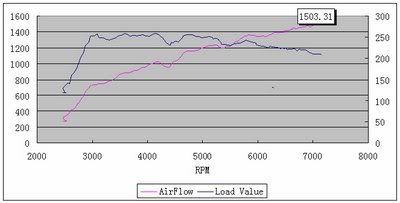
I wanted to compare AirFlow to Load Value because I wanted to see the correlation of how the boost characteristics of the turbocharger affect the two. As I can tell, the AirFlow continues to increase even though the boost (or what I am directly relating, the Load Value) decreases, which makes sense since air intake volume continues to increase as the rpm climbs higher. It does however look like the rate of change in the Load Value has a direct effect on the the slope of AirFlow, meaning more acceleration in "boost" equals steeper AirFlow slope. As the boost tapers, the AirFlow continues to increase but with a decreasing slope.
In Summary: Is the Evo well tuned from the factory?
Now, time to pause and think a little bit. I've been behind stock Evo's and smelled the nasty rich mixture that it spews out from the tailpipe. I've seen many rear bumpers (including mine) coated with filthy layer of black carbon sut, evidence of a poor A/F tune. On the contrary, it does hit a solid 0.940v A/F ratio toward the top RPM range. It should have the perfect fuel mixture right now, which means it is producing the max power with the given air and fuel. Can we squeeze more out of the Evo, Stock?
Next Step
I think there are two questions I will be seeking answers to next. Does the Evo have a poor factory tune afterall? Maybe it is not evident during the "open loop" state under WOT (wide open throttle). It could be possible that it occurs during partial throttle/partial boost conditions. I want to know.
The second question is, is there much to be gained out of a stock Evo without mods? With its existing near "perfect" A/F ratio at WOT, I shouldn't mess with it right? Well, that is true if and only if the air intake volume cannot be changed. How do we change air volume without messing around with bolt-ons? Right off the top of my head, I can think of two: Timing Advance and Boost, both of which can be altered using the OpenECU program.
For now, I'm going to continue to understand the car as much as possible using the Mitsulogger software before I jump into the horsepower game.
~~~~~~~~~~~~~~~~~~~~~~~~~~~~~~~~~~
Comments:
AirFlow - Let's talk about the AirFlow reading for a little bit. If the logging software did its job correctly, it's telling me that I am pulling in 1500hz of air ONLY. Does anyone find that weird or low? Compared to the DSM example I brought up, there's a few things that jumps right out.
- There's MUCH MUCH more to be gained out of the stock Evo since there's a lot of room to grow before the MAF reaches the fuel cut limit
- The airflow path in the stock Evo is very restrictive at best. I bet freeing up the exhaust and upping the boost will result in significant gains (which is evident with B-Street Prepared modified cars here in local autocrosses.)
Load Value - The more I think about it the more I want to say it has less to do with boost level and more to do with engine torque. Doing a quick search on EvoM, I couldn't find a satisfying answer right away. The reason why I say this is because if you stare at the Load Value graph, you can see that it tapers off like the torque curve you will see on a stock Evo.
`Gus
Blog:
~~~~~~~~~~~~~~~~~~~~~~~~~~~~~~~~~~
I got Mitsulogger to work over the weekend. Awesome! It was a piece of cake and everything worked very well. The driver for the tactrix cable was already installed when I installed the OPENECU software, so the only thing I had to do was connect the cable from the car to the computer, start the program, and click "Start Logging."
The software had to make an "initialize" attempt to connect with the car CPU, and after a good 5 seconds, it creates a new log file and begun the logging of data.
I kept as many variable as I know "on" as I logged, but I've been told that the program will log slower with more values being tracked. I had the RPM, Speed, Load Value, AirFlow, Knock, and Timing Advance turned on. I might have left a few other things on just for kicks, and I went out for a drive.
Apparently in the MR, the advantage of the gear ratio really comes out in its 4th gear. Having heard that when comparing two similarly modified BPU Evo's (exhaust, intake pipes, boost controller, tune), a MR has been known to pull away from a GSR in 4th, I wanted to capture a 4th gear pull as my first significant log.
The night was around 40~50F and I did a 2500rpm to redline pull with 100% throttle committed. Here's the result from the pull:
Load Value vs. NarrowBand O2 Sensor
With the limited knowledge that I have, I have been told that the load value has a lot to do with the boost level of the car. Assuming that is correct, you can see that the full boost hits around a hair after 3000rpm and holds steadily, then starts to drop off as it approaches redline. It is important to understand load value because it will help you locate the "cell" that you will be modifying when you're changing the parameters of the engine maps. Seeing how full boost on a typically stock MR is set at 19psi and tapers to 16psi at redline, for now I will correlate the assumption as follows: 19psi~250Load :: 16psi~210Load. I'm sure there's something else about Load Value I need to know.
The NarrowBand O2, while not the recommended parameter to understand Air Fuel (A/F) ratio, nonetheless provides some insight. From the DSM tuning days, it is recommended for the car to hold a steady 0.940V at full throttle in 3rd gear (they only had 5 gears in the box). It is said that at that voltage, you have the best air to fuel ratio mixture for power. Apparently the stock EVO map is tuned similarly. As you can see, the A/F ratio climbed up as the rpm rose to provide a richer mixture (avoid detonation) to a final 0.940V. Just to note, no knock was detected throughout the pull.
AirFlow vs. Timing Advance
I know something about AirFlow since I have played around with an Apexi S-AFC before! Evo (like DSM) comes with a MAF sensor and will read in unit of Hz (hertz). More AirFlow means more hertz. Typically during a cruise, the AirFlow will read a range between 100-1000 Hz; the value is affected by throttle position, boost, oxygen density, engine efficiency, ect. Under heavy boosting, the Hz level will climb higher and higher all the way to redline.
As a reference, a typically modified DSM (16G with full supporting mods) will pull a 2000+Hz reading at over 21psi of boost. On a cold night the MAF may be overrun and the fuel cut will kick it (meaning the computer believes the car has reached its highest intake capacity with the factory equipped fuel system and shuts down the car before damage is done). The highest AirFlow value I logged was at 1503.31 Hz.
I don't know much about Timing Advance other than the fact that it is measured in the unit of degrees before TDC (top dead center), referring to the location where the spark ignites the fuel. The closer to TDC when the mixture is combusted, the more power is generated which makes sense since it is exploding from a "more" compressed state. More about that later.
AirFlow vs. Load Value
I wanted to compare AirFlow to Load Value because I wanted to see the correlation of how the boost characteristics of the turbocharger affect the two. As I can tell, the AirFlow continues to increase even though the boost (or what I am directly relating, the Load Value) decreases, which makes sense since air intake volume continues to increase as the rpm climbs higher. It does however look like the rate of change in the Load Value has a direct effect on the the slope of AirFlow, meaning more acceleration in "boost" equals steeper AirFlow slope. As the boost tapers, the AirFlow continues to increase but with a decreasing slope.
In Summary: Is the Evo well tuned from the factory?
Now, time to pause and think a little bit. I've been behind stock Evo's and smelled the nasty rich mixture that it spews out from the tailpipe. I've seen many rear bumpers (including mine) coated with filthy layer of black carbon sut, evidence of a poor A/F tune. On the contrary, it does hit a solid 0.940v A/F ratio toward the top RPM range. It should have the perfect fuel mixture right now, which means it is producing the max power with the given air and fuel. Can we squeeze more out of the Evo, Stock?
Next Step
I think there are two questions I will be seeking answers to next. Does the Evo have a poor factory tune afterall? Maybe it is not evident during the "open loop" state under WOT (wide open throttle). It could be possible that it occurs during partial throttle/partial boost conditions. I want to know.
The second question is, is there much to be gained out of a stock Evo without mods? With its existing near "perfect" A/F ratio at WOT, I shouldn't mess with it right? Well, that is true if and only if the air intake volume cannot be changed. How do we change air volume without messing around with bolt-ons? Right off the top of my head, I can think of two: Timing Advance and Boost, both of which can be altered using the OpenECU program.
For now, I'm going to continue to understand the car as much as possible using the Mitsulogger software before I jump into the horsepower game.
~~~~~~~~~~~~~~~~~~~~~~~~~~~~~~~~~~
Comments:
AirFlow - Let's talk about the AirFlow reading for a little bit. If the logging software did its job correctly, it's telling me that I am pulling in 1500hz of air ONLY. Does anyone find that weird or low? Compared to the DSM example I brought up, there's a few things that jumps right out.
- There's MUCH MUCH more to be gained out of the stock Evo since there's a lot of room to grow before the MAF reaches the fuel cut limit
- The airflow path in the stock Evo is very restrictive at best. I bet freeing up the exhaust and upping the boost will result in significant gains (which is evident with B-Street Prepared modified cars here in local autocrosses.)
Load Value - The more I think about it the more I want to say it has less to do with boost level and more to do with engine torque. Doing a quick search on EvoM, I couldn't find a satisfying answer right away. The reason why I say this is because if you stare at the Load Value graph, you can see that it tapers off like the torque curve you will see on a stock Evo.
`Gus
Last edited by PSG Evo; Nov 21, 2007 at 11:31 AM.

Project Evo Tuning (WOT Comparison - '03 Evo8 GSR)
Project Evo Tuning (WOT Comparison - '03 Evo8 GSR)
Blog:
~~~~~~~~~~~~~~~~~~~~~~~~~~~~~~~~~~
Before I dive into playing around with the ECU, I wanted to do some comparisons of my stock MR against other stock Evo's out there. Out of the list of people I know, I've called up Jeff (Evo8 GSR - Stock with Muffler Delete) and Richard (Evo9RS - Stock) for the following reasons.
Why Evo8?
I really wanted to know how much of a difference does the MIVEC and the larger turbo make on the Evo9 versus the Evo8. Sure you've heard that Evo9's are supposedly more responsive to mods, right?
Why Evo9RS?
That's because they are monsters! Stock to Stock comparison, I know Rich's car pulls away from any MR, any day. It is because of its light weight? Is it because it has a more aggressive ECU tune?
My Appointment with Jeff
Lucky for me, over the weekend I had a chance to meet up with Jeff, who drives a 2003 Evo8 GSR . The only mod that is installed is the Buschur muffler delete (which I thought would not skew the comparison by too much).
Having sat in and drove Jeff's car many times (including autocrosses), I've always thought his car felt about the same as mine power-wise. I didn't think MIVEC added any distinct adventages, nor can I really feel it more.
3rd Gear Pull Result - trouble
In Jeff's car, the Mitsulogger initialized successfully and created a new file to begin logging. Everything seemed just fine. I asked Jeff to put the car in third gear, and start a pull from 2500rpm. He hits the gas and mashed the pedal to the metal...we waited, and waited, and where's the boost? Looking down at the datalogging software, RPM reads 0, Knock Count reads 243, and AirFlow reads 0! Something is going on here.
There were two issues we were combating here. First, Jeff's car wasn't accelerating like it is suppose to, and the weird thing is neither of us could hear the turbo boosting. Could it be boost leak, stuck BOV, or the car being stuck in limp mode? Second, the datalogger wasn't recording the values correctly. Amongst multiple mis-readings, I noticed the following repeating errors:
* RPM values goes to 0 as it goes beyond 4000 rpm
* AirFlow values goes to 0 as it goes beyond 793 Hz
* AirTemp is stuck on 360F (it's FREEZING out)
Graphs
Because we didn't have RPM's beyond 4000rpm, I couldn't accurately compare my data to Jeff's. In the end I salvaged what was available and rendered the following graphs. Keep in mind I used Log Unit instead of RPM to complete the x-axis of the graph.
Timing Advance Vs Knock Sum Vs Narrow Band O2 (1)

<2700rpm-redline in 3rd gear>
The first thing I wanted to know is, how does the muffler delete affect the Air Fuel (A/F) mixture? Because the modification reduces exhaust back pressure, the end result is air can enter the intake easier. Since Jeff's ECU has not been reflashed, under open loop conditions (WOT), the Narrow Band O2 sensor should read "leaner." In my opinion, it certainly does read a bit leaner, as you can see that it oscillates between 0.940V and 0.920V several times before settling on 0.940V.
Something else to note is, 2 counts of KnockSum value was immediately present occurring as soon as Jeff slammed on the gas at 2700rpm and dropped to 0 at 4000rpm.
Timing Advance on the Evo8 was very impressive indeed. If you compare his values to my MR, you will find that at redline the Evo8 held 25 while the MR only had 16 degrees. I suspect this has something to do with the MIVEC.
Timing Advance Vs Knock Sum Vs Narrow Band O2 (2)

<2700rpm-redline in 3rd gear>
At the point when we logged this 3rd gear pull, Jeff's car was already showing signs of sluggishness. You can see that there was something really weird about the Narrow Band O2 value at the beginning of the pull, dipping dangerously into 0.080V for a while before skipping to 0.760V and climbing to 0.940V at redline. You can also see that his Timing Advance value experienced a dip at approximately 5000-6000rpm range to 13 before climbing up to 23 at redline. KnockSum was recorded at 1 count at redline.
Summary
The whole experience was a tuner's nightmare. I wasn't able to read majority of the data and the car couldn't product repeatable results. Next step? I'm going to research on the aktivematrix forum to figure out why the dataloging program is mulfunctioning, and at the same time help Jeff troubleshoot the Evo8. Ultimately I want to be able to:
* Compare AirFlow values to see which car pulls higher Hz across the rpm range;
* Compare Load value to construct correlation amongst Load, Torque, and Boost;
Wish me better luck next time!
~~~~~~~~~~~~~~~~~~~~~~~~~~~~~~~~~~
Comments:
See https://www.evolutionm.net/forums/sh...=309578&page=2
`Gus
Blog:
~~~~~~~~~~~~~~~~~~~~~~~~~~~~~~~~~~
Before I dive into playing around with the ECU, I wanted to do some comparisons of my stock MR against other stock Evo's out there. Out of the list of people I know, I've called up Jeff (Evo8 GSR - Stock with Muffler Delete) and Richard (Evo9RS - Stock) for the following reasons.
Why Evo8?
I really wanted to know how much of a difference does the MIVEC and the larger turbo make on the Evo9 versus the Evo8. Sure you've heard that Evo9's are supposedly more responsive to mods, right?
Why Evo9RS?
That's because they are monsters! Stock to Stock comparison, I know Rich's car pulls away from any MR, any day. It is because of its light weight? Is it because it has a more aggressive ECU tune?
My Appointment with Jeff
Lucky for me, over the weekend I had a chance to meet up with Jeff, who drives a 2003 Evo8 GSR . The only mod that is installed is the Buschur muffler delete (which I thought would not skew the comparison by too much).
Having sat in and drove Jeff's car many times (including autocrosses), I've always thought his car felt about the same as mine power-wise. I didn't think MIVEC added any distinct adventages, nor can I really feel it more.
3rd Gear Pull Result - trouble
In Jeff's car, the Mitsulogger initialized successfully and created a new file to begin logging. Everything seemed just fine. I asked Jeff to put the car in third gear, and start a pull from 2500rpm. He hits the gas and mashed the pedal to the metal...we waited, and waited, and where's the boost? Looking down at the datalogging software, RPM reads 0, Knock Count reads 243, and AirFlow reads 0! Something is going on here.
There were two issues we were combating here. First, Jeff's car wasn't accelerating like it is suppose to, and the weird thing is neither of us could hear the turbo boosting. Could it be boost leak, stuck BOV, or the car being stuck in limp mode? Second, the datalogger wasn't recording the values correctly. Amongst multiple mis-readings, I noticed the following repeating errors:
* RPM values goes to 0 as it goes beyond 4000 rpm
* AirFlow values goes to 0 as it goes beyond 793 Hz
* AirTemp is stuck on 360F (it's FREEZING out)
Graphs
Because we didn't have RPM's beyond 4000rpm, I couldn't accurately compare my data to Jeff's. In the end I salvaged what was available and rendered the following graphs. Keep in mind I used Log Unit instead of RPM to complete the x-axis of the graph.
Timing Advance Vs Knock Sum Vs Narrow Band O2 (1)
<2700rpm-redline in 3rd gear>
The first thing I wanted to know is, how does the muffler delete affect the Air Fuel (A/F) mixture? Because the modification reduces exhaust back pressure, the end result is air can enter the intake easier. Since Jeff's ECU has not been reflashed, under open loop conditions (WOT), the Narrow Band O2 sensor should read "leaner." In my opinion, it certainly does read a bit leaner, as you can see that it oscillates between 0.940V and 0.920V several times before settling on 0.940V.
Something else to note is, 2 counts of KnockSum value was immediately present occurring as soon as Jeff slammed on the gas at 2700rpm and dropped to 0 at 4000rpm.
Timing Advance on the Evo8 was very impressive indeed. If you compare his values to my MR, you will find that at redline the Evo8 held 25 while the MR only had 16 degrees. I suspect this has something to do with the MIVEC.
Timing Advance Vs Knock Sum Vs Narrow Band O2 (2)
<2700rpm-redline in 3rd gear>
At the point when we logged this 3rd gear pull, Jeff's car was already showing signs of sluggishness. You can see that there was something really weird about the Narrow Band O2 value at the beginning of the pull, dipping dangerously into 0.080V for a while before skipping to 0.760V and climbing to 0.940V at redline. You can also see that his Timing Advance value experienced a dip at approximately 5000-6000rpm range to 13 before climbing up to 23 at redline. KnockSum was recorded at 1 count at redline.
Summary
The whole experience was a tuner's nightmare. I wasn't able to read majority of the data and the car couldn't product repeatable results. Next step? I'm going to research on the aktivematrix forum to figure out why the dataloging program is mulfunctioning, and at the same time help Jeff troubleshoot the Evo8. Ultimately I want to be able to:
* Compare AirFlow values to see which car pulls higher Hz across the rpm range;
* Compare Load value to construct correlation amongst Load, Torque, and Boost;
Wish me better luck next time!
~~~~~~~~~~~~~~~~~~~~~~~~~~~~~~~~~~
Comments:
See https://www.evolutionm.net/forums/sh...=309578&page=2
`Gus
Last edited by PSG Evo; Nov 26, 2007 at 08:07 AM.
Trending Topics


Next I'm going to schedule a 3rd gear pull with Rich to see what his EvoIXRS reads.
Predictions:
Stock to stock comparison, I'm going to expect the RS's timing to be a little more aggressive, the AirFlow value to hike at a sooner RPM and to hold steadily higher AirFlow value all the way to redline.
I'm curious to see what his NarrowBand O2 reading says and if there's any difference in ECU load.
As far as I can tell, Mitsulogger doesn't log boost from the ECU directly, but that would definitely be another interesting array of data.
`Gus
Predictions:
Stock to stock comparison, I'm going to expect the RS's timing to be a little more aggressive, the AirFlow value to hike at a sooner RPM and to hold steadily higher AirFlow value all the way to redline.
I'm curious to see what his NarrowBand O2 reading says and if there's any difference in ECU load.
As far as I can tell, Mitsulogger doesn't log boost from the ECU directly, but that would definitely be another interesting array of data.
`Gus

Mitsulogger doesn't log boost because the ECU doesn't use any boost data. There is a calculation floating around to get a fairly accurate boost reading from the 2-byte load data. I believe it's in the ECUFlash forum.
Great thread BTW. It's nice to see someone put up some detailed info on the trials and tribulations of tuning.
BTW, don't trust the narrow band O2. Evo's are quite rich on the stock tune ...
Great thread BTW. It's nice to see someone put up some detailed info on the trials and tribulations of tuning.
BTW, don't trust the narrow band O2. Evo's are quite rich on the stock tune ...
Last edited by TouringBubble; Nov 26, 2007 at 08:49 AM.
Dyno Comparisons - Stock RS vs MR

To facilitate the comparison between the RS and the MR , here's the dyno comparison of them stock versus stock.
What do you see - Torque
Well, right off the bat the RS's torque is just a hair ahead of the MR (@ 2300rpm) and you can clearly see that RS manages to pull just a bit more (with a steeper slope) all the way up until it peaks in torque. Some important thing to note is the MR never catches up on torque value and peaks at a later rpm (@ 4050). Unfortunately for the MR the torque gap opens up again (between 4500-5000rpm) before making a valient effort to catch up torward redline. It never does!
What do you see - Horsepower
Same story here (since horsepower is correlated with torque via rpm). The RS kicks off with an advantage while maintaining it and growing it in the middle of the power band. Toward the end the MR makes an effort to catch up but ended up 6hp down.
So???
Seeing how weight plays little to no role in a dyno test, the RS's weight advantage clearly did not contribute to it out performing the MR. I would conclude the following:
Just emailed Rich. We're going to datalog his car this week.
Keep in tune!
`Gus
To facilitate the comparison between the RS and the MR , here's the dyno comparison of them stock versus stock.
What do you see - Torque
Well, right off the bat the RS's torque is just a hair ahead of the MR (@ 2300rpm) and you can clearly see that RS manages to pull just a bit more (with a steeper slope) all the way up until it peaks in torque. Some important thing to note is the MR never catches up on torque value and peaks at a later rpm (@ 4050). Unfortunately for the MR the torque gap opens up again (between 4500-5000rpm) before making a valient effort to catch up torward redline. It never does!
What do you see - Horsepower
Same story here (since horsepower is correlated with torque via rpm). The RS kicks off with an advantage while maintaining it and growing it in the middle of the power band. Toward the end the MR makes an effort to catch up but ended up 6hp down.
So???
Seeing how weight plays little to no role in a dyno test, the RS's weight advantage clearly did not contribute to it out performing the MR. I would conclude the following:
- * RS dyno'ed in 3rd gear while the MR dyno'ed in 4th, giving the RS gear advantage
- * RS's Mivec Map, Timing, and Boost are tuned more aggressively than the MR
- * Rich's RS is a BEAST?!?! (not likely)
Just emailed Rich. We're going to datalog his car this week.
Keep in tune!
`Gus
Mitsulogger doesn't log boost because the ECU doesn't use any boost data. There is a calculation floating around to get a fairly accurate boost reading from the 2-byte load data. I believe it's in the ECUFlash forum.
Great thread BTW. It's nice to see someone put up some detailed info on the trials and tribulations of tuning.
BTW, don't trust the narrow band O2. Evo's are quite rich on the stock tune ...
Great thread BTW. It's nice to see someone put up some detailed info on the trials and tribulations of tuning.
BTW, don't trust the narrow band O2. Evo's are quite rich on the stock tune ...

It drops to 13.0:1 at around 3000rpm and continues to get richer and richer to 10.0:1 or below at redline! The ideal AFR as I've been told is to hold around 13.0-13.2:1 steadily. 10.0:1 is far from it! No wonder the black suts are evident on factory tuned Evo's.
Soon as I make more progress I will be getting a WidebandO2 and an accurate Boost gauge to datalog my MR and my friend's Evo's.
`Gus
p.s. thanks for sharing the insight.


Yes, that dyno is my completely stock IX MR. The wideband wasn't set up to register below 10:1. The dyno was done in early November in temps around 70º.
Ideal fuel mix is .85 to .9 lambda, which translates to 12.5 to 13.2 AFR for gasoline. On a turbo vehicle, you generally shoot for a target a little below that ... around .82 - .87 is ideal (12.0 - 12.8 AFR).
However, if you are running on pump gas, your fuel mix will be what we refer to as "knock limited." This means that you will encounter knock before you get the fuel mix to that ideal point. Because of this, people generally tune a little richer, allowing for advanced timing and more boost, which means more power. It's not ideal, but is the best approach for pump gas. Some chose to run VERY rich and claim it "cools" the mix, but anything richer than 10.5:1 should not be considered.
11.5:1 is what most people will tune for on 93 octane ... 11.2:1 or so on 91. It's also standard practice to taper the AFR richer toward redline for safety, often by .3 to .5 AFR.
Ideal fuel mix is .85 to .9 lambda, which translates to 12.5 to 13.2 AFR for gasoline. On a turbo vehicle, you generally shoot for a target a little below that ... around .82 - .87 is ideal (12.0 - 12.8 AFR).
However, if you are running on pump gas, your fuel mix will be what we refer to as "knock limited." This means that you will encounter knock before you get the fuel mix to that ideal point. Because of this, people generally tune a little richer, allowing for advanced timing and more boost, which means more power. It's not ideal, but is the best approach for pump gas. Some chose to run VERY rich and claim it "cools" the mix, but anything richer than 10.5:1 should not be considered.
11.5:1 is what most people will tune for on 93 octane ... 11.2:1 or so on 91. It's also standard practice to taper the AFR richer toward redline for safety, often by .3 to .5 AFR.
Last edited by TouringBubble; Nov 26, 2007 at 09:27 AM.