


Stacking Spacers?


Can certainly agree with #1 but what is needed here is a specific offset. Just want to make sure its clear it doesnt matter how you get there to the loads on the bearing.
On #2, thats just not right. The center "spigot" does nothing to support load. A wheel rolls and the fit of the wheel on that center is not an interference fit. That means, there is no way load is transferred continuously along is perimeter. The generally accepted load transfer is via the friction force created by clamping loads.
http://www.eng-tips.com/viewthread.cfm?qid=152939
On #2, thats just not right. The center "spigot" does nothing to support load. A wheel rolls and the fit of the wheel on that center is not an interference fit. That means, there is no way load is transferred continuously along is perimeter. The generally accepted load transfer is via the friction force created by clamping loads.
http://www.eng-tips.com/viewthread.cfm?qid=152939
On topic #1 the load path to the hub is dependent on the hub plane vs wheel contact center. There are various ways to get to the same distance via wheel offset + spacer, but essentially when doing a load condition in CAE none of that stuff matters, its the difference in wheel diameter and offset of the planes (hub vs wheel center)
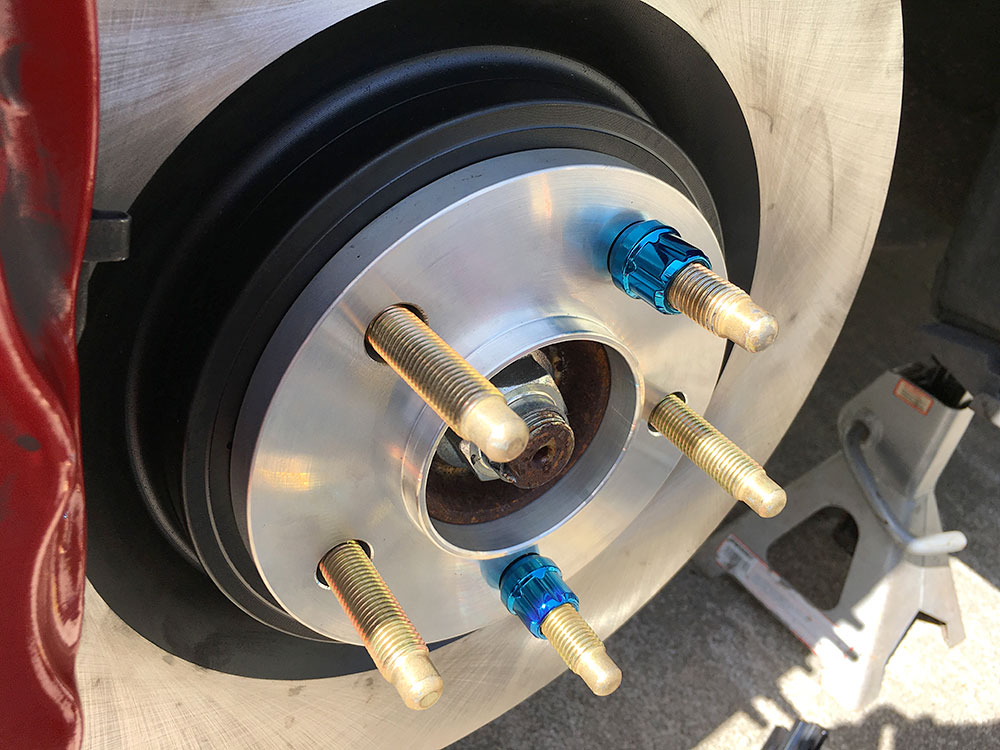
On topic #2 you all are correct to some point, the sigpot or in our world known as the pilot literally does support the vehicle's weight.
However, depending on what spec you run there is about 0.7mm gap or less, so if the wheel rotates 180 degree's this can not be true without joint slip from the wheel and hub.... and if you know anything about joints, if you get constant slip so the pilot of the wheel and hub are in full contact every rotation supporting the vehicle weight, you will get torque loss.
The primary purpose of the pilot is to align the axis rotation centers of the hub and wheel on concentric centers. This allows for a better balance for the entire assembly in terms of rotation when you actually tighten your wheel lugs/bolts.
Just like a brake disk has a pilot, so does the wheel for balance issues and judder. The pilot is typically the datum for these types of parts and used for the balance measurement and dimensioning other features of the part.
In addition the lugs/bolts also will have an alignment feature, these features work together. In addition the conical feature of a bolt/lug is also a mechanical torque loss prevention feature in shear (many people don't know that)
Secondary feature by default is to support the weight of the vehicle.
The primary purpose of the lugs and bolts is to clamp the wheel and hub joint. This joint is what supports the primary weight of the vehicle. The frictional force from the contact surface as stated.
To say the pilot does not support weight of the vehicle would be false, it will carry some amount of load, its just not the primary load path. It would have to be press fit or conical feature to guarantee contact 100% of the time.
Did I help?


The center bore doesn't support any weight. If it did, plastic hub rings for centering aftermarket wheels would fail in about .2 miles. Hell, the aluminum hub rings on my car are a touch loose, and you can move them with a screwdriver with the car on the ground and the wheel torqued. All of the support comes from friction between the wheel and hub mounting surfaces, which is generated by the clamp load of the fasteners.


Last edited by MinusPrevious; Sep 20, 2016 at 02:35 PM.



Thread
Thread Starter
Forum
Replies
Last Post
myersap93
For Sale - Wheels / Tires
6
Apr 24, 2014 01:23 PM
R/TErnie
Northwest Region
2
Aug 14, 2009 09:08 AM