When you click on links to various merchants on this site and make a purchase, this can result in this site earning a commission. Affiliate programs and affiliations include, but are not limited to, the eBay Partner Network.
I've recently made my bid to join the wide tire club, and enjoy the wide selection of 18" r-comps available. I wanted to go with the tried and true setup - RPF1s.
18x9.5 +38s, I'm going to run 255/35s and 265/35s R-Comps on the car.
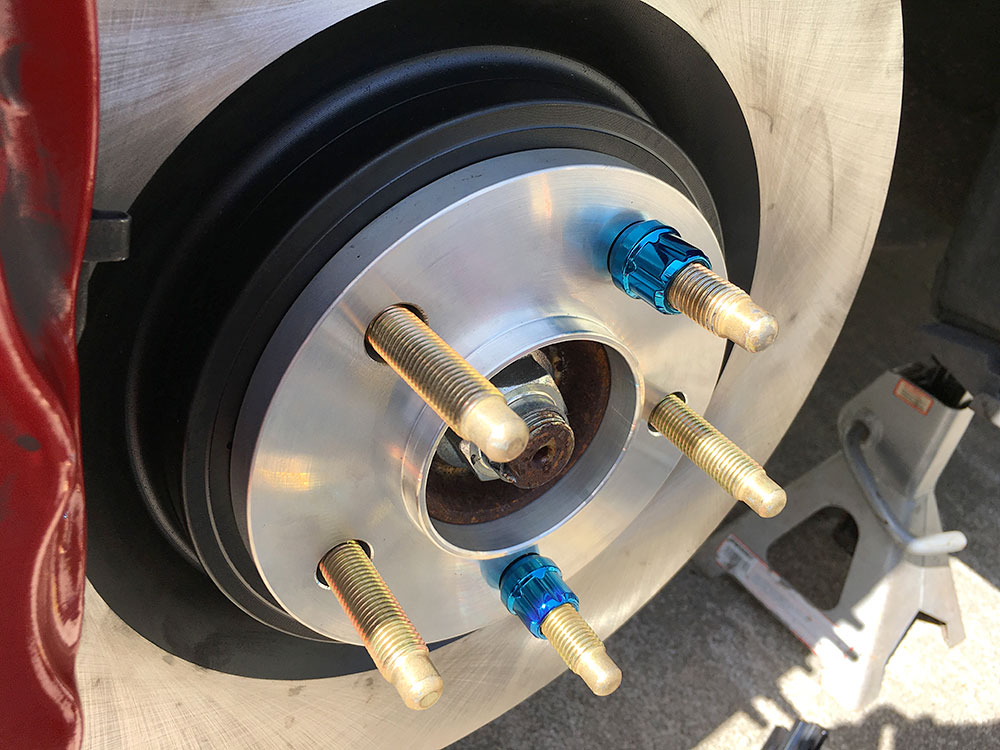
I put ARP extended studs all around, and purchased some STM 20mm spacers for the front. From what I read, i figured this would be an ideal fitment. However the clearance for the front caliper is tiny. I'd say 1-2mm.
Now my first thought was to simply add a cheap 3mm spacer underneath my hubcentric 20mm spacers to give me the perfect fit up front. My goal is minimal fender modifications. Is stacking spacers a serious no-no?
What are my other options? 25mm spacers (any recommendations as I already installed studs)? Custom 23mm (from where)?
I don't have my tires yet, but when I get them mounted I'll be evaluating the rear trailing arm clearance, seems tight. Definitely the closest point. Might go with 5mm spacers in the rear.
Running a spacer in itself, if not machined perfectly, adds another rotating part to the equation.
Stacking one on top of the other sounds like a bad idea
I would be inclined to run the larger 25mm single spacer. With spoke flex, that 1-2mm may not be enough
I always thought the vast majority of people with 18x9.5 +38 RPF1's ran 20mm spacers in the front without trouble; is it actually ~23mm that most people use with these wheels?
Running a spacer in itself, if not machined perfectly, adds another rotating part to the equation.
Stacking one on top of the other sounds like a bad idea
I would be inclined to run the larger 25mm single spacer. With spoke flex, that 1-2mm may not be enough
We typically target 3mm to guarantee clearance with wheel deflection under high loading
With stacking spacers your largest concern is maintaining the assembled runout of all the components. When you add more components your are adding more tolerance of the combined flatness of the assembly, essentially it will always give you more runout.
From a mechanical point of view, the more surfaces you have in a joint the higher risk for torque loss, usually there is more relaxation in a joint with more surfaces.
In terms to spacers and your suspension geometry:
Essentially it boils down to what choice of wheel width/size, offset spec you choose in the first place. A spacer is specifically reducing your wheel offset spec, its that simple.
So if it is down to a specific suspension geometry vs fitting a wheel spoke design to fit a brake package, you would need to choose a different wheel. However, there is always a limit
^x3 I too bought my spacers from them and they turned out great. They ended up being a couple mm's too large (my fault I didnt know exactly what size I needed) so I had a local machine shop turn them down for me.
But I would recommend them over other spacers given the fact that they are both hub centric and wheel centric. Most spacers are either/or.
^x3 I too bought my spacers from them and they turned out great. They ended up being a couple mm's too large (my fault I didnt know exactly what size I needed) so I had a local machine shop turn them down for me.
But I would recommend them over other spacers given the fact that they are both hub centric and wheel centric. Most spacers are either/or.
This is why I went with them. They are the only I've found that will a custom spacer your specs for thickness, hub size, and wheel bore size. And they don't cost an arm and a leg. A couple companies would do it, but, "oh, well, we'd have to change programming and redo the fixture, so it would be like an extra $100"....f#ck outta here.