


4G69 Oil analysis




4G69 Oil analysis
Thought some of you might find this interesting. On my last oil change, I sent a sample of my oil to this company to help me get an idea of how my engine is doing in general, as well as to see if it'd be feasible to using longer oil change intervals. I currently change every 5k, but wanted to see if I could do 10k. This was done with Royal Purple 5w-30. I've since switched over to Amsoil 0w-20 for the winter. I use the OEM oil filter.
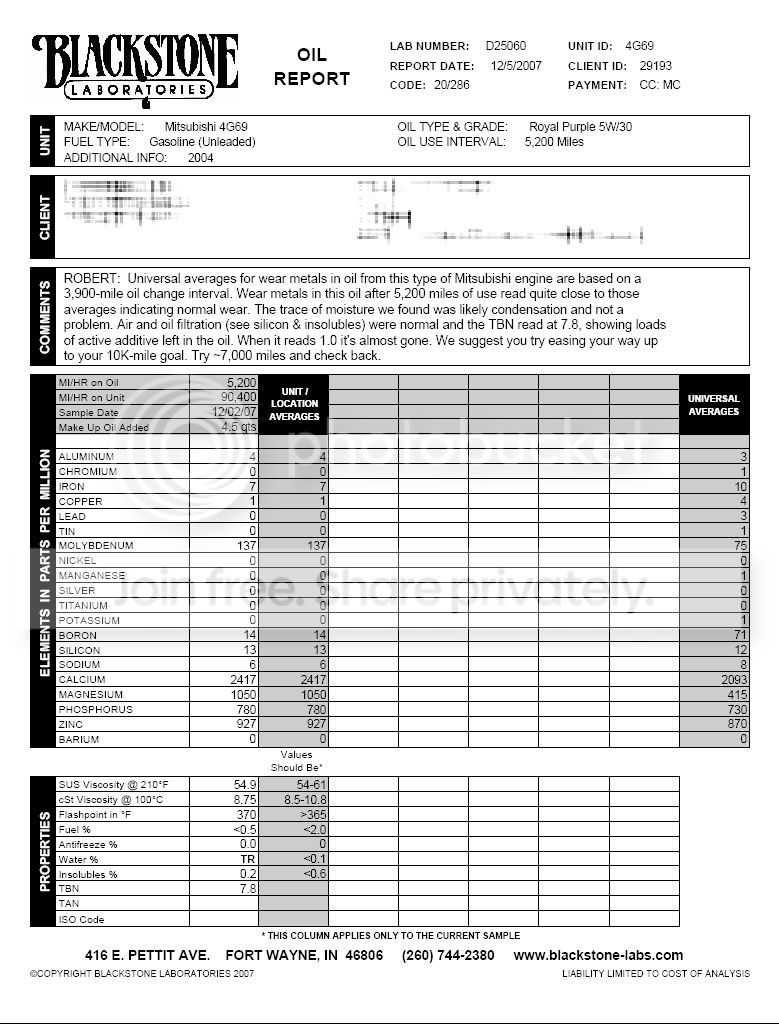
http://www.blackstone-labs.com/gasol...port_expl.html
http://www.blackstone-labs.com/gasol...port_expl.html
Elements are quantified in the oil at part per million levels (PPM). This list shows the most common sources of the elements in a gasoline or diesel engine oil.
Aluminum: Pistons, bearings, cases (heads & blocks).
Chromium: Rings, a trace element in steel.
Iron: Cylinders, rotating shafts, the valve train, and any steel part sharing the oil.
Copper : Brass or bronze parts, copper bushings, bearings, oil coolers, also an additive in some gasoline engine oils.
Lead: Bearings.
Tin : Bearings, bronze parts, piston coatings.
Molybdenum: Anti-wear additive, coating on some new rings
(washes off as break-in occurs).
Nickel : Trace element in steel.
Manganese: Trace element, additive in gasoline.
Silver: Trace element.
Titanium: Trace element.
Potassium: Antifreeze inhibitor, additive in some oil types.
Boron: Detergent/dispersant additive, antifreeze inhibitors.
Silicon : Airborne dirt, sealers, gaskets, antifreeze inhibitors.
Sodium: Antifreeze inhibitors, additive in some gasoline engine oils.
Calcium : Detergent/dispersant additive.
Magnesium: Detergent/dispersant additive.
Phosphorus: Anti-wear additive.
Zinc : Anti-wear additive.
Barium: Detergent/dispersant additive.
Physical properties: Viscosity, flashpoint, % fuel and antifreeze, % water and insolubles are all measured in gasoline and diesel engine oils. If fuel is present in the oil, the viscosity and flashpoint will often be lower than what was stated in the "Should be" line. Insolubles are solid material that is centrifuged out of the oil. They are typically free carbon from the oxidation of the oil itself, along with blow-by past the rings.
Aluminum: Pistons, bearings, cases (heads & blocks).
Chromium: Rings, a trace element in steel.
Iron: Cylinders, rotating shafts, the valve train, and any steel part sharing the oil.
Copper : Brass or bronze parts, copper bushings, bearings, oil coolers, also an additive in some gasoline engine oils.
Lead: Bearings.
Tin : Bearings, bronze parts, piston coatings.
Molybdenum: Anti-wear additive, coating on some new rings
(washes off as break-in occurs).
Nickel : Trace element in steel.
Manganese: Trace element, additive in gasoline.
Silver: Trace element.
Titanium: Trace element.
Potassium: Antifreeze inhibitor, additive in some oil types.
Boron: Detergent/dispersant additive, antifreeze inhibitors.
Silicon : Airborne dirt, sealers, gaskets, antifreeze inhibitors.
Sodium: Antifreeze inhibitors, additive in some gasoline engine oils.
Calcium : Detergent/dispersant additive.
Magnesium: Detergent/dispersant additive.
Phosphorus: Anti-wear additive.
Zinc : Anti-wear additive.
Barium: Detergent/dispersant additive.
Physical properties: Viscosity, flashpoint, % fuel and antifreeze, % water and insolubles are all measured in gasoline and diesel engine oils. If fuel is present in the oil, the viscosity and flashpoint will often be lower than what was stated in the "Should be" line. Insolubles are solid material that is centrifuged out of the oil. They are typically free carbon from the oxidation of the oil itself, along with blow-by past the rings.
Last edited by otter; Dec 6, 2007 at 07:06 PM.

looks promising. in your communication with them did you happen to get an opinion on oil types? I have read that different oil types will react differently in any particular engine, but maybe a generalization about certain oils was mentioned?
Nah, when I mailed them the sample, in the comment section of their form, I noted that I was changing to Amsoil, and nothing came back to me mentioning oil type differences. I think differences in oil types will show up in this test, though, simply by comparing results between different oils. I'll get the test done again next oil change, so I'll be able to see the difference between RP and Amsoil.

Evolved Member
Joined: Sep 2005
Posts: 1,625
Likes: 1
From: MD
that sounds pretty good, ive been freaking out lately about changing my oil since im 2k over(i change every 3k miles)but after reading this maybe i can save some $$ by doing it every 5k miles.
oh, i liked the other otter with the beer better lol.
oh, i liked the other otter with the beer better lol.
 )
)As for the avatar, I needed change. Beer-otter may return with a different brand down the road.

The $0.90 / quart dinosaur crap I pour into my truck gets changed once a year, at about 1000 miles.


Trending Topics
I have read negative things about mobil1 in the g35 engine. I use it in the RA some though, so I'm not saying it's bad.
yeah, Otter, that's what I assumed you were going to say. The reports I have read online comparing apples to apples show that oil brand and type do make a difference, but the significance is more of a quality issue than brand.
yeah, Otter, that's what I assumed you were going to say. The reports I have read online comparing apples to apples show that oil brand and type do make a difference, but the significance is more of a quality issue than brand.

This is by far the most interesting thread on here in awhile. Thanks Rob!
I just ordered my sample kit. I use Mobil 1 full synthetic 5W30 year-round (with the Puralator PureOne filters), and I have just under 50k on the clock. Will be interesting to compare the results.
EDIT: BTW --- I am close to an oil change too.
I normally change about every 3-3500k miles.
I just ordered my sample kit. I use Mobil 1 full synthetic 5W30 year-round (with the Puralator PureOne filters), and I have just under 50k on the clock. Will be interesting to compare the results.
EDIT: BTW --- I am close to an oil change too.
I normally change about every 3-3500k miles.
Last edited by Eclipse2Lancer; Dec 7, 2007 at 06:45 AM.
This is by far the most interesting thread on here in awhile. Thanks Rob!
I just ordered my sample kit. I use Mobil 1 full synthetic 5W30 year-round (with the Puralator PureOne filters), and I have just under 50k on the clock. Will be interesting to compare the results.
I just ordered my sample kit. I use Mobil 1 full synthetic 5W30 year-round (with the Puralator PureOne filters), and I have just under 50k on the clock. Will be interesting to compare the results.
 I had used Mobil 1 up until about a year ago when I heard about Mobil 1 not being 100% synthetic like they imply on their label. Been using RP since then, but I recently found a great deal on Amsoil through an EvoM vendor, so I'll be using that from now on.
Last edited by otter; Dec 7, 2007 at 06:35 AM.
Typical test + the TBN test that cost an extra $10. I would only get the TBN if you're interested in seeing how much life your oil has left in it and want to do extended change intervals.


Interesting. I had thought about having an analysis done back in the day when I had my DSM but never got around to it. Maybe I should have one done when I change the oil in the Evo.
Just for ***** and giggles, someone should send in a sample from a blown motor and leave a big chunk of block in it. :P
Just for ***** and giggles, someone should send in a sample from a blown motor and leave a big chunk of block in it. :P
Just for ***** and giggles, someone should send in a sample from a blown motor and leave a big chunk of block in it. :P
Rob, I also did the Mobil1-->RP switch a while ago. I've been changing my oil every 5000 miles since somewhere in the 30K range, up until then I was doing it every 3750. I have almost as many miles as you do, too. It'd be interesting to see if our test results were identical.
