


2nd trip to the strip--please critique results


Here's my example:
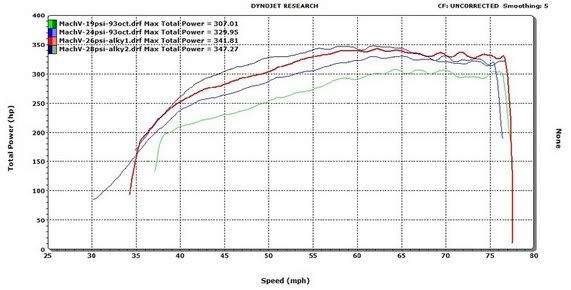
The rpm readings were off on the 93oct runs, so I'm unable to show the torque readings, but you can imagine them based on the HP curve. Look at the 4 curves: 19psi (93oct), 24psi (93oct), 26psi (93+alky), 28psi (93+alky). Notice the diminishing marginal utility. As I increase the boost, I get a lot more peak torque and mid-range, but my top-end only increases marginally, and that margin diminishes as boost increases. In fact, my 28psi HP curve dipped below the 26psi curve at high rpm. The tunes were the same on the 19/24 and 26/28, but the fuel was different. You can easily see how much fatter the mid-range is thanks to all the extra boost. Also, the differences in peak torque were huge. Here are the numbers are I remember them (not exact):
19psi = 307whp/280wtq
24psi = 330whp/330wtq
26psi = 341whp/361wtq
28psi = 347whp/383wtq
Take those numbers and digest them, then go back and read my previous explanations. Next, take your power curve and compare it to my 4 curves. Which one does it most resemble? The 19psi one, right? A slow, linear increase, then a plateau that stays flat almost all the way to cutoff. That's due to running lower boost levels that don't reach efficiency limits until very high rpm. The more boost you run, the earlier you reach that limit. In my case, I was on the stock FMIC and stock IC piping, so my limits were reached very quickly at high boost. Your FMIC helps delay it, but the 91oct of course counteracts that.
Oh, and based off the detected inefficiency at 28psi, I elected to go with 26psi for 24/7 use. I didn't think it was worth the 6whp/20wtq to run the turbo ragged all the time. I have been running 26psi since that day over 2 years ago.
The rpm readings were off on the 93oct runs, so I'm unable to show the torque readings, but you can imagine them based on the HP curve. Look at the 4 curves: 19psi (93oct), 24psi (93oct), 26psi (93+alky), 28psi (93+alky). Notice the diminishing marginal utility. As I increase the boost, I get a lot more peak torque and mid-range, but my top-end only increases marginally, and that margin diminishes as boost increases. In fact, my 28psi HP curve dipped below the 26psi curve at high rpm. The tunes were the same on the 19/24 and 26/28, but the fuel was different. You can easily see how much fatter the mid-range is thanks to all the extra boost. Also, the differences in peak torque were huge. Here are the numbers are I remember them (not exact):
19psi = 307whp/280wtq
24psi = 330whp/330wtq
26psi = 341whp/361wtq
28psi = 347whp/383wtq
Take those numbers and digest them, then go back and read my previous explanations. Next, take your power curve and compare it to my 4 curves. Which one does it most resemble? The 19psi one, right? A slow, linear increase, then a plateau that stays flat almost all the way to cutoff. That's due to running lower boost levels that don't reach efficiency limits until very high rpm. The more boost you run, the earlier you reach that limit. In my case, I was on the stock FMIC and stock IC piping, so my limits were reached very quickly at high boost. Your FMIC helps delay it, but the 91oct of course counteracts that.
Oh, and based off the detected inefficiency at 28psi, I elected to go with 26psi for 24/7 use. I didn't think it was worth the 6whp/20wtq to run the turbo ragged all the time. I have been running 26psi since that day over 2 years ago.

Go with 100oct or E-85 if you can source it. If not, alky/meth definitely works, but the other 2 are preferred (especially E-85) for safety reasons. I'm switching to E-85 within the next month or so - just waiting on my IC pipes.
It is funny that you should mentioned E-85 because there is a gas station within 5 miles of my house that sells it. I know more and more people are using it. My wife's Evo is our daily driver, so 100octane isn't financially feasible. E-85 or water-meth is much more economical. I have two issues of concern with E-85: (1) it appears that the jury is still out as to whether the OEM components can handle E-85 and (2) the person who tunes my car has no experience tuning a vehicle with E-85 and he is hesistent in doing so. I don't really understand what the difference would be in tuning methods would be...
Well, the jury may still be out, but there have been no problems so far.
You should be going to an expert tuner anyway, and that would include knowledge of how to expertly tune E-85 and Evos. I wouldn't go to someone who wasn't an expert at both.
E-85 will cost less AND make more power than both 100oct and 91+alky/meth.
It uses 30% more fuel, so the AFRs are way different, and you have to have much larger injectors (changes the dynamics of the tune both at full and part throttle), but the lambda targets are the same.
You should be going to an expert tuner anyway, and that would include knowledge of how to expertly tune E-85 and Evos. I wouldn't go to someone who wasn't an expert at both.
E-85 will cost less AND make more power than both 100oct and 91+alky/meth.
It uses 30% more fuel, so the AFRs are way different, and you have to have much larger injectors (changes the dynamics of the tune both at full and part throttle), but the lambda targets are the same.
Well, the jury may still be out, but there have been no problems so far.
You should be going to an expert tuner anyway, and that would include knowledge of how to expertly tune E-85 and Evos. I wouldn't go to someone who wasn't an expert at both.
E-85 will cost less AND make more power than both 100oct and 91+alky/meth.
It uses 30% more fuel, so the AFRs are way different, and you have to have much larger injectors (changes the dynamics of the tune both at full and part throttle), but the lambda targets are the same.
You should be going to an expert tuner anyway, and that would include knowledge of how to expertly tune E-85 and Evos. I wouldn't go to someone who wasn't an expert at both.
E-85 will cost less AND make more power than both 100oct and 91+alky/meth.
It uses 30% more fuel, so the AFRs are way different, and you have to have much larger injectors (changes the dynamics of the tune both at full and part throttle), but the lambda targets are the same.
I currently have PTE780cc injectors and a Walbro 255. From what I've read thus far, I might be ok with the stock turbo, but if I do max out the injectors I think I'd start by upgrading to the BR twin Walbro setup.
780s won't be enough for E-85, but they are ok for anything else (91oct, 100oct, alky/meth). You don't need twin Walbros to do E-85 on the stock turbo - you'd need 880 or 1000cc injectors.
Huh...I read a thread on this forum where somebody thought you could get away with 780cc if you had a twin pump setup.

sEvoIXnturboS2k: There is a Soco(may have changed names) in El Cajon that has 110 at the pump, and every grade of VP race fuel (leaded&unleaded) that you could want. You would never know they have it though, because it looks like a truck stop. This is another one in El Cajon called Fiber-Tech (619-448-0221). I moved a year ago so this one might be closed.
Is this new shop your talking about owned by a guy named James?
Is this new shop your talking about owned by a guy named James?

Went to the track tonight and left a bit disappointed. Here are my numbers and associated setup:
Run 1: 5500 RPMs, 28psi all around, shifted at 8100 in 1st-3rd, 1.907 60', 7.960 @ 89.82 1/8th
Run 2: 5500 RPMs, 28psi all around, shifted at 8100 in 1st-3rd, 1.939 60', 7.964 @ 90.18 1/8th
Run 3: 5500 RPMs, 28psi all around, shifted at 7000 in 1st-2nd and hit 8100 by 1/8th, 1.960 60', 7.983 @ 90.73 1/8th
Run 4: 5500 RPMs, 28psi all around, shifted at 7000 in 1st-2nd and hit 8100 by 1/8th, 1.904 60', 7.903 @ 90.91 1/8th
Run 5: 5500 RPMs, 26psi all around, shifted at 7000 in 1st-2nd and hit 8100 by 1/8th, 1.932 60', 7.926 @ 90.73 1/8th
Run 6: 5500 RPMs, 26psi all around, shifted at 7000 in 1st-2nd and hit 8100 by 1/8th, 1.863 60', 7.875 @ 89.63 1/8th
The stock clutch was not a happy camper tonight and was smelling pretty bad. I don't think I am going to hit the track again until I have an upgraded clutch.
Run 1: 5500 RPMs, 28psi all around, shifted at 8100 in 1st-3rd, 1.907 60', 7.960 @ 89.82 1/8th
Run 2: 5500 RPMs, 28psi all around, shifted at 8100 in 1st-3rd, 1.939 60', 7.964 @ 90.18 1/8th
Run 3: 5500 RPMs, 28psi all around, shifted at 7000 in 1st-2nd and hit 8100 by 1/8th, 1.960 60', 7.983 @ 90.73 1/8th
Run 4: 5500 RPMs, 28psi all around, shifted at 7000 in 1st-2nd and hit 8100 by 1/8th, 1.904 60', 7.903 @ 90.91 1/8th
Run 5: 5500 RPMs, 26psi all around, shifted at 7000 in 1st-2nd and hit 8100 by 1/8th, 1.932 60', 7.926 @ 90.73 1/8th
Run 6: 5500 RPMs, 26psi all around, shifted at 7000 in 1st-2nd and hit 8100 by 1/8th, 1.863 60', 7.875 @ 89.63 1/8th
The stock clutch was not a happy camper tonight and was smelling pretty bad. I don't think I am going to hit the track again until I have an upgraded clutch.


I don't see how that would do anything but create more wheel spin. If anything it seems like I need to lower the 2step some. I was getting too much wheel spin off the line last night, and I didn't launch any differently then in the past. They did not have any VHT on the right side of the track last night. That had, what appeared to be, a fair amount on the left side, but they only let those with slicks or DRs run. So, I was basically launching on bare concrete. 
I have about 3K more miles on the stock tires and then I need to find a suitable replacement. I am very tempted to replace them with DRs, but am concerned about the loss of cornering ability. I need to find a tire that excels in drag racing while still being good in the corners.