


Shift points


Thread Starter
Account Disabled
iTrader: (5)
Joined: Dec 2006
Posts: 345
Likes: 1
From: santa rosa CA
Shift points
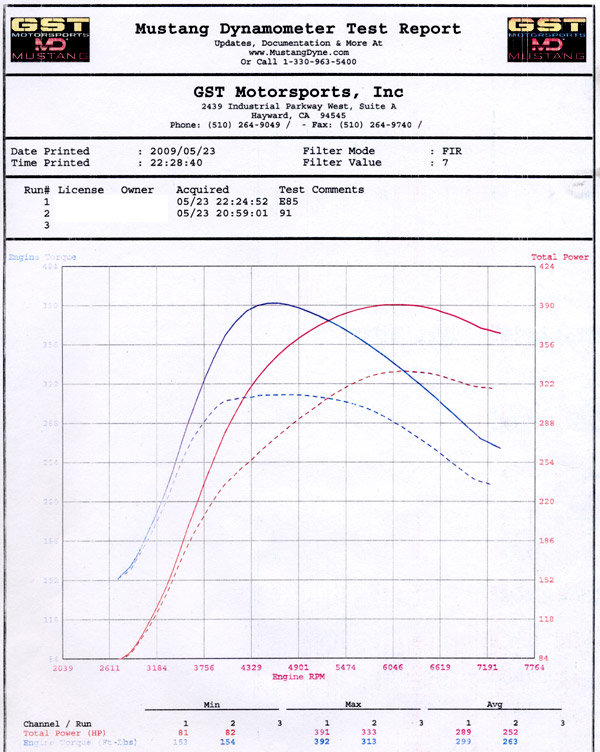
So Ill be drag racing my car here soon and basically just want to go out once and get a solid time to see what the car will do. Havent drag raced in a long time, and was curious to see what your opinions were on my shift points. heres my graphs, both 91oct and E85.. Ill only be running the E85 map though. car weighs 2980with 1/4 tank and with my fat *** its about 3230lbs.

Thread Starter
Account Disabled
iTrader: (5)
Joined: Dec 2006
Posts: 345
Likes: 1
From: santa rosa CA
From what I recieved through pm's and from people in person.. And the way the car feels, about 6800 is a nice spot with that power. Basically just as or before hp falls off.
As a side not I threw some kelford 272's in and made 404/403 with about 20whp more around 5600rpm and it made a world of difference in the way the top end feels now. I'll post graphs tonight.
As a side not I threw some kelford 272's in and made 404/403 with about 20whp more around 5600rpm and it made a world of difference in the way the top end feels now. I'll post graphs tonight.

This is very interesting, I would love to hear more about this topic.
What year evo do you drive? What trans? Stock gears? What size tires?
With the answers to these questions, I could dig up a graph I have somewhere and tell you what speed you will be going @ a given rpm. With that data you would look to the next gear by finding the speed and match the rpm. With that data you can see if you are in your "power band".
Personally I have always been a fan of runnying out the gear to red line for max acceleration. Although certian turbo's tend to "die" up top so to speak, I still believe you need to draw out the gear to put you in the maximum efficency range of the motor. If your gears are too large or you shift early it may cost you valuable time to enter that power range.
Additionally changing gears takes time, if you could emiminate the need for a gear change I believe you would also run quicker times.
I am a true believer in actual hard numbers, because there are other factors that are involved in calculating shift points that may vary the results. For example: above speeds of 110 wind resistance will play a huge roll (wind direction also), and in between gears I'm not sure if wind resistance will allow you to continue accelerating, keep you at a constant speed or actually slow you down (also dependant on wind direction).
I would be very interested to see if the real world differences, one a track? or even on a dyno somehow?
What year evo do you drive? What trans? Stock gears? What size tires?
With the answers to these questions, I could dig up a graph I have somewhere and tell you what speed you will be going @ a given rpm. With that data you would look to the next gear by finding the speed and match the rpm. With that data you can see if you are in your "power band".
Personally I have always been a fan of runnying out the gear to red line for max acceleration. Although certian turbo's tend to "die" up top so to speak, I still believe you need to draw out the gear to put you in the maximum efficency range of the motor. If your gears are too large or you shift early it may cost you valuable time to enter that power range.
Additionally changing gears takes time, if you could emiminate the need for a gear change I believe you would also run quicker times.
I am a true believer in actual hard numbers, because there are other factors that are involved in calculating shift points that may vary the results. For example: above speeds of 110 wind resistance will play a huge roll (wind direction also), and in between gears I'm not sure if wind resistance will allow you to continue accelerating, keep you at a constant speed or actually slow you down (also dependant on wind direction).
I would be very interested to see if the real world differences, one a track? or even on a dyno somehow?

Registered User
Joined: Nov 2007
Posts: 1,507
Likes: 2
From: Trinidad
This is very interesting, I would love to hear more about this topic.
What year evo do you drive? What trans? Stock gears? What size tires?
With the answers to these questions, I could dig up a graph I have somewhere and tell you what speed you will be going @ a given rpm. With that data you would look to the next gear by finding the speed and match the rpm. With that data you can see if you are in your "power band".
Personally I have always been a fan of runnying out the gear to red line for max acceleration. Although certian turbo's tend to "die" up top so to speak, I still believe you need to draw out the gear to put you in the maximum efficency range of the motor. If your gears are too large or you shift early it may cost you valuable time to enter that power range.
Additionally changing gears takes time, if you could emiminate the need for a gear change I believe you would also run quicker times.
I am a true believer in actual hard numbers, because there are other factors that are involved in calculating shift points that may vary the results. For example: above speeds of 110 wind resistance will play a huge roll (wind direction also), and in between gears I'm not sure if wind resistance will allow you to continue accelerating, keep you at a constant speed or actually slow you down (also dependant on wind direction).
I would be very interested to see if the real world differences, one a track? or even on a dyno somehow?
What year evo do you drive? What trans? Stock gears? What size tires?
With the answers to these questions, I could dig up a graph I have somewhere and tell you what speed you will be going @ a given rpm. With that data you would look to the next gear by finding the speed and match the rpm. With that data you can see if you are in your "power band".
Personally I have always been a fan of runnying out the gear to red line for max acceleration. Although certian turbo's tend to "die" up top so to speak, I still believe you need to draw out the gear to put you in the maximum efficency range of the motor. If your gears are too large or you shift early it may cost you valuable time to enter that power range.
Additionally changing gears takes time, if you could emiminate the need for a gear change I believe you would also run quicker times.
I am a true believer in actual hard numbers, because there are other factors that are involved in calculating shift points that may vary the results. For example: above speeds of 110 wind resistance will play a huge roll (wind direction also), and in between gears I'm not sure if wind resistance will allow you to continue accelerating, keep you at a constant speed or actually slow you down (also dependant on wind direction).
I would be very interested to see if the real world differences, one a track? or even on a dyno somehow?
 ) and would like to know my shift points. with the stock turbo and cams the car falls flat at the 6000-7000rpm range.
 would be nice if the hardcore racers come in and provide some feedback.
the communication i always got was similar to what u do. that is, run each gear as high as possible. kinda weird though since my HP numbers are lowER when compared to 6500 or so.

Based on the graph, I would say that shifting around the 6600-6700 mark, a bit after HP starts falling, should get you around 4.5k RPM after the shift, where you should get maximum torque.
Knowing where your RPM drops to after shifting at a given RPM would help you know exactly where to shift to stay in your power band.
Knowing where your RPM drops to after shifting at a given RPM would help you know exactly where to shift to stay in your power band.
Trending Topics
Registered User
Joined: Nov 2007
Posts: 1,507
Likes: 2
From: Trinidad
Based on the graph, I would say that shifting around the 6600-6700 mark, a bit after HP starts falling, should get you around 4.5k RPM after the shift, where you should get maximum torque.
Knowing where your RPM drops to after shifting at a given RPM would help you know exactly where to shift to stay in your power band.
Knowing where your RPM drops to after shifting at a given RPM would help you know exactly where to shift to stay in your power band.
Ok let me give you a quick example, if the ssteve was running stock size tires 235/45/17, Stock evo 9 trans with that power graph:
If he shifted at 6500 rpm right before his power begins to fall off he would be shifting out of first gear and into second at 39.1 mph.
He would enter Second gear at around 4500 rpm 38.6 mph (just go with it I know someone is going to ask what will account for the .5 mph difference). He would be changing from second gear to third gear in a 6500 rpm shift at 55.8 mph.
When he enters third gear he will be at around 4800rpm amd 55.6mph. At 6500rpms he would be shifting out of third into fourth at 75.3 mph.
He would be at 4900 rpms and 74.8 mph in fourth gear (here I would not reccomend shifting into 5th gear because thats how many evo drivers develop that infamous 5th gear grind, I believe this is do to having only one synchro on the 5th gear).
If he revved the 4th gear out not sure what he would be trapping due to a combination of factors and so fourth but I would guess by those hp / tq numbers gear ratios, tires, and weight I would say thats around a 115 trap car. With that said to achieve that trap speed the motor would have to be revved out to around 7700 rpms @117.5 mph because the trap speed is an average of the final 100 or so feet of the quater mile.
I dont know what if any changes would be made in the e.t. I am no an expert in drag racing, and there are many factors that would influience the each individual out come such as grip, weather, driver ability and so fourth. I would love to see someone try this and report their findings. Supported by a few back to back runs.
In all honesty, if I were a bettin man, which I usually am I would guess the driver would run a faster time by shifting at the maximum rpm.
I know that some drag race that have their cars dialed in very well might do something like all shifts done at 7.6k rpm and revv 4th gear to 8.1k through the traps. It seems to work for them.
If he shifted at 6500 rpm right before his power begins to fall off he would be shifting out of first gear and into second at 39.1 mph.
He would enter Second gear at around 4500 rpm 38.6 mph (just go with it I know someone is going to ask what will account for the .5 mph difference). He would be changing from second gear to third gear in a 6500 rpm shift at 55.8 mph.
When he enters third gear he will be at around 4800rpm amd 55.6mph. At 6500rpms he would be shifting out of third into fourth at 75.3 mph.
He would be at 4900 rpms and 74.8 mph in fourth gear (here I would not reccomend shifting into 5th gear because thats how many evo drivers develop that infamous 5th gear grind, I believe this is do to having only one synchro on the 5th gear).
If he revved the 4th gear out not sure what he would be trapping due to a combination of factors and so fourth but I would guess by those hp / tq numbers gear ratios, tires, and weight I would say thats around a 115 trap car. With that said to achieve that trap speed the motor would have to be revved out to around 7700 rpms @117.5 mph because the trap speed is an average of the final 100 or so feet of the quater mile.
I dont know what if any changes would be made in the e.t. I am no an expert in drag racing, and there are many factors that would influience the each individual out come such as grip, weather, driver ability and so fourth. I would love to see someone try this and report their findings. Supported by a few back to back runs.
In all honesty, if I were a bettin man, which I usually am
I would guess the driver would run a faster time by shifting at the maximum rpm. I know that some drag race that have their cars dialed in very well might do something like all shifts done at 7.6k rpm and revv 4th gear to 8.1k through the traps. It seems to work for them.

with my car i shift about 7g but it all depends on thwe mods. ill be shifting a lot higher after the work i got done now. when you get your print out of the dyno than you'll really know

i seem to have way higher 1/8 mile and 1/4 mile traps revving out as much as possible. usually around 7600-8000rpm and holding 4th out past the traps. I tried shifting earlier at 7krpm... and both my 1/8 & 1/4 mile traps suffered big time... but thats me.
Thread Starter
Account Disabled
iTrader: (5)
Joined: Dec 2006
Posts: 345
Likes: 1
From: santa rosa CA
I'm running 285/30/18 tires and it's a viii.. In theory the car should go mid to low 11's at 118-121mph with the power I have and what my car weighs. I am shifting on the street at about 6700 right now with 404/403 but peak numbers still fall at about the same spots,tq just doesn't fall off as hard now.

With the stock turbo you are going to fall flat after about 7k. Why keep revving if there is no usable power? With the stock turbo i never shifted over 7200rpm. In the quarter though i would stretch 4th all the way threw if you can.
Registered User
Joined: Nov 2007
Posts: 1,507
Likes: 2
From: Trinidad
With the stock turbo you are going to fall flat after about 7k. Why keep revving if there is no usable power? With the stock turbo i never shifted over 7200rpm. In the quarter though i would stretch 4th all the way threw if you can.