


Tuning for Intake?


Thread Starter
Evolving Member
Joined: Sep 2006
Posts: 368
Likes: 0
From: California
Tuning for Intake?
Ok so everybody is saying the stock air box is good for a lot of hp. And if you get an intake and cone filter you have to tune for it.
What exactly do you tune about it, do you tune the added air flow? would would you change as far as timing and fuel maps go generaly? or are there other things you change in the ecu flash ?
What exactly do you tune about it, do you tune the added air flow? would would you change as far as timing and fuel maps go generaly? or are there other things you change in the ecu flash ?

Evolved Member


Joined: May 2006
Posts: 2,399
Likes: 6
From: UK
The elegant/"correct" to do it would be to adjust the airflow meter scaling. However, because the exact processing of the airflow signal is relatively poorly understood, many will just scale the fuel and timing maps to suit.
Closed loop stuff will give away the changes from the fuel trims.
Open loop stuff from your wideband.
Timing from your knock sum/octane number/knowledge of sensible timing on these engines/your setup.
The stock airbox is limited. At 7000 RPM at 21 PSI on pump fuel on a IX with exhaust, pump and HKS hard pipes I was getting a 1.5 PSI depression from atmospheric pressure at the airflow meter. This was halved by removing the airbox lid and securing the filter - you've just gained 5% air density before the compressor which will either allow more boost and airflow, or allow the turbo to run at a slower speed by opening the wastegate (so improved compressor efficiency and lower exhaust manifold pressure, less pollution of the fresh air charge from the end gases etc). Some have had similar results by cutting a hole like the one for the snorkel in the lid of the airbox on the opposite side to the snorkel. This is away from most of the hot air. Doesn't seem to upset MAF readings, looks stealth, still increases induction noise a bit. FWIW with the airbox lid off you can record gains in acceleration and on the dyno.
Closed loop stuff will give away the changes from the fuel trims.
Open loop stuff from your wideband.
Timing from your knock sum/octane number/knowledge of sensible timing on these engines/your setup.
The stock airbox is limited. At 7000 RPM at 21 PSI on pump fuel on a IX with exhaust, pump and HKS hard pipes I was getting a 1.5 PSI depression from atmospheric pressure at the airflow meter. This was halved by removing the airbox lid and securing the filter - you've just gained 5% air density before the compressor which will either allow more boost and airflow, or allow the turbo to run at a slower speed by opening the wastegate (so improved compressor efficiency and lower exhaust manifold pressure, less pollution of the fresh air charge from the end gases etc). Some have had similar results by cutting a hole like the one for the snorkel in the lid of the airbox on the opposite side to the snorkel. This is away from most of the hot air. Doesn't seem to upset MAF readings, looks stealth, still increases induction noise a bit. FWIW with the airbox lid off you can record gains in acceleration and on the dyno.
Last edited by jcsbanks; Oct 15, 2006 at 12:08 PM.
Thread Starter
Evolving Member
Joined: Sep 2006
Posts: 368
Likes: 0
From: California
so the main thing that gets thrown off is the scaling of the mass air flow sensor? when you throw on a cone filter? And people compinsate by fuel/timing maps ?
does somebody design an intake and filter , that keeps the MAS signal stable?
does somebody design an intake and filter , that keeps the MAS signal stable?
Thread Starter
Evolving Member
Joined: Sep 2006
Posts: 368
Likes: 0
From: California
can you elaborate on what you mean by air flow pattern?
do you mean at mid range it will flow this much in complement to the fuel/ignition timing
and at different rpms it will flow different from the stock air box, in complement to the fuel/ignition maps?
Also if technecly you run a bit leaner wouldnt it be better, because a stock evo runs pretty rich up top?
do you mean at mid range it will flow this much in complement to the fuel/ignition timing
and at different rpms it will flow different from the stock air box, in complement to the fuel/ignition maps?
Also if technecly you run a bit leaner wouldnt it be better, because a stock evo runs pretty rich up top?
Evolved Member
Joined: May 2006
Posts: 2,399
Likes: 6
From: UK
Running leaner will probably kill the torque at 2500-4000 RPM.
Airflow pattern - the airflow sensor is about in the center of the pipe so only samples from there. Many detailed posts from me and others about the issue in this thread: http://www.lancerregister.com/showth...ht=missing+bhp
Airflow pattern - the airflow sensor is about in the center of the pipe so only samples from there. Many detailed posts from me and others about the issue in this thread: http://www.lancerregister.com/showth...ht=missing+bhp

I will throw my 2c on this subject. Here is what I observed on an 05 Evo 8 like mine, but running an open element Apexi filter. Both cars have a TBE. The car with the open filter has been slightly leaned up top to a 10.4-10.5 AFR, the timing is stock and so is the boost. My car is fully tuned with an 11.3-11.2 AFR tapering to 11.0 by redline and 10.9-10.8 by cuttoff. The boost peaks @ 21-22 psi.
The Apexi filter Evo has a 267 load number @ peak torque/boost and then it falls like a rock. My car with stock filter never peaks @ more than 240-250 and then drops a bit, but not like the other car. The Apexi filter Evo also has IDCs @ 95% while my car is @ 90%.
I suspect that the erratic behavior of the load and higher IDC is related to the Apexi filter element. I have asked the guy to switch back to the stock filter element and come back for a retest. Check out these charts.
Apexi filter Evo

My stock filter Evo

IMHO, the stock box is perfect. Mitsu had to design it that way due to packaging. Messing with it will only cause havoc on the MAF. If you are running below 400 hp, then keep the stock filter box.
The Apexi filter Evo has a 267 load number @ peak torque/boost and then it falls like a rock. My car with stock filter never peaks @ more than 240-250 and then drops a bit, but not like the other car. The Apexi filter Evo also has IDCs @ 95% while my car is @ 90%.
I suspect that the erratic behavior of the load and higher IDC is related to the Apexi filter element. I have asked the guy to switch back to the stock filter element and come back for a retest. Check out these charts.
Apexi filter Evo
My stock filter Evo
IMHO, the stock box is perfect. Mitsu had to design it that way due to packaging. Messing with it will only cause havoc on the MAF. If you are running below 400 hp, then keep the stock filter box.
Last edited by nj1266; Oct 16, 2006 at 08:19 AM.
Trending Topics

It would be good to see the boost and AFR logged for your comparison, nj.
The car with the Apex'i filter may have just been spiking to a higher boost level, then dropping, which would explain the higher load.
An AFR plot should show if that is the case or not, too.
John Banks already answered the orignial posted question, so I won't add much to it, but basically an intake may make you run lean because not enough vortices are created at the location where the Karman MAF counts them. The more the airflow pattern is changed, the more the effect. The paper mentioned by John also explains this.
Talking about the Apex'i, though, that filter should straighten the aiflow out relatively well due to the design of the filter. I am interested in more data from your tests, nj.
Eric
The car with the Apex'i filter may have just been spiking to a higher boost level, then dropping, which would explain the higher load.
An AFR plot should show if that is the case or not, too.
John Banks already answered the orignial posted question, so I won't add much to it, but basically an intake may make you run lean because not enough vortices are created at the location where the Karman MAF counts them. The more the airflow pattern is changed, the more the effect. The paper mentioned by John also explains this.
Talking about the Apex'i, though, that filter should straighten the aiflow out relatively well due to the design of the filter. I am interested in more data from your tests, nj.
Eric
Originally Posted by l2r99gst
It would be good to see the boost and AFR logged for your comparison, nj.
The car with the Apex'i filter may have just been spiking to a higher boost level, then dropping, which would explain the higher load.
An AFR plot should show if that is the case or not, too.
John Banks already answered the orignial posted question, so I won't add much to it, but basically an intake may make you run lean because not enough vortices are created at the location where the Karman MAF counts them. The more the airflow pattern is changed, the more the effect. The paper mentioned by John also explains this.
Talking about the Apex'i, though, that filter should straighten the aiflow out relatively well due to the design of the filter. I am interested in more data from your tests, nj.
Eric
The car with the Apex'i filter may have just been spiking to a higher boost level, then dropping, which would explain the higher load.
An AFR plot should show if that is the case or not, too.
John Banks already answered the orignial posted question, so I won't add much to it, but basically an intake may make you run lean because not enough vortices are created at the location where the Karman MAF counts them. The more the airflow pattern is changed, the more the effect. The paper mentioned by John also explains this.
Talking about the Apex'i, though, that filter should straighten the aiflow out relatively well due to the design of the filter. I am interested in more data from your tests, nj.
Eric
I have the AFR plots for both cars and I will post them when I get a chance. I have the boost plot for my car, but I do not have it for the Apexi filter car. But from what I observed on the car's boost gauge (Defi D) the Apexi filter car's boost behaves no different than the boost on my car when it had stock boost. But I cannot confirm that with hard data. To get boost data from the apexi filter car, I would have had to hack into the stock MAP sensor wire to get a voltage into the GM 3 bar sensor that I use on my car. I do not think the owner would have liked that

Last edited by nj1266; Oct 16, 2006 at 09:06 AM.
I didn't expect you to have the boost log for his car, just saying that it would be good data to see if it was actually a boost spike or bad airflow reading at that point due to the filter.
I don't have any experience with the Apex'i filter, but they do use a good design with a velocity stack, which they call a funnel, to elimnate dead spots and direct the airflow straight into the MAF sensor. I would expect a filter like this one to have less problems than other open element cone filters without a velocity stack.
This picture describes what I am talking about:
I don't have any experience with the Apex'i filter, but they do use a good design with a velocity stack, which they call a funnel, to elimnate dead spots and direct the airflow straight into the MAF sensor. I would expect a filter like this one to have less problems than other open element cone filters without a velocity stack.
This picture describes what I am talking about:

Newbie
Joined: Oct 2004
Posts: 45
Likes: 0
Originally Posted by l2r99gst
I didn't expect you to have the boost log for his car, just saying that it would be good data to see if it was actually a boost spike or bad airflow reading at that point due to the filter.
I don't have any experience with the Apex'i filter, but they do use a good design with a velocity stack, which they call a funnel, to elimnate dead spots and direct the airflow straight into the MAF sensor. I would expect a filter like this one to have less problems than other open element cone filters without a velocity stack.
This picture describes what I am talking about:
I don't have any experience with the Apex'i filter, but they do use a good design with a velocity stack, which they call a funnel, to elimnate dead spots and direct the airflow straight into the MAF sensor. I would expect a filter like this one to have less problems than other open element cone filters without a velocity stack.
This picture describes what I am talking about:

Originally Posted by l2r99gst
I didn't expect you to have the boost log for his car, just saying that it would be good data to see if it was actually a boost spike or bad airflow reading at that point due to the filter.
I don't have any experience with the Apex'i filter, but they do use a good design with a velocity stack, which they call a funnel, to elimnate dead spots and direct the airflow straight into the MAF sensor. I would expect a filter like this one to have less problems than other open element cone filters without a velocity stack.
This picture describes what I am talking about:
I don't have any experience with the Apex'i filter, but they do use a good design with a velocity stack, which they call a funnel, to elimnate dead spots and direct the airflow straight into the MAF sensor. I would expect a filter like this one to have less problems than other open element cone filters without a velocity stack.
This picture describes what I am talking about:
My car also produces a boost spike to 22 psi, but hold boost @ 18-19 to redline since I have boost control. I have tested my Defi D gauge and found it to be about 1-1.5 psi off. So his 22-23 psi is about one psi less. His car might be spiking to 21-22. So the spike in both cars are almost the same, yet the load on his car is much higher than mine and then drops like a rock.
Last edited by nj1266; Oct 16, 2006 at 04:21 PM.
Here are the AFRs that you asked for Eric. As you can see the low boost/torque AFRs are not that much different on botth cars. The AFR is different above 4500-5000 rpm. I still suspect it is the filter element that is causing the load to spike so high. I guess I will know when I log his car with a stock filter element next time.
Evo w/ apexi filter system

My evo w/stock box.
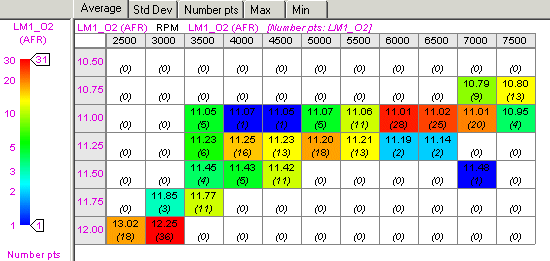
Evo w/ apexi filter system
My evo w/stock box.

Originally Posted by nj1266
Here are the AFRs that you asked for Eric. As you can see the low boost/torque AFRs are not that much different on botth cars. The AFR is different above 4500-5000 rpm. I still suspect it is the filter element that is causing the load to spike so high. I guess I will know when I log his car with a stock filter element next time.
Evo w/ apexi filter system
My evo w/stock box.
Evo w/ apexi filter system
My evo w/stock box.