


Maximum load value on stock ECU?


Here is my average load values in map tracer EVOScan 2.1.....
I like this new feature it works really well and makes it easy to see where you need to make changes!!
25psi 93 octane pump gas, 48 deg. F, 40% Humidity:

If the load values keep going up like this I am going to run out of scaling ideas to get more resolution on these maps....
~Zach
I like this new feature it works really well and makes it easy to see where you need to make changes!!
25psi 93 octane pump gas, 48 deg. F, 40% Humidity:
If the load values keep going up like this I am going to run out of scaling ideas to get more resolution on these maps....
~Zach
I think Phenem's numbers make sense to me. If you look at a thread (https://www.evolutionm.net/forums/sh...d.php?t=307894) I made a while back about estimating boost from load, I came up with the following equations:
BoostEst = [(load *10.73 * T *3456 *14.7)/(95*454*29*Patm in psi*VE*122)]-14.7
That is with most of the terms kept separate. If the 95 constant proves to be OK and you are 2.0L engine, it can be simplified to
BoostEst=[(load*T)/(P*VE*280)]-14.7
T = actual intake air temp (not MAF temp) in degrees Rankin (degrees F +460)
P = atmospheric pressure in psi at the MAF(baro)
VE = VE of engine at the RPM being measured
Using Phenem's numbers, I used an intake temp of 60F (assuming a slight rise from maf intake temps) and a baro of 14.5 psi (assuming a slight pressure drop) and I come up with the following for his 2.3 L engine:
BoostEst = 357.2*10.73*(60+460)*3456*14.7)/(95*454*29*14.5*1*140)-14.7
BoostEst = 25.2 psi
Agrees perfectly with my equation.
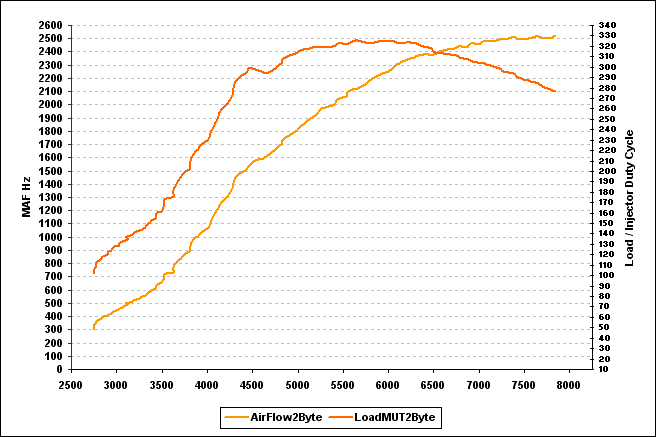
What were the MAF and intake temps on that 2.3 GT35R that you were tuning? What IC? Was boost logged/what sensor? Also, I am assuming that is was the stock maf, since you have a plot of the MAF Hz? Phenem's numbers look spot on to me....that 2.3 35R should have similar load numbers, if not better, at that same boost/RPM/temp/baro.
Eric
Last edited by l2r99gst; Mar 3, 2008 at 02:11 PM.


thx, i already know abt this thread, but still having some issues controllling boost based on load (mainly boost spike)...
im thinking of buying an eboost controler, i think i consumed more money on gas trying to tune boost than its price hehehe
anyway, thx again, i'll try to boost up my desired load numbers, as i was adjusting them thinking they are 2-byte load...
Cheers
im thinking of buying an eboost controler, i think i consumed more money on gas trying to tune boost than its price hehehe
anyway, thx again, i'll try to boost up my desired load numbers, as i was adjusting them thinking they are 2-byte load...
Cheers
What is your current boost offset setting? WGDC settings?
Could you post all your boost tables? WGDC / BDEL / Offset / Error Correction
So, yes, I don't agree that the stock turbo will be able to push that much air, seeing that the compressor map is limited to about 44 or so.
But, if you notice, that EvoScan maptracer isn't really putting the numbers in the correct cells. It looks like if it is even 1 over, it goes to the next cell. For example in his screenshot a 335 load is shown under the 360 column instead of the 330 column. I'm guessing the RPM is doing the same thing. That 298 load is probably more in line with the 6500 RPM cell.
That would change the calculations to be flowing 44.9 lb/min. That makes more sense and is believable.
Eric
I noticed those are also average numbers. The plot I posted are straight logged numbers. I wonder what the straight logged numbers are.
phenem, can you just post your straight logged load numbers?
phenem, can you just post your straight logged load numbers?

We regularly log 379.x on the OKIX car. These are 2byte loads and while tuning the new FP HD actuator for the street maps, I hit it on 101 +meth for a brief moment. As mentioned earlier, I've also seen errors of 399.x, but not very often.



So why not cut the stock MAF scaling in half for the same amount of airflow, wouldn't that drop the load back to normal (or in this case tuneable) levels? Or am I missing something in the MAF scaling dept?
Last edited by JohnBradley; Mar 3, 2008 at 02:35 PM. Reason: grammar

Manipulating the MAF parameters to solve these issues has definitely caught my attention and I look forward to seeing how we can remedy these issues 
John, did you get my PM about the injector scaling/IDC testing?
John, did you get my PM about the injector scaling/IDC testing?

Here is my map in relation to my RPM, both are 2byte values, load on left RPM on right:

I recently fixed a boost leak on my TB and replaced the stock EVO9 BOV with a synapse BOV which holds boost amazingly compared to the stock one. The turbo spools much faster now and holds boost much better up top. I will do some logs later next week (once the weather gets nice again) and see what has changed in comparison with this log.
~Zach
I recently fixed a boost leak on my TB and replaced the stock EVO9 BOV with a synapse BOV which holds boost amazingly compared to the stock one. The turbo spools much faster now and holds boost much better up top. I will do some logs later next week (once the weather gets nice again) and see what has changed in comparison with this log.
~Zach
Since I dont have airflow to go by, I can only guess based on watching the load curve, but it looks like peak power is about 6500. Using Eric's formula from earlier in the year, it would look something like this:
298.125/95=3.13815 g/rev
3.13815*6515/454=45.033 lbs. min (already covered I know but seems kind of high)
45.003*9.15=412whp
That seems pretty high for a stock turbo on pump. Not saying its not possible, but it seems like its not exactly where it should be. Then again the 2.3 is throwing a wrench in what I would expect no doubt.
For comparison I saw these same level of loads at the same rpm on C16 with a pulled WG line with the Green.
Aaron
298.125/95=3.13815 g/rev
3.13815*6515/454=45.033 lbs. min (already covered I know but seems kind of high)
45.003*9.15=412whp
That seems pretty high for a stock turbo on pump. Not saying its not possible, but it seems like its not exactly where it should be. Then again the 2.3 is throwing a wrench in what I would expect no doubt.
For comparison I saw these same level of loads at the same rpm on C16 with a pulled WG line with the Green.
Aaron
Here is my map in relation to my RPM, both are 2byte values, load on left RPM on right:
I recently fixed a boost leak on my TB and replaced the stock EVO9 BOV with a synapse BOV which holds boost amazingly compared to the stock one. The turbo spools much faster now and holds boost much better up top. I will do some logs later next week (once the weather gets nice again) and see what has changed in comparison with this log.
~Zach
I recently fixed a boost leak on my TB and replaced the stock EVO9 BOV with a synapse BOV which holds boost amazingly compared to the stock one. The turbo spools much faster now and holds boost much better up top. I will do some logs later next week (once the weather gets nice again) and see what has changed in comparison with this log.
~Zach

So about 25-30 less load at 7k than the 2.3L GT35R
Last edited by razorlab; Mar 3, 2008 at 06:29 PM.

maybe use an adjustable resistor on the maf input wire to bring the voltage down on the maf (work the same way as a safc). we used these on the srt-4 going to the map sensor to either A. lean out the mixture a bit B. disable fuel cut.
http://www.gcsrts.com/dasmopar/clamp.asp
basically its three wires
power
ground
sensor input
bad thing is you have to do a WOT pull to set your voltage limit. You will have to take a digital multi-meter, place the postive prong to the sensor input and the neg prong to the sensor ground. Adjust the dail counter clock-wise a bit, do a pull with the multi-meter in hand (bring a friend) and check the new voltage limit @ WOT. Do this process until you hit your desire voltage limilt. I highly suggest you set your fuel tables back to stock or richen them up a bit.
Or this one if your worried about the load on the sensor and does not require a WOT pull to set the voltage limit. You can adjust the voltage limit at idle. This one works like a SAFC with cutting the sensor input wire. One end going the module input and the other going to the module output. (You wouldnt need to use the TIP wires)
http://www.pt-performance.com/showPr...1&cID=8&pID=17
http://www.gcsrts.com/dasmopar/clamp.asp
basically its three wires
power
ground
sensor input
bad thing is you have to do a WOT pull to set your voltage limit. You will have to take a digital multi-meter, place the postive prong to the sensor input and the neg prong to the sensor ground. Adjust the dail counter clock-wise a bit, do a pull with the multi-meter in hand (bring a friend) and check the new voltage limit @ WOT. Do this process until you hit your desire voltage limilt. I highly suggest you set your fuel tables back to stock or richen them up a bit.
Or this one if your worried about the load on the sensor and does not require a WOT pull to set the voltage limit. You can adjust the voltage limit at idle. This one works like a SAFC with cutting the sensor input wire. One end going the module input and the other going to the module output. (You wouldnt need to use the TIP wires)
http://www.pt-performance.com/showPr...1&cID=8&pID=17
Last edited by bnice01; Mar 10, 2008 at 12:14 PM.