


Mitsubishi OEM Boost Pill


How is the curve compared to using a Hallman MBC? How is it compared to using the same pill combination but using a GM 3 port Solenoid as opposed to the OEM solenoid. Is the limitation the control solenoid or MBC or is it the turbo runnin out of juice?


Does the modified GST pill in combination with the OEM solenoid makes a good job holding boost (not very high boot, just 23 psi) to redline? Or is it better to change the stock for the 3 Port GM for 23 psi apps.
I note that the Subaru guys are using a ProDrive EBCS (Electronic Boost Control Solenoid). Is that compatible with the EVO?
I note that the Subaru guys are using a ProDrive EBCS (Electronic Boost Control Solenoid). Is that compatible with the EVO?
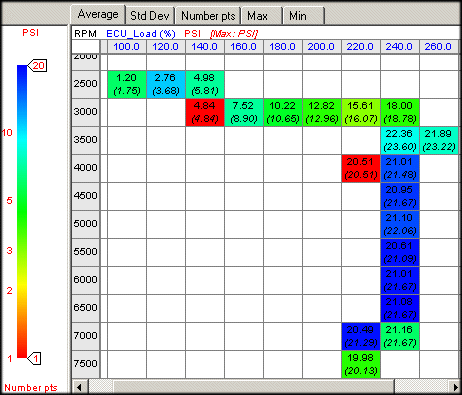
Here is a chart of average boost for 4 back-to-back WOT runs. The numbers in brackets are for peak boost. The WGDC is at 97% by redline. I am pretty certain that with a #67 pill (I have those), I can hold one more psi by redline. That will take me to the maximum effeciency of the stock turbo.
I have a 3 inch WORKS TBE (Down pipe, Resonated Test Pipe, and Catback). I also have a WORKS in box panel filter. It is not an open air element but it is suppose to have good flow. I may need to modify the stock airbox cover if the intake is really a restriction.
What the difference in design of your #65 pill as compared to the GST pill?
What the difference in design of your #65 pill as compared to the GST pill?
^ Opinion follows....
The open element filter is good for holding boost up top but I have yet to see the added boost reflect added horsepower. It may simply mean more heat.
Razorlab had a dyno of MBC vs GM3 power gains. Those were real gains.
He also posted a BCS vs GM3 boost curve and it did hold boost better. However, we never got to see what that added boost ment in terms of WHP.
I dislike the conical filters because they suck in hot engine air from behind the FMIC and radiator. During lapping days I would rather have a cool high pressure air source forcing only cool air down the throat of my turbo. Another perk is the car remains quiet instead of sounding like a high school kids 92 DSM.
Lastly.... its much easier to hold boost when you have the stock exhaust on. Once you uncork the exhaust it take much more airflow to hold high PSI in the upper RPM range.
The open element filter is good for holding boost up top but I have yet to see the added boost reflect added horsepower. It may simply mean more heat.
Razorlab had a dyno of MBC vs GM3 power gains. Those were real gains.
He also posted a BCS vs GM3 boost curve and it did hold boost better. However, we never got to see what that added boost ment in terms of WHP.
I dislike the conical filters because they suck in hot engine air from behind the FMIC and radiator. During lapping days I would rather have a cool high pressure air source forcing only cool air down the throat of my turbo. Another perk is the car remains quiet instead of sounding like a high school kids 92 DSM.
Lastly.... its much easier to hold boost when you have the stock exhaust on. Once you uncork the exhaust it take much more airflow to hold high PSI in the upper RPM range.
Last edited by Jeff_Jeske; Apr 11, 2008 at 11:15 AM.
The power gains are concentrated above 5000 rpm. Below that the car lost a bit of power, especially torque. The average HP gains from 5500 rpm to 7500 rpm were 16 hp and the average torque gains were 15 ft-lbs. The peak HP gain was 19 hp.
With the RMR hood scoop, this will be the golden standard of intakes. too bad the scoop costs $350


Zetronix would be one way.... there are a number of aftermareket maps sensors available that work with scanning software.
As for the filter.... I would like to see the difference during a 30 minute lapping session where then entire engine bay is so hot that you see heavy heat wash coming out of the hood vent for 30 minutes after shut down. If the AFRs were the same those are big gains but for some reason it seems like too much. Was that a K&N drop in or stock?
Either way I still do not like the ricer noise it makes.
As for the filter.... I would like to see the difference during a 30 minute lapping session where then entire engine bay is so hot that you see heavy heat wash coming out of the hood vent for 30 minutes after shut down. If the AFRs were the same those are big gains but for some reason it seems like too much. Was that a K&N drop in or stock?
Either way I still do not like the ricer noise it makes.
Last edited by Jeff_Jeske; Apr 11, 2008 at 02:14 PM.
I have a 3 inch WORKS TBE (Down pipe, Resonated Test Pipe, and Catback). I also have a WORKS in box panel filter. It is not an open air element but it is suppose to have good flow. I may need to modify the stock airbox cover if the intake is really a restriction.
What the difference in design of your #65 pill as compared to the GST pill?
What the difference in design of your #65 pill as compared to the GST pill?


As for the filter.... I would like to see the difference during a 30 minute lapping session where then entire engine bay is so hot that you see heavy heat wash coming out of the hood vent for 30 minutes after shut down. If the AFRs were the same those are big gains but for some reason it seems like too much. Was that a K&N drop in or stock?
Either way I still do not like the ricer noise it makes.
Went back to the track after my hacked airbox mod, still using the cone filter and AFR was stable all day long.
High intake temps will also cause high EGT's. Had a customer with the same thing, open filter and his EGT's would go over 1700F. We are working on a custom box/intake to use with the open filter as he has a ETS UICP that won't allow the hacked oem airbox to work.
As far as ricer noise. With a fully open filter, yes it's loud as hell. Yes I don't like it. Some people do. With my hacked OEM airbox mod it is much quieter.

I still haven't got around to doing the overlay. However he went to the strip right after moving from the stock BCS to the GM solenoid and trapped 2mph higher.
