


SD Troubles: JDM MAP -> OmniPower 4bar




I scale it for 2 sensors but I only use and recommend one sensor these days the 4Bar. Other than its really easy its the JDM 3 bar and its 1:1. I know that ends up KPA so thats easy since it runs out with stock resolution.
I use the MAPVE like a glorified MAFT. Aux, Base, Idle, Cruise, WOT. If you look at it like that and use the WB its real obvious what needs tweaked and what wont. I take a good known fuel map and injector scaling set and adjust the WOT VE till it has the desired AFR curve for the map I have used.
I double check idle and cruise, start up, tip in and make sure these are still good and then run with it. I do not use RPMVE to tune other than to lean idle when all else fails or some small whips in the airflow at certain rpm. As John pointed out above 100 (107 in my experience) really spooky things start happening with everything else. As long as the RPMVE isnt too much past 100 it doesnt mess with IDC. Then again I have been at it long enough I know the difference between a static injector and one I have full control of by looking at the dyno WB log despite what the IDC is telling me.
In car I use IDC as a benchmark but I dont get hung up on it since in SD I know I cant 100% trust it (not that the MAF is much better). I try to leave RPMVE flat and work either the table or MAPVE. If you look at my settings that I post I have all the data right there to see how it all comes together. Load follows VE (almost perfect with peak power actually according to IDC) and drops a little out the top past peak power. I will not lie I am spoiled with a dyno so data collection, interpretation and retest is a little easier for me than a street tuner with limited area to make pulls and collect data. The other thing is volume, I have spent alot of time seeing how the curves look on different turbos, stock head vs ported, stock intake vs aftermarket. For the fuel map to look like it does in a traditional MAF car, my settings get you there the fastest.
I am also the ***** Wonka of Tuning.
I am the engineer that disregards the textbook.
I am a little rebel, pun intended.
No disrespect meant to anyone, as we all know we have our own methods that we are used to and comfortable with. I choose the path less travelled
aaron
I use the MAPVE like a glorified MAFT. Aux, Base, Idle, Cruise, WOT. If you look at it like that and use the WB its real obvious what needs tweaked and what wont. I take a good known fuel map and injector scaling set and adjust the WOT VE till it has the desired AFR curve for the map I have used.
I double check idle and cruise, start up, tip in and make sure these are still good and then run with it. I do not use RPMVE to tune other than to lean idle when all else fails or some small whips in the airflow at certain rpm. As John pointed out above 100 (107 in my experience) really spooky things start happening with everything else. As long as the RPMVE isnt too much past 100 it doesnt mess with IDC. Then again I have been at it long enough I know the difference between a static injector and one I have full control of by looking at the dyno WB log despite what the IDC is telling me.
In car I use IDC as a benchmark but I dont get hung up on it since in SD I know I cant 100% trust it (not that the MAF is much better). I try to leave RPMVE flat and work either the table or MAPVE. If you look at my settings that I post I have all the data right there to see how it all comes together. Load follows VE (almost perfect with peak power actually according to IDC) and drops a little out the top past peak power. I will not lie I am spoiled with a dyno so data collection, interpretation and retest is a little easier for me than a street tuner with limited area to make pulls and collect data. The other thing is volume, I have spent alot of time seeing how the curves look on different turbos, stock head vs ported, stock intake vs aftermarket. For the fuel map to look like it does in a traditional MAF car, my settings get you there the fastest.
I am also the ***** Wonka of Tuning.
I am the engineer that disregards the textbook.
I am a little rebel, pun intended.
No disrespect meant to anyone, as we all know we have our own methods that we are used to and comfortable with. I choose the path less travelled
aaron
Aaron,
Are you saying that you don't scale the mapve table for different sensors then? If so, then how do you tune the mapve table, not knowing what cell corresponds to what map value? Or is that why you used to leave that table at 1:1 and use RPM VE instead to tune?
When I went through tuning SD a while back, I made spreadsheets to make a 3D VE table out of the two SD VE tables. The most accurate way to emulate the 3D maf based VE chart was to use both tables. Using just the RPM table and leaving map 1:1 wouldn't cover certain areas. I then verified with before and after logs that AFR, loads, and everything were the same on maf and SD.
Also as you and John mentioned, then you are messing with your calculated load values as well, which in turn messes with your IDC calcs, etc.
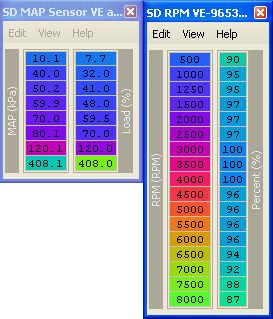
What I do to tune SD is to make the mid range RPM VE 100 and taper up and down from there. For Map VE, I taper down at idle and up towards a 1:1 or whatever is needed at higher map values. Then use either the map ve or rpm ve to fine tune, depending on which one is needed. For my car, the best emulation of my maf based VE and load were with these settings (of course it will be different for cars with different mods, but it gives you the idea of what I am referring to):
Are you saying that you don't scale the mapve table for different sensors then? If so, then how do you tune the mapve table, not knowing what cell corresponds to what map value? Or is that why you used to leave that table at 1:1 and use RPM VE instead to tune?
When I went through tuning SD a while back, I made spreadsheets to make a 3D VE table out of the two SD VE tables. The most accurate way to emulate the 3D maf based VE chart was to use both tables. Using just the RPM table and leaving map 1:1 wouldn't cover certain areas. I then verified with before and after logs that AFR, loads, and everything were the same on maf and SD.
Also as you and John mentioned, then you are messing with your calculated load values as well, which in turn messes with your IDC calcs, etc.
What I do to tune SD is to make the mid range RPM VE 100 and taper up and down from there. For Map VE, I taper down at idle and up towards a 1:1 or whatever is needed at higher map values. Then use either the map ve or rpm ve to fine tune, depending on which one is needed. For my car, the best emulation of my maf based VE and load were with these settings (of course it will be different for cars with different mods, but it gives you the idea of what I am referring to):
Last edited by JohnBradley; Jan 8, 2010 at 01:02 AM.

You definitely have your own unique way...and by no means am I saying it's the wrong way. I still think I can convince you to use the other method, but I would have to write too much.
Seriously, though...there are only two main issues I see with your method:
1. Leaving RPMve flat for the most part and using the mapve similar to a MAFT (aux, base, idle, cruise, wot) gets you arbitrary numbers instead of real numbers. Depending on turbo, engine, other mods, your idle, cruise, wot 'cells' will be slightly different. Also, your load will be different (I think...going off of memory here) from maf based. (Also, from my experience, you can't emulate premaf conditions sufficiently without using 2 tables. Heck, you can't even do it perfectly with two tables and why I asked for a 3-d table. I even talked to Tom Dorris of DSMLink and he stated that they started with two tables similar to this and they changed to a 3-d table.)
2. After the car is fully tuned, any new parts that are added that increase VE should be tuned using the RPMve table. For example. Let's say you tuned a car and have it dialed in perfectly. Let's say that you add an intake manifold or set of cams that increase airflow, at the same boost pressure, in the 6000-8000RPM range. All you need to do is adjust the 6000-8000 RPM cells in the RPMve table until you get back to the same AFR. The MAPve isn't changing because the boost is the same. The airflow is changing at the same boost level. That's why you don't use MAPve, but RPMve instead. I like to think of MAPve as more of a curve showing the response from partial throttle to WOT. Of course, it's a combination of both, but partial to WOT has the most effect on MAPve and when constant boost, RPM has most effect on VE.
In your method, for #2 above, I would assume that you would find your 'WOT' cells for MAPve and bump it up. But, what if your new IM or cams only give gains in a small RPM window? Now, you are effecting the VE (load , fueling, and timing) at all all RPM ranges for that boost (which doesn't correlate because of the arbitrary numbers anyway, so it's hard to tell which cell is exactly what boost for finer tuning, etc). So, now, you will have to fix that by adjusting the timing and fueling maps. If you just use RPMve, then you adjust about 2 cells and you're done. See what I'm saying, sort of?
Again, by no means am I arguing. This is a civil discussion about different tuning methods for SD. I think it may help some people since so many ppl ask about how tos, etc. And of course, I like hearing other people's methods and ideas as well.
Eric
Seriously, though...there are only two main issues I see with your method:
1. Leaving RPMve flat for the most part and using the mapve similar to a MAFT (aux, base, idle, cruise, wot) gets you arbitrary numbers instead of real numbers. Depending on turbo, engine, other mods, your idle, cruise, wot 'cells' will be slightly different. Also, your load will be different (I think...going off of memory here) from maf based. (Also, from my experience, you can't emulate premaf conditions sufficiently without using 2 tables. Heck, you can't even do it perfectly with two tables and why I asked for a 3-d table. I even talked to Tom Dorris of DSMLink and he stated that they started with two tables similar to this and they changed to a 3-d table.)
2. After the car is fully tuned, any new parts that are added that increase VE should be tuned using the RPMve table. For example. Let's say you tuned a car and have it dialed in perfectly. Let's say that you add an intake manifold or set of cams that increase airflow, at the same boost pressure, in the 6000-8000RPM range. All you need to do is adjust the 6000-8000 RPM cells in the RPMve table until you get back to the same AFR. The MAPve isn't changing because the boost is the same. The airflow is changing at the same boost level. That's why you don't use MAPve, but RPMve instead. I like to think of MAPve as more of a curve showing the response from partial throttle to WOT. Of course, it's a combination of both, but partial to WOT has the most effect on MAPve and when constant boost, RPM has most effect on VE.
In your method, for #2 above, I would assume that you would find your 'WOT' cells for MAPve and bump it up. But, what if your new IM or cams only give gains in a small RPM window? Now, you are effecting the VE (load , fueling, and timing) at all all RPM ranges for that boost (which doesn't correlate because of the arbitrary numbers anyway, so it's hard to tell which cell is exactly what boost for finer tuning, etc). So, now, you will have to fix that by adjusting the timing and fueling maps. If you just use RPMve, then you adjust about 2 cells and you're done. See what I'm saying, sort of?
Again, by no means am I arguing. This is a civil discussion about different tuning methods for SD. I think it may help some people since so many ppl ask about how tos, etc. And of course, I like hearing other people's methods and ideas as well.
Eric
Last edited by l2r99gst; Jan 8, 2010 at 05:52 AM.


Ok guys, I swapped back in the 4bar sensor today. I kept all of my original settings for my 3-bar (per first post) and simply changed the scaling of MAP kPa per the link on page 1. The car was already hot/warm from driving so I cannot comment on cold start or cold driveability yet (but will soon, its 0°F here and I'm bouncing from place to place today for work), but warm start, hot start, driveability is, as of my initial test, identical to the JDM 3bar. All of the issues I had that prompted this post melted away today.
Part of me is happy, part of me just knew there had to be a way to simply rescale for the different sensor and use my existing settings, and the other part of me feels a little less of a man for not being able to get the car to run nice on JB's method. I think the fact that I've tied myself to my existing MAF scaling, injector latency, and injector scaling values are probably what is holding me back.
I'll report back later with a final thumbs up or down; The truth finally hit me when my wife commented on how jerky the car had began to feel after putting in the new sensor....we'll let her give the final thumbs up or down
Part of me is happy, part of me just knew there had to be a way to simply rescale for the different sensor and use my existing settings, and the other part of me feels a little less of a man for not being able to get the car to run nice on JB's method. I think the fact that I've tied myself to my existing MAF scaling, injector latency, and injector scaling values are probably what is holding me back.
I'll report back later with a final thumbs up or down; The truth finally hit me when my wife commented on how jerky the car had began to feel after putting in the new sensor....we'll let her give the final thumbs up or down
Eric,
I usually way whats the easiest on the retune. Sometimes it is just RPM VE and I can get away with it, sometimes the load is even for the entire rev range at a given boost (no drop in pressure) so I just grab the map.
I do see your point, but then it comes back to the economics of time. I now have all my basemaps set the way I have been doing it (like my MIVEC back in the day) and going back and changing each one for a given airflow set would be time consuming.
I categorise something like this:
Stock turbo
Stock appearing turbo
Black
GT
Stock Intake manifold
Magnus
Injector size
Cam selection
Year
All my maps are derivatives of all those (each category factored) so I can look at a car for the first tune and run with it. All the idle, drivability, and WOT are done. Flash and fine tune. Typically when I get a customer that comes in its never so simple as one mod, so adjusting the 2 cells like you outline isnt something I can always get away with. I have SD customers that can come back and decide more meth, bigger cams, bigger turbo all at the same time. I think I have one guy that has ever been just cams. That was a map change (actual fuel map) and done.
I will promise this though, that I will spend more time and try a map using your method on the very next SD car I do. It took me long enough to even get in the SD mojo, another change wont hurt me I am sure
I usually way whats the easiest on the retune. Sometimes it is just RPM VE and I can get away with it, sometimes the load is even for the entire rev range at a given boost (no drop in pressure) so I just grab the map.
I do see your point, but then it comes back to the economics of time. I now have all my basemaps set the way I have been doing it (like my MIVEC back in the day) and going back and changing each one for a given airflow set would be time consuming.
I categorise something like this:
Stock turbo
Stock appearing turbo
Black
GT
Stock Intake manifold
Magnus
Injector size
Cam selection
Year
All my maps are derivatives of all those (each category factored) so I can look at a car for the first tune and run with it. All the idle, drivability, and WOT are done. Flash and fine tune. Typically when I get a customer that comes in its never so simple as one mod, so adjusting the 2 cells like you outline isnt something I can always get away with. I have SD customers that can come back and decide more meth, bigger cams, bigger turbo all at the same time. I think I have one guy that has ever been just cams. That was a map change (actual fuel map) and done.
I will promise this though, that I will spend more time and try a map using your method on the very next SD car I do. It took me long enough to even get in the SD mojo, another change wont hurt me I am sure
Just an update guys, the re-scale worked absolutely perfect. Driveability is perfect under all conditions, cold start is fine, cold idle is fine, warm idle is fine, cold driveability is good, and WOT fuel/timing all is exactly the same as with the JDM 3.3bar. I am absolutely so happy with my car on speed density now, I am hesitant to touch anything on it.
That being said, my SpoolinUp COP should arrive tomorrow
That being said, my SpoolinUp COP should arrive tomorrow

scheides, what scaling did you use for the Omni 4 bar? This is the updated scaling I am using. This is in my latest release of the v7 XML.
Code:
<scaling name="BoostErrorPsi OMNI4barMAP" units="psi" toexpr="(x-128)/(8*4.23)" frexpr="x*8*4.23+128" format="%.1f" min="-3.8" max="3.8" inc="0.1" storagetype="uint16" endian="big"/>

<scaling name="PSIa16 OMNI4barMAP" units="PSIa" toexpr="x/(4.23*2)" frexpr="x*(2*4.23)" format="%.1f" min="0" max="39.2" inc="0.1" storagetype="uint16" endian="big"/>

<scaling name="PSIa8 OMNI4barMAP" units="PSIa" toexpr="x/(4.23*2)" frexpr="x*(2*4.23)" format="%.1f" min="0" max="30.1" inc="0.1" storagetype="uint8" endian="big"/>

<scaling name="kPa OMNI4barMAP" units="kPa" toexpr="x*0.4072" frexpr="x/0.4072" format="%.1f" min="0" max="450" inc="0.4072" storagetype="uint16" endian="big"/>
I went through and verified, those are the exact scalings I am using.
I used mrfred's xml here:
https://www.evolutionm.net/forums/7727415-post110.html
And mrfred's second post in his links to jcbanks' SD patches, linked on page one of this thread. I just updated the kpa 16bit, because I didn't want to go through and find all of the tables that had kpa 16bit in them. If you would be interested in including that 'kpa OMNI4barMAP' (or should it really be 'kpa OMNI4barMAP 16bit' ?) in your XML, I'd like to make that list and update my howto so there's zero XML editing, or if users are savvy enough, they can choose to do so.
I used mrfred's xml here:
https://www.evolutionm.net/forums/7727415-post110.html
And mrfred's second post in his links to jcbanks' SD patches, linked on page one of this thread. I just updated the kpa 16bit, because I didn't want to go through and find all of the tables that had kpa 16bit in them. If you would be interested in including that 'kpa OMNI4barMAP' (or should it really be 'kpa OMNI4barMAP 16bit' ?) in your XML, I'd like to make that list and update my howto so there's zero XML editing, or if users are savvy enough, they can choose to do so.
I went through and verified, those are the exact scalings I am using.
I used mrfred's xml here:
https://www.evolutionm.net/forums/7727415-post110.html
And mrfred's second post in his links to jcbanks' SD patches, linked on page one of this thread. I just updated the kpa 16bit, because I didn't want to go through and find all of the tables that had kpa 16bit in them. If you would be interested in including that 'kpa OMNI4barMAP' (or should it really be 'kpa OMNI4barMAP 16bit' ?) in your XML, I'd like to make that list and update my howto so there's zero XML editing, or if users are savvy enough, they can choose to do so.
I used mrfred's xml here:
https://www.evolutionm.net/forums/7727415-post110.html
And mrfred's second post in his links to jcbanks' SD patches, linked on page one of this thread. I just updated the kpa 16bit, because I didn't want to go through and find all of the tables that had kpa 16bit in them. If you would be interested in including that 'kpa OMNI4barMAP' (or should it really be 'kpa OMNI4barMAP 16bit' ?) in your XML, I'd like to make that list and update my howto so there's zero XML editing, or if users are savvy enough, they can choose to do so.

Has anybody ran 94170015 and 96530006 on speed density?
I've been curious how they compare. I noticed the 96530006 SD patch replaced an old table with RPM VE. I thought 94170015 did not replace any tables and just had both below the 3300 address?
The table that got replaced I noticed was used in two different routines. Just wondering if maybe it's related to some of the random issues 96530006 has shown.
I've been curious how they compare. I noticed the 96530006 SD patch replaced an old table with RPM VE. I thought 94170015 did not replace any tables and just had both below the 3300 address?
The table that got replaced I noticed was used in two different routines. Just wondering if maybe it's related to some of the random issues 96530006 has shown.
Honestly, my laptop with all my xml files crashed and I have a new laptop with a fresh version of 1.4 in it, so I may have a bad xml file now. But I seem to remember seeing this exact same thing when I had a known good xml file. If somebody could double check the dissasembly, that would help.
The MAPVE table is below 3300 which is where the MAF tables reside and seems to be the start of the tuning tables. The RPMVE table sits around the 3500 area and replaces a table that is mostly 0xff except for the first three values.
The table that gets replaced is referenced twice in the code, that I could find. I beleive once in the main load calcs, and then again in some other code I couldn't determine what it was doing.
I ask because my car seems to have a split personality. Most of the time, the AFR below 2500 RPM is right. But it seems like the car every once in a while goes lean as hell for no apparent reason. It's like the ECU decided to use a different branch of the main code due to some condition that got it there. It's not the jitter issue though, the IPW just drops and stays low until about 2500 RPM, then it hits a switch point and goes back to normal.
I thought it was just a warmup issue, but I started to notice it does it when it's warm too, but closed loop helps hide it. It's not all the time though. I also beleive it's related to why a couple people have noted the car drives the best when you leave the fuel trims on the rich side. It helps cover up this lean issue that pops up every once in a while.
The MAPVE table is below 3300 which is where the MAF tables reside and seems to be the start of the tuning tables. The RPMVE table sits around the 3500 area and replaces a table that is mostly 0xff except for the first three values.
The table that gets replaced is referenced twice in the code, that I could find. I beleive once in the main load calcs, and then again in some other code I couldn't determine what it was doing.
I ask because my car seems to have a split personality. Most of the time, the AFR below 2500 RPM is right. But it seems like the car every once in a while goes lean as hell for no apparent reason. It's like the ECU decided to use a different branch of the main code due to some condition that got it there. It's not the jitter issue though, the IPW just drops and stays low until about 2500 RPM, then it hits a switch point and goes back to normal.
I thought it was just a warmup issue, but I started to notice it does it when it's warm too, but closed loop helps hide it. It's not all the time though. I also beleive it's related to why a couple people have noted the car drives the best when you leave the fuel trims on the rich side. It helps cover up this lean issue that pops up every once in a while.
Has anybody ran 94170015 and 96530006 on speed density?
I've been curious how they compare. I noticed the 96530006 SD patch replaced an old table with RPM VE. I thought 94170015 did not replace any tables and just had both below the 3300 address?
The table that got replaced I noticed was used in two different routines. Just wondering if maybe it's related to some of the random issues 96530006 has shown.
I've been curious how they compare. I noticed the 96530006 SD patch replaced an old table with RPM VE. I thought 94170015 did not replace any tables and just had both below the 3300 address?
The table that got replaced I noticed was used in two different routines. Just wondering if maybe it's related to some of the random issues 96530006 has shown.
Maybe start a new thread on this?

Has anybody ran 94170015 and 96530006 on speed density?
I've been curious how they compare. I noticed the 96530006 SD patch replaced an old table with RPM VE. I thought 94170015 did not replace any tables and just had both below the 3300 address?
The table that got replaced I noticed was used in two different routines. Just wondering if maybe it's related to some of the random issues 96530006 has shown.
I've been curious how they compare. I noticed the 96530006 SD patch replaced an old table with RPM VE. I thought 94170015 did not replace any tables and just had both below the 3300 address?
The table that got replaced I noticed was used in two different routines. Just wondering if maybe it's related to some of the random issues 96530006 has shown.
Believe or not though, my MAP VE was pretty much auto-calc'd in my 9417 rom just due to the fact that I applied mrfred's map sensor patch on previously. All I had to adjust from that point on was my RPM VE.
On a separate note, has anyone tried the GM 3 bar? I'm helping a friend out soon with the SD patch on his Evo ecu'd 97 Eclipse and he picked up a GM 3 bar to use, just wondering if the resolution will still be a 1:1 although I imagine it will be off.
Last edited by Slo_crx1; Jan 12, 2010 at 03:13 PM.

Thread
Thread Starter
Forum
Replies
Last Post
scheides
ECU Flash
357
Oct 22, 2021 08:59 AM
scheides
ECU Flash
9
Dec 22, 2009 06:06 PM
mrfred
ECU Flash
10
Aug 14, 2009 07:17 PM
