


Turbo Effeciency Tables


Thread Starter
Evolved Member
iTrader: (22)
Joined: Nov 2003
Posts: 2,408
Likes: 7
From: Northern KY near Cincy
I found it....I am not certain that the green is the same as the 20g. My green has a 5 blade compressor. The TD06 20g has a 6 blade. There would be distinct differences in the efficiency tables.
The search continues....
The search continues....

Thread Starter
Evolved Member
iTrader: (22)
Joined: Nov 2003
Posts: 2,408
Likes: 7
From: Northern KY near Cincy
FP claims 700CFM.
http://store.forcedperformance.net/m..._Code=Turbo-FP
Thus, the 20g table we are using is not accurate for what we are trying to do.
http://store.forcedperformance.net/m..._Code=Turbo-FP
Thus, the 20g table we are using is not accurate for what we are trying to do.
Thread Starter
Evolved Member
iTrader: (22)
Joined: Nov 2003
Posts: 2,408
Likes: 7
From: Northern KY near Cincy
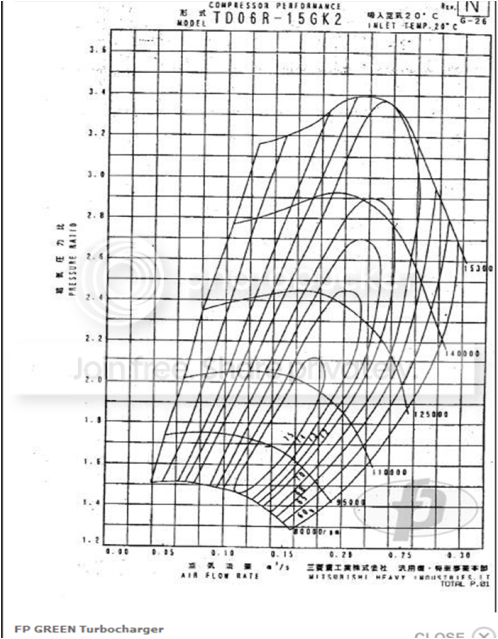
This appears to be the Green table...
Hopefully someone with some Excel skill can input this into the nifty Compressor Map Calculator.
http://www.grippybits.com/tuning/Com...tor%20v2.1.zip
Hopefully someone with some Excel skill can input this into the nifty Compressor Map Calculator.
http://www.grippybits.com/tuning/Com...tor%20v2.1.zip
Last edited by Appauldd; Jan 9, 2010 at 02:11 AM.


I added the Evo8 compressor map to the spreadsheet.
I can probably do it tomorrow. But, we still need a place to host it. Or I can email it to you.
I can probably do it tomorrow. But, we still need a place to host it. Or I can email it to you.
Last edited by l2r99gst; Jan 12, 2010 at 06:50 AM.
Thread Starter
Evolved Member
iTrader: (22)
Joined: Nov 2003
Posts: 2,408
Likes: 7
From: Northern KY near Cincy
Thread Starter
Evolved Member
iTrader: (22)
Joined: Nov 2003
Posts: 2,408
Likes: 7
From: Northern KY near Cincy
Amazing work as always.
It appears the Green is a lot more efficient down low than I had though.
My goal was to tune for 27psi. It appears that I can get 27psi as early as 2600 rpm assuming a 90 VE ratio this low. Then I can easily hold 27psi until 6000 rpm (100 VE). There after the turbo rapidly runs out of breath. By 7400 (95 VE) I should be no higher than 21psi.
Now the goal is to find this boost down low.
I started another thread about tuning for faster spool....
https://www.evolutionm.net/forums/ec...ter-spool.html
There is some wonderful suggestions so far. The goal, in my case, is to have to longest torque curve as possible for AutoX, and the occasional Track day.
I am not sure if I am estimating my VE correctly though. Can someone chime in on the exact method to calculate accurate VE ? ? ?
It appears the Green is a lot more efficient down low than I had though.
My goal was to tune for 27psi. It appears that I can get 27psi as early as 2600 rpm assuming a 90 VE ratio this low. Then I can easily hold 27psi until 6000 rpm (100 VE). There after the turbo rapidly runs out of breath. By 7400 (95 VE) I should be no higher than 21psi.
Now the goal is to find this boost down low.
I started another thread about tuning for faster spool....
https://www.evolutionm.net/forums/ec...ter-spool.html
There is some wonderful suggestions so far. The goal, in my case, is to have to longest torque curve as possible for AutoX, and the occasional Track day.
I am not sure if I am estimating my VE correctly though. Can someone chime in on the exact method to calculate accurate VE ? ? ?
You have to understand that the compressor map is just a characteristic of the compressor wheel. An engine is 'fit' to that map. Just because the compressor wheel would be able to reach 27psi at 2600RPM on our engines doesn't mean that you can achieve that.
Thread Starter
Evolved Member
iTrader: (22)
Joined: Nov 2003
Posts: 2,408
Likes: 7
From: Northern KY near Cincy
I am actually getting closer, especially in higher gears. The turbo will build boost very fast in higher gears. I am easily in the 20s by 3k in 5th from a down low WOT pull.
I think this is because the VE of the engine is higher when the car is moving. The engine has less mass to move because it is already moving.
I understand what you are saying though. In 1st and 2nd it may not be possible.
I think this is because the VE of the engine is higher when the car is moving. The engine has less mass to move because it is already moving.
I understand what you are saying though. In 1st and 2nd it may not be possible.
Last edited by Appauldd; Jan 12, 2010 at 08:32 AM. Reason: spelling error
I am actually getting closer, especially in higher gears. The turbo will build boost very fast in higher gears. I am easily in the 20s by 3k in 5th from a down low WOT pull.
I think this is because the VE of the engine is higher when the car is moving. The engine has less mass to move because it is already moving.
I understand what you are saying though. In 1st and 2nd it may not be possible.
I think this is because the VE of the engine is higher when the car is moving. The engine has less mass to move because it is already moving.
I understand what you are saying though. In 1st and 2nd it may not be possible.
Thread Starter
Evolved Member
iTrader: (22)
Joined: Nov 2003
Posts: 2,408
Likes: 7
From: Northern KY near Cincy
Found a GREAT article that explains it all in great detail.
Compressor map reading for dummies.
By JustinSane
A compressor map can be a daunting thing to look at, but I will show you a few simple tricks to use a turbos compressor map to learn a couple important pieces of information.
In this tutorial I will use the TD05 big 16g currently on my CRX as an example. You can download the map below and print it out to make it easier to follow the tutorial.
Lesson one- determine how much flywheel horse power a turbo can support.
Ok a few facts that your should take note of, a turbos flow is measured in CFM or IB/MIN, these are the numbers you see across the bottom of the compressor map. It takes
Approximately 1 LB/MIN to support 10 flywheel horse power. So if your HP goal is 300 flywheel horsepower you divide 300 by 10 to find out how many LB/MIN you need. So 300/10=30 so we know we need a turbo capable of flowing 30 LB/MIN to support 300 crank horse power. If the map you have don’t show the flow in IB/MIN but rather it’s in CFM then simply divide the CFM by 14.27 to convert it. Ok so we look at the map for the big 16g and notice it can flow up to 550 CFM or 38.5 IB/MIN. Remember I said that each LB/MIN can support 10 HP? So we take 38.5 and multiply it by 10 and get 385, so we now know this turbo is capable of flowing enough air to support 385 horsepower at the flywheel. One last thing you should take note of while we are looking at the turbos flow is the efficiency of the turbo at any given point. If you look at the map you can see there are loops called islands and on this map they are labeled 71,70,68,65 and 60 from the center out, this is the turbos efficiency rating the lower the rating the more heat the turbo pumps out, typically 70 and up is great. We will touch more on this later in lesson three. Let’s go to lesson two.
Lesson two- determine how well the turbo will spool.
Ok we can also use the map to get a general idea on how quickly a turbo is capable of spooling up to a certain boost level, in this tutorial we will use 20 psi. If you look along the left side of a compressor map you will see the pressure ratio values. To determine where 20 PSI factors in that scale you use the following formula 14.7+boost you want to run / 14.7= pressure ratio. So we take 14.7 add it to 20 psi and get 34.7 and we divide that by 14.7 and get 2.36 so our pressure ratio for 20 psi is 2.36 so find where 2.36 is on the map and mark it like I did in red below.
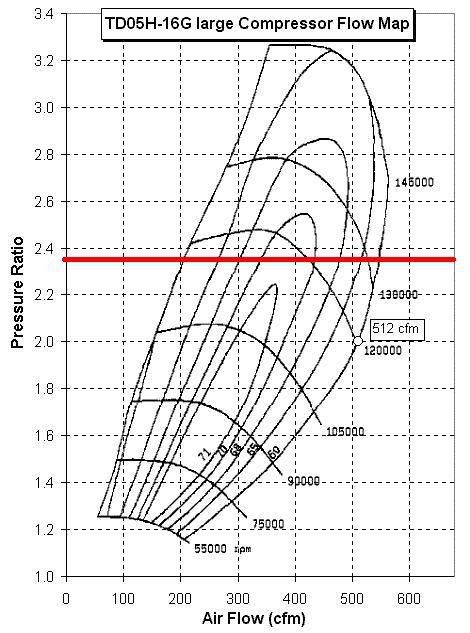
Ok so this is where our goal of 20 PSI fits in on this map, next we want to see how quickly the turbo could potentially spool to 20 psi. For this we can use this calculator http://www.lovehorsepower.com/CFM1.htm to determine the CFM at any given RPM CFM Calculations so we fill in the fields with the information they ask for.
Size of engine = 1.6
VE = 90 (good conservative value for a healthy motor)
Maximum boost we want to hit = 20
Maximum engine rpm =7400
Of course these values will vary according to your application but we are using these figures for this tutorial. Any way now we look on the map for where the red line first meets up with the compressor map lines and we see it’s just about at the 210 CFM mark. So let’s draw a line down to the CFM value like I did here in blue.
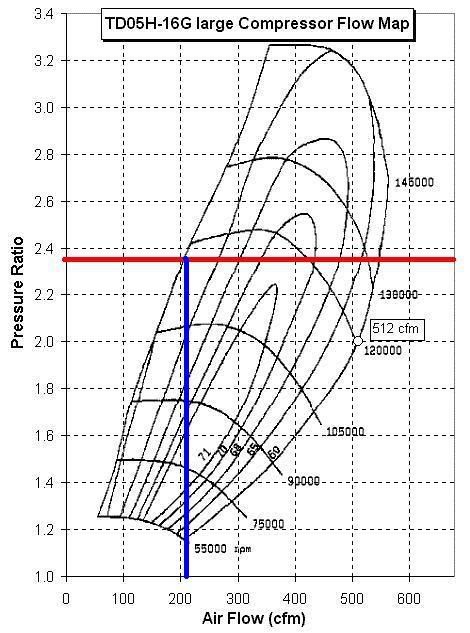
So let’s go back to the calculator find the 20 psi value along the left side and then follow that column to the right until you find 210 CFM or as close to it as you can, then follow that column up to find the RPM. So we see 210.1 CFM is in the 3500 RPM column. Great so now we know this turbo has the potential to reach 20 psi as early as 3500 RPM based on our motors specs.
Lesson three- This is a continuation of lesson one. We determined in lesson one that this turbo can support 385 flywheel horsepower, now let’s see what its actual potential is on our motor. The calculator we used above could be used again here but it only takes RPM values in increments of 500 so since our maximum RPM in this tutorial is 7400 we will do it by hand. Use the following formula, Engine size in liters x max rpm x VE x PR and then divide by 5660, so its 1.6 x 7400 x 90(good conservative value for a healthy motor)x 2.36 (the PR figure we figured up earlier in lesson two) =2514816 / 5660 = 444 ok so we now know our set up is capable of 444 cfm so lets see where it fits in on our compressor map at 20 PSI. I marked it with a yellow line.
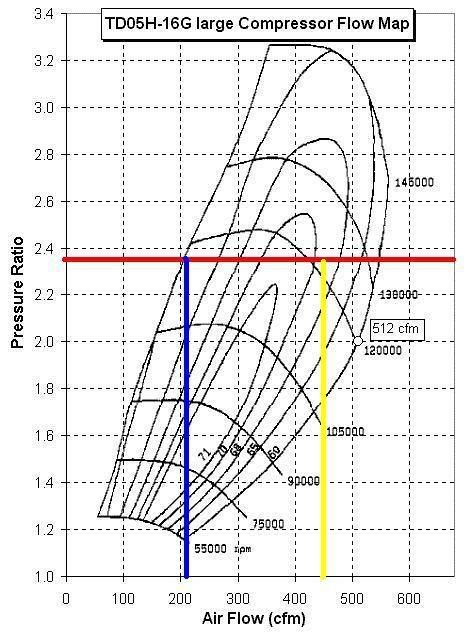
Now we have mapped this turbo to our set up . Let’s see what this can tell us, first off we already learned by the blue line that it’s a pretty fast spooling turbo on our motor but what else can we learn? Well by looking where the red and yellow intersect we can see that point is in a island that’s rated at 68% efficiency, and if you recall I said 70 and up is good, 68 isn’t real bad but its definitely not ideal so this turbo on this set up will generate a little heat. Lastly we can take the CFM figure we came up with of 444 and turn it into IB/MIN to see our potential horsepower at the flywheel. So 444 / 14.27 = 31.1 and if you recall in lesson one we can take 31.1 and multiply by 10 to get our potential crank horse power for our given motor so 31.1 x 10 = 310. Great now we know that we should be able to reach a ballpark of 310 flywheel horse power with this turbo and the values we entered for our motor. Different factors like a motors health and modifications can affect the motors VE value, 90 is just a good conservative ballpark number to use, your motor may be higher or lower. This is a good simple basic guide to reading and using compressor maps to determine spool time and potential power, I left out some stuff like determining if surge is a factor for your combo along with how the exhaust side of the turbo can also affect spool time. I hope this helps lift some of the mystery of compressor maps for some of you. Thanks for looking in. if you have any questions of want to post maps mapped for your self and have questions on feel free. also feel free to sticky this, it may help some people figure out if a turbo they found will suit their set up.
Some maps don't use CFM or LB/MIN but rather they use cubic meter per second (m3/s) i converted the typical values found on these sort of maps to CFM for you guys.
.05 = 106
.10 = 212
.15 = 317
.20 = 423
.25 = 530
.30 = 636
Compressor map reading for dummies.
By JustinSane
A compressor map can be a daunting thing to look at, but I will show you a few simple tricks to use a turbos compressor map to learn a couple important pieces of information.
In this tutorial I will use the TD05 big 16g currently on my CRX as an example. You can download the map below and print it out to make it easier to follow the tutorial.
Lesson one- determine how much flywheel horse power a turbo can support.
Ok a few facts that your should take note of, a turbos flow is measured in CFM or IB/MIN, these are the numbers you see across the bottom of the compressor map. It takes
Approximately 1 LB/MIN to support 10 flywheel horse power. So if your HP goal is 300 flywheel horsepower you divide 300 by 10 to find out how many LB/MIN you need. So 300/10=30 so we know we need a turbo capable of flowing 30 LB/MIN to support 300 crank horse power. If the map you have don’t show the flow in IB/MIN but rather it’s in CFM then simply divide the CFM by 14.27 to convert it. Ok so we look at the map for the big 16g and notice it can flow up to 550 CFM or 38.5 IB/MIN. Remember I said that each LB/MIN can support 10 HP? So we take 38.5 and multiply it by 10 and get 385, so we now know this turbo is capable of flowing enough air to support 385 horsepower at the flywheel. One last thing you should take note of while we are looking at the turbos flow is the efficiency of the turbo at any given point. If you look at the map you can see there are loops called islands and on this map they are labeled 71,70,68,65 and 60 from the center out, this is the turbos efficiency rating the lower the rating the more heat the turbo pumps out, typically 70 and up is great. We will touch more on this later in lesson three. Let’s go to lesson two.
Lesson two- determine how well the turbo will spool.
Ok we can also use the map to get a general idea on how quickly a turbo is capable of spooling up to a certain boost level, in this tutorial we will use 20 psi. If you look along the left side of a compressor map you will see the pressure ratio values. To determine where 20 PSI factors in that scale you use the following formula 14.7+boost you want to run / 14.7= pressure ratio. So we take 14.7 add it to 20 psi and get 34.7 and we divide that by 14.7 and get 2.36 so our pressure ratio for 20 psi is 2.36 so find where 2.36 is on the map and mark it like I did in red below.
Ok so this is where our goal of 20 PSI fits in on this map, next we want to see how quickly the turbo could potentially spool to 20 psi. For this we can use this calculator http://www.lovehorsepower.com/CFM1.htm to determine the CFM at any given RPM CFM Calculations so we fill in the fields with the information they ask for.
Size of engine = 1.6
VE = 90 (good conservative value for a healthy motor)
Maximum boost we want to hit = 20
Maximum engine rpm =7400
Of course these values will vary according to your application but we are using these figures for this tutorial. Any way now we look on the map for where the red line first meets up with the compressor map lines and we see it’s just about at the 210 CFM mark. So let’s draw a line down to the CFM value like I did here in blue.
So let’s go back to the calculator find the 20 psi value along the left side and then follow that column to the right until you find 210 CFM or as close to it as you can, then follow that column up to find the RPM. So we see 210.1 CFM is in the 3500 RPM column. Great so now we know this turbo has the potential to reach 20 psi as early as 3500 RPM based on our motors specs.
Lesson three- This is a continuation of lesson one. We determined in lesson one that this turbo can support 385 flywheel horsepower, now let’s see what its actual potential is on our motor. The calculator we used above could be used again here but it only takes RPM values in increments of 500 so since our maximum RPM in this tutorial is 7400 we will do it by hand. Use the following formula, Engine size in liters x max rpm x VE x PR and then divide by 5660, so its 1.6 x 7400 x 90(good conservative value for a healthy motor)x 2.36 (the PR figure we figured up earlier in lesson two) =2514816 / 5660 = 444 ok so we now know our set up is capable of 444 cfm so lets see where it fits in on our compressor map at 20 PSI. I marked it with a yellow line.
Now we have mapped this turbo to our set up . Let’s see what this can tell us, first off we already learned by the blue line that it’s a pretty fast spooling turbo on our motor but what else can we learn? Well by looking where the red and yellow intersect we can see that point is in a island that’s rated at 68% efficiency, and if you recall I said 70 and up is good, 68 isn’t real bad but its definitely not ideal so this turbo on this set up will generate a little heat. Lastly we can take the CFM figure we came up with of 444 and turn it into IB/MIN to see our potential horsepower at the flywheel. So 444 / 14.27 = 31.1 and if you recall in lesson one we can take 31.1 and multiply by 10 to get our potential crank horse power for our given motor so 31.1 x 10 = 310. Great now we know that we should be able to reach a ballpark of 310 flywheel horse power with this turbo and the values we entered for our motor. Different factors like a motors health and modifications can affect the motors VE value, 90 is just a good conservative ballpark number to use, your motor may be higher or lower. This is a good simple basic guide to reading and using compressor maps to determine spool time and potential power, I left out some stuff like determining if surge is a factor for your combo along with how the exhaust side of the turbo can also affect spool time. I hope this helps lift some of the mystery of compressor maps for some of you. Thanks for looking in. if you have any questions of want to post maps mapped for your self and have questions on feel free. also feel free to sticky this, it may help some people figure out if a turbo they found will suit their set up.
Some maps don't use CFM or LB/MIN but rather they use cubic meter per second (m3/s) i converted the typical values found on these sort of maps to CFM for you guys.
.05 = 106
.10 = 212
.15 = 317
.20 = 423
.25 = 530
.30 = 636
Last edited by Appauldd; Jan 12, 2010 at 09:31 AM.