


BLOWN motor Part 2 (upper end pics)


When I bought my car it had 18 miles on it.
In the prior 18 miles a salesman can start the car on a ice cold morning and, without warmup, send it up to the rev limit in all the gears. Now that abuse I feel would make the engine out of tolerance and prone to blowing.
Makes me wonder
In the prior 18 miles a salesman can start the car on a ice cold morning and, without warmup, send it up to the rev limit in all the gears. Now that abuse I feel would make the engine out of tolerance and prone to blowing.
Makes me wonder

Some info on how rod bolts are tested for strech

The proper way to tighten rod bolts is to measure the strech to determine the proper "pre load"
A bolt that has deformed by a permanent increase of .001 " more than standard should be replaced
The way to check the rod bolts is to take the load off the fastner and measure the length comapred to a new one
If the fastner has increased in length it has streched out and would result in a lower pre load than specified
The problem is if the fastner streches after it is originally installed then the pre load would be too low on the rod cap
Many people do not realize how critical ROD BOLTS are
Here is some info from ARP on this subject
More info is on the tech notes of this page

The part # for the replacement 8 mm stock rod bolts is 107-6002
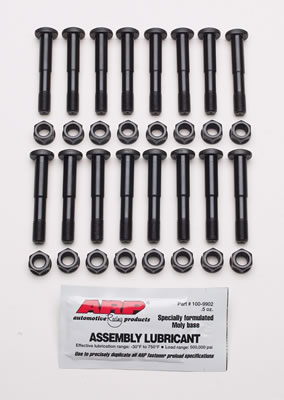
Summit Racing sells it for $36.99 and they will take you a half day to install youself
The proper way to tighten rod bolts is to measure the strech to determine the proper "pre load"
A bolt that has deformed by a permanent increase of .001 " more than standard should be replaced
The way to check the rod bolts is to take the load off the fastner and measure the length comapred to a new one
If the fastner has increased in length it has streched out and would result in a lower pre load than specified
The problem is if the fastner streches after it is originally installed then the pre load would be too low on the rod cap
Many people do not realize how critical ROD BOLTS are
Here is some info from ARP on this subject
Pre-Load
Finally, although not a design parameter, the subject of bolt installation preload must be addressed. It is a fundamental engineering concept that the force in a bolt in an ideal preloaded joint will remain equal to the preload until the externally applied force exceeds the preload. Then the force in the bolt will be equal to the external force. This means that fluctuating external forces will not cause fluctuating forces in a preloaded bolt as long as the preload exceeds the external force. The result is that fatigue failure will not occur.
In a non-ideal joint, such as in a connecting rod, the bolt will feel fluctuating stresses due to fluctuating rod distortions. These are additive to the preload, so that fatigue could result. In connecting rods, precise preloads are required because if they are too low, the external forces (the reciprocating weights) will exceed the preloads, thus causing fatigue. If they are too high, they provide a high mean stress that combines with the fluctuating stresses due to rod distortion. Again, fatigue is promoted. The objective, then, is to preload a bolt so that it just exceeds the external load, and no higher.
To sum up: both insufficient preloads and excessive preloads can lead to fatigue failures.
Finally, although not a design parameter, the subject of bolt installation preload must be addressed. It is a fundamental engineering concept that the force in a bolt in an ideal preloaded joint will remain equal to the preload until the externally applied force exceeds the preload. Then the force in the bolt will be equal to the external force. This means that fluctuating external forces will not cause fluctuating forces in a preloaded bolt as long as the preload exceeds the external force. The result is that fatigue failure will not occur.
In a non-ideal joint, such as in a connecting rod, the bolt will feel fluctuating stresses due to fluctuating rod distortions. These are additive to the preload, so that fatigue could result. In connecting rods, precise preloads are required because if they are too low, the external forces (the reciprocating weights) will exceed the preloads, thus causing fatigue. If they are too high, they provide a high mean stress that combines with the fluctuating stresses due to rod distortion. Again, fatigue is promoted. The objective, then, is to preload a bolt so that it just exceeds the external load, and no higher.
To sum up: both insufficient preloads and excessive preloads can lead to fatigue failures.
More info is on the tech notes of this page
The part # for the replacement 8 mm stock rod bolts is 107-6002
Summit Racing sells it for $36.99 and they will take you a half day to install youself
Last edited by DynoFlash; Mar 9, 2006 at 08:54 PM.

Originally Posted by DynoFlash
Some info on how rod bolts are tested for strech
The proper way to tighten rod bolts is to measure the strech to determine the proper "pre load"
A bolt that has deformed by a permanent increase of .001 " more than standard should be replaced
The way to check the rod bolts is to take the load off the fastner and measure the length comapred to a new one
If the fastner has increased in length it has streched out and would result in a lower pre load than specified
The problem is if the fastner streches after it is originally installed then the pre load would be too low on the rod cap
The proper way to tighten rod bolts is to measure the strech to determine the proper "pre load"
A bolt that has deformed by a permanent increase of .001 " more than standard should be replaced
The way to check the rod bolts is to take the load off the fastner and measure the length comapred to a new one
If the fastner has increased in length it has streched out and would result in a lower pre load than specified
The problem is if the fastner streches after it is originally installed then the pre load would be too low on the rod cap


Originally Posted by Greg K
with labor including the valves and a valve job I would estimate approx 6-8K. The turbo should probably be replace too because there was a lot of metal bits that went out through the exhaust valves and throught the hotside of the turbo when that popped.
Wow ! That is less than a quote I have seen for a more with less damage.


Account Disabled
Joined: Feb 2006
Posts: 190
Likes: 0
Al you once stated that you looked at your stock bolts and they were very worn. How do you check for wear on these bolts?
Thanks Al. 37 for bolts is very cheap.
Hey Al, if you combine ARP Head studs and Rod bolts, is it safe to rev till 8000++++?
Thanks Al. 37 for bolts is very cheap.
Hey Al, if you combine ARP Head studs and Rod bolts, is it safe to rev till 8000++++?
Originally Posted by FahKen Evo!
Al you once stated that you looked at your stock bolts and they were very worn. How do you check for wear on these bolts?
Thanks Al. 37 for bolts is very cheap.
Hey Al, if you combine ARP Head studs and Rod bolts, is it safe to rev till 8000++++?
Thanks Al. 37 for bolts is very cheap.
Hey Al, if you combine ARP Head studs and Rod bolts, is it safe to rev till 8000++++?
the rod bolts deal with the stress of high rpms
The head studs deal with high thermal loads and high cyl pressures that try and push or lift the head
The real common theme is that they are both strech style fastners designed to hold down under a pre load.
With a set of rod bolts and upgraded valve springs and retainers you shoulod be able to do 8,000 but no more with the stock rods

Originally Posted by DynoFlash
While I would certainly respect your thoughts about this situation, I would like to tell you that the past three years of experience with evos have shown that a bone 100% stock evo is just as likely to have an engine failure as one with a few minor upgrades
of course with a completely totally stock car you will not have any warranty concerns if it blows up
As for the saftey of mail in flashes, myself and other tuners have been offering them and there are several thousand out there with only a few individual failures. Most importantly, this one and the others can not be related to the tuning of the mail in flashes. I have over 2500 ecu flashes out there with no tuning realeted failures and only a few that experienced this kind of rod bearing problem. This percentage is similar to that of 100% stock cars which is to be expected.
In fact, for those who are modifying an evos with modifications that are typical (known as "basic performance upgrades" BPU) such as intakes, exhausts and boost controllers the fact is that running without a proper tune to match your modifications is more dangerous than running with a properly set up tune.
of course with a completely totally stock car you will not have any warranty concerns if it blows up
As for the saftey of mail in flashes, myself and other tuners have been offering them and there are several thousand out there with only a few individual failures. Most importantly, this one and the others can not be related to the tuning of the mail in flashes. I have over 2500 ecu flashes out there with no tuning realeted failures and only a few that experienced this kind of rod bearing problem. This percentage is similar to that of 100% stock cars which is to be expected.
In fact, for those who are modifying an evos with modifications that are typical (known as "basic performance upgrades" BPU) such as intakes, exhausts and boost controllers the fact is that running without a proper tune to match your modifications is more dangerous than running with a properly set up tune.
 I just feel safer having it on a dyno and knowing what its doing. I plan on visiting you at buschur as soon as I get the parts I want on the car before the tune


Originally Posted by 56Hotrod
Question for Stew. You're the 1st owner of this car I take it. How many miles were on the car when you picked it up? I've heard some bad stories about test drives.
Originally Posted by Greg K
with labor including the valves and a valve job I would estimate approx 6-8K. The turbo should probably be replace too because there was a lot of metal bits that went out through the exhaust valves and throught the hotside of the turbo when that popped.
a tad over $10,000 maybe?


If you're checking for permanent stretch (which is indicative of a failed bolt), the bolt must obviously be un-torqued. I suppose you could do it with the rod in place if you really wanted to do it without removing the rod/piston. The gauge can be used with an assembled block.
FWIW, there are two schools of thought with respect to rod bolt torque. Some say just torque to a specified stretch. Others say torque to a specified torque reading, at which point the specified stretch should be attained. My hunch is the latter is correct, as if a bolt happens not to stretch uniformly (which implies a defect), that means uneven torque between it and its sister bolt.
FWIW, there are two schools of thought with respect to rod bolt torque. Some say just torque to a specified stretch. Others say torque to a specified torque reading, at which point the specified stretch should be attained. My hunch is the latter is correct, as if a bolt happens not to stretch uniformly (which implies a defect), that means uneven torque between it and its sister bolt.
Last edited by Ted B; Mar 10, 2006 at 07:11 AM.


Evolving Member
Joined: Sep 2005
Posts: 106
Likes: 0
From: Florida
Originally Posted by C6C6CH3vo
When I bought my car it had 18 miles on it.
In the prior 18 miles a salesman can start the car on a ice cold morning and, without warmup, send it up to the rev limit in all the gears. Now that abuse I feel would make the engine out of tolerance and prone to blowing.
Makes me wonder
In the prior 18 miles a salesman can start the car on a ice cold morning and, without warmup, send it up to the rev limit in all the gears. Now that abuse I feel would make the engine out of tolerance and prone to blowing.
Makes me wonder
*********DECISION FROM MITSUBISHI*********
Just talked to the service manager, who talked to the district representative, who got this information from Mitsubishi:
They are DENYING the warranty work due to "PRE-DETONATION".
My first comment was, "there is no such thing as pre-detonation. Its either pre-ignition or detonation. "
Who's seen 'Malibu's Most Wanted'??? "I got Game Cast." , "uh, its either Game Cube, or Dream Cast, whatchu got?" "I SAID GAME CAST MOTHER F*CKER"
..Anyway, atleast Mistu did not care about anything to do with over-revving (which did NOT happen anyway).
Correct me if I'm wrong, but does anyone else see any signs of Detonation there??? Pre-ignition??? I'm about to eat a $15,000 bill.. would like to make sure its legit.
Just talked to the service manager, who talked to the district representative, who got this information from Mitsubishi:
They are DENYING the warranty work due to "PRE-DETONATION".
My first comment was, "there is no such thing as pre-detonation. Its either pre-ignition or detonation. "
Who's seen 'Malibu's Most Wanted'??? "I got Game Cast." , "uh, its either Game Cube, or Dream Cast, whatchu got?" "I SAID GAME CAST MOTHER F*CKER"
..Anyway, atleast Mistu did not care about anything to do with over-revving (which did NOT happen anyway).
Correct me if I'm wrong, but does anyone else see any signs of Detonation there??? Pre-ignition??? I'm about to eat a $15,000 bill.. would like to make sure its legit.